" height="21.943622918266314px" id="HqU1V_VXu" width="76.57577685890533px"/><path d="M 20.228 10.24 L 10.114 10.24 L 10.114 8.777 L 20.228 8.777 Z M 21.672 20.48 L 15.171 20.48 L 15.171 19.018 L 21.672 19.018 Z M 0 19.018 L 0 0 L 1.445 0 L 1.445 19.018 Z M 20.228 19.018 L 20.228 0 L 21.672 0 L 21.672 19.018 Z" fill="rgb(255, 255, 255)" height="20.480488152641314px" id="bfuCuMlPp" transform="translate(27.507 1.519)" width="21.672358558014366px"/><path d="M 42.622 19.018 L 42.622 0 L 44.067 0 L 44.067 19.018 Z M 54.903 8.777 L 54.903 0 L 56.348 0 L 56.348 8.777 Z M 75.131 8.777 L 75.131 0 L 76.575 0 L 76.575 8.777 Z M 70.796 19.018 L 70.796 10.241 L 72.241 10.241 L 72.241 19.018 Z M 59.238 19.018 L 59.238 10.241 L 60.683 10.241 L 60.683 19.018 Z M 1.445 0 L 1.445 20.481 L 0 20.481 L 0 0 Z M 11.559 20.481 L 1.445 20.481 L 1.445 19.018 L 11.559 19.018 Z M 21.672 10.24 L 10.114 10.24 L 10.114 8.777 L 21.672 8.777 Z" fill="rgb(255, 255, 255)" height="20.480826258659363px" id="TduQKyNcg" transform="translate(0 1.519)" width="76.57543472988937px"/><path d="M 10.114 9.07 L 10.114 0 L 11.559 0 L 11.559 9.07 Z M 0 19.311 L 0 10.533 L 1.445 10.533 L 1.445 19.311 Z M 10.114 20.774 L 10.114 13.459 L 11.559 13.459 L 11.559 20.774 Z M 4.334 20.774 L 4.334 13.458 L 5.779 13.458 L 5.779 20.774 Z M 5.78 13.459 L 10.114 13.459 L 10.114 14.922 L 5.78 14.922 Z M 5.78 19.311 L 10.114 19.311 L 10.114 20.774 L 5.78 20.774 Z M 79.032 2.487 L 92.035 2.487 L 92.035 3.95 L 79.032 3.95 Z M 96.37 2.487 L 109.373 2.487 L 109.373 3.95 L 96.37 3.95 Z M 113.708 2.487 L 126.711 2.487 L 126.711 3.95 L 113.708 3.95 Z M 135.38 2.487 L 148.384 2.487 L 148.384 3.95 L 135.38 3.95 Z M 86.256 8.339 L 92.035 8.339 L 92.035 9.802 L 86.256 9.802 Z M 97.815 8.339 L 110.818 8.339 L 110.818 9.802 L 97.815 9.802 Z M 80.477 15.653 L 93.48 15.653 L 93.48 17.116 L 80.477 17.116 Z M 97.815 15.653 L 110.818 15.653 L 110.818 17.116 L 97.815 17.116 Z M 79.032 15.653 L 79.032 3.95 L 80.477 3.95 L 80.477 15.653 Z M 96.37 15.653 L 96.37 3.95 L 97.815 3.95 L 97.815 15.653 Z M 113.708 17.116 L 113.708 3.95 L 115.153 3.95 L 115.153 17.116 Z M 135.38 15.653 L 135.38 3.95 L 136.825 3.95 L 136.825 15.653 Z M 152.718 15.653 L 152.718 2.487 L 154.163 2.487 L 154.163 15.653 Z M 170.056 15.653 L 170.056 2.487 L 171.5 2.487 L 171.5 15.653 Z M 187.394 15.653 L 187.394 2.487 L 188.839 2.487 L 188.839 15.653 Z" fill="rgb(255, 255, 255)" height="20.773521135658505px" id="jAG3tW2Le" transform="translate(10.169 1.182)" width="188.83858780606124px"/><path d="M 62.127 5.852 L 75.131 5.852 L 75.131 7.315 L 62.127 7.315 Z M 79.465 5.852 L 92.469 5.852 L 92.469 7.315 L 79.465 7.315 Z M 96.803 5.852 L 108.362 5.852 L 108.362 7.315 L 96.803 7.315 Z M 79.465 0 L 91.024 0 L 91.024 1.463 L 79.465 1.463 Z M 92.469 1.463 L 92.469 5.852 L 91.024 5.852 L 91.024 1.463 Z M 109.807 7.315 L 109.807 14.629 L 108.362 14.629 L 108.362 7.315 Z M 62.127 13.166 L 75.131 13.166 L 75.131 14.629 L 62.127 14.629 Z M 79.465 13.166 L 92.469 13.166 L 92.469 14.629 L 79.465 14.629 Z M 34.675 14.629 L 34.675 1.463 L 36.12 1.463 L 36.12 14.629 Z M 56.348 13.166 L 56.348 1.463 L 57.793 1.463 L 57.793 13.166 Z M 44.789 13.166 L 57.793 13.166 L 57.793 14.629 L 44.789 14.629 Z M 39.01 14.629 L 39.01 2.926 L 40.455 2.926 L 40.455 14.629 Z M 39.01 1.463 L 39.01 0 L 40.455 0 L 40.455 1.463 Z M 0 13.166 L 0 5.852 L 1.445 5.852 L 1.445 13.166 Z M 17.338 5.852 L 17.338 1.463 L 18.782 1.463 L 18.782 5.852 Z M 106.917 0 L 108.361 0 L 108.361 1.463 L 106.917 1.463 Z M 105.472 1.463 L 106.917 1.463 L 106.917 2.926 L 105.472 2.926 Z M 104.027 2.926 L 105.472 2.926 L 105.472 4.389 L 104.027 4.389 Z M 102.583 4.389 L 104.027 4.389 L 104.027 5.852 L 102.583 5.852 Z" fill="rgb(255, 255, 255)" height="14.62930651858536px" id="yTdOA_r0t" transform="translate(102.194 3.714)" width="109.80650620205734px"/></g></svg>)
A practical sourcing guide for founders who need to find a manufacturer without wasting weeks in vague RFQs, mismatched suppliers, and quote comparisons that do not reflect real production risk.

Most founders trying to find a manufacturer frame their problem as "I'm not getting enough quotes." The real diagnosis is different: they are sending vague requests to mismatched suppliers, then comparing the responses as if the numbers mean the same thing. They do not. A quote is not a price — it is a supplier's interpretation of an incomplete document. The key variable is not volume of outreach but input quality combined with supplier fit. Fix the inputs, target the right tier of factory for your production stage, and the quote process collapses from weeks of chaos into a few high-signal conversations. That is the structural shift this piece maps.
The Quote Accumulation Trap
There's a common early-founder move documented across hardware startup communities, including conversations on Foundr: send an RFQ to twenty factories, wait two weeks, compare the numbers, pick the lowest price. It feels rigorous. It is not.
Why does this approach fail even when executed perfectly? The answer sits in a structural mismatch between what the founder thinks they are buying — a standardized price — and what the factory is actually selling, which is a response to an ambiguous brief.
When a factory in Shenzhen or Dongguan receives an RFQ without complete drawings, without a defined BOM, without a stated quantity range, and without test standards, they do not reject it. They answer it. They fill in the blanks themselves, using whatever assumptions make the quote fastest to produce and most likely to get a reply. One factory assumes injection-molded ABS housing. Another assumes aluminum extrusion. A third assumes the buyer wants a prototype quantity. Now you have three quotes that cannot be compared — not because the factories are deceptive, but because they were asked to quote three different products.
The key point is not that Chinese factories give bad quotes. Incomplete inputs produce incomparable outputs. The quote accumulation strategy generates the illusion of market data while producing noise.
This is structurally similar to what happened in early e-commerce when buyers tried to compare shipping rates without specifying dimensional weight. Every carrier quoted a different number. The problem was never the carriers — it was the input variable buyers assumed was fixed but wasn't.

What Must Exist Before You Send a Single RFQ
The Minimum Viable Technical Package
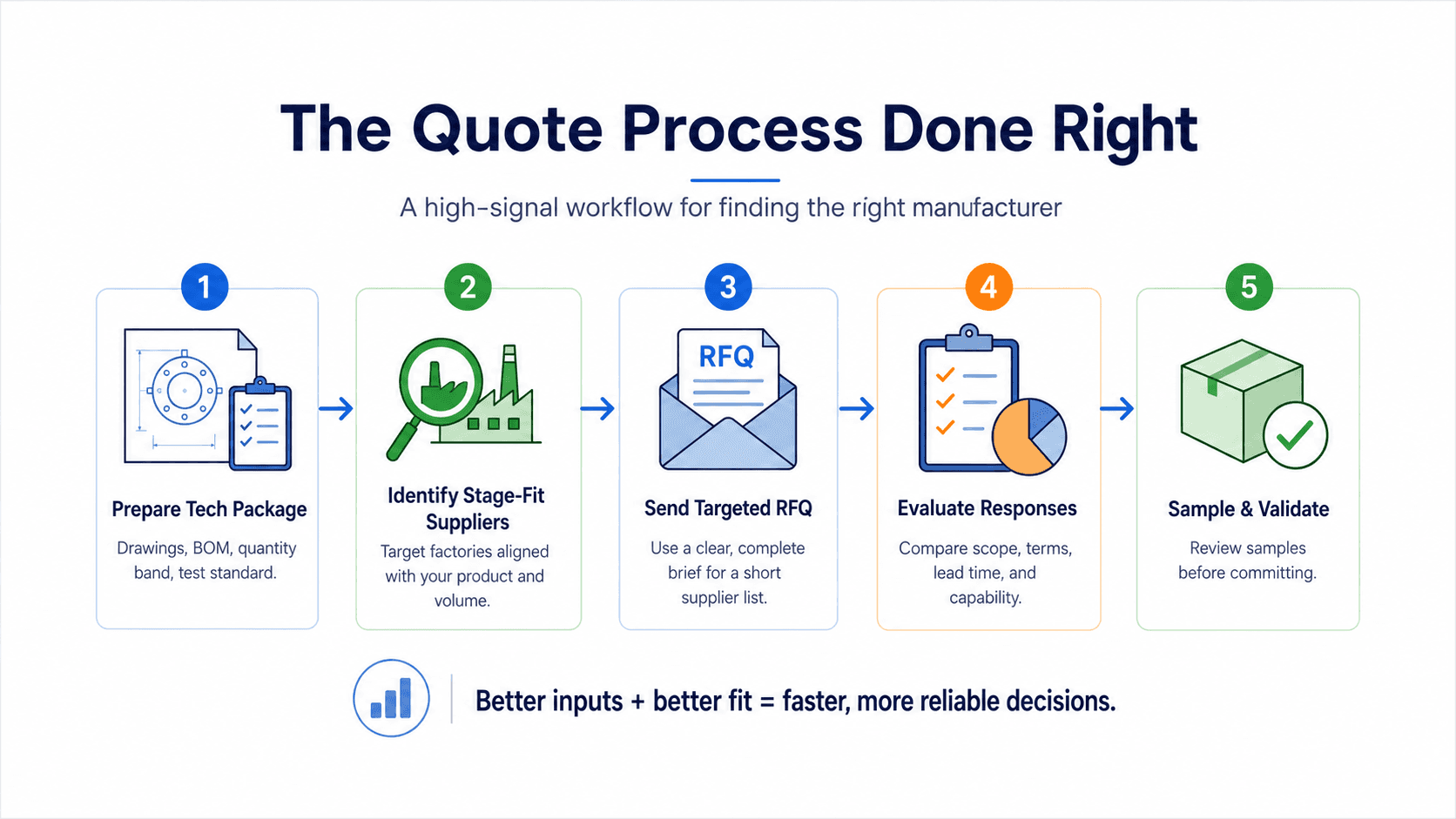
Before any outreach to find a manufacturer, four documents need to exist in a form a factory engineer can act on without guessing.
The first is a drawing or 3D file with tolerances. A sketch or a concept render does not count. The factory needs to know what they are actually making — STEP files are the standard for mechanical parts, Gerber files for PCBs. Without these, the supplier is quoting their imagination.
The second is a bill of materials with part specifications. Not a list of component categories, but a list of actual components with key specifications flagged. If there is a proprietary sensor or a specific connector form factor that is non-negotiable, that needs to be in the document. Factories substitute components by default when specs are absent. This is not a quality failure; it is how they manage margin. The substitution changes the product.
The third is a quantity band, not a single number. Founders often ask for pricing at their “target” volume without specifying what pilot quantities and scale quantities look like. This matters because many factories will not quote accurately for 500 units if they only want to work with buyers at 10,000 units. Showing your quantity range surfaces this mismatch before you invest three weeks in email chains (which, once you’ve been through it, you’ll never want to repeat).
The fourth is a test standard or acceptance criteria. What does a passing unit look like? What failures are grounds for rejection? Without this, the factory defines quality themselves — and their definition is optimized for throughput, not for your customer’s experience.
The practical implication here is not bureaucratic. It is strategic. The moment you send a complete technical package, you radically cut the number of factories willing to quote — and the ones who do are signaling actual capability rather than aspirational interest.
The Stage-Fit Question Nobody Asks
Even with a complete technical package, there is a second dimension that most founders skip: does this factory’s business model fit your current production stage?
A factory optimized for mass production at 50,000 units per month has a cost structure that makes small runs actively unprofitable for them. They will quote you, take your order, deprioritize your production, and deliver late. Not malice. Incentive alignment. Their machine utilization model does not have room for you.
The question to ask is not “can you make this?” Almost every factory will say yes. Ask instead: “What is your typical order size, and where does our volume fit in your production queue?” That question produces honest answers and, more importantly, reveals whether the relationship is viable before the PO is signed.
Channel Selection Is a Signal, Not a Search
How Different Sourcing Channels Produce Different Supplier Types
When founders are told to “find a manufacturer,” the instinct is to open Alibaba. Alibaba is a legitimate tool, but it is a search engine for suppliers who have paid to be discoverable by Western buyers. That is a selection effect. The factories on page one are optimized for inquiry volume, not for technical complexity — they have English-speaking sales teams, flexible MOQ claims, and fast response rates. These are marketing capabilities, not manufacturing capabilities.
The channel used to find a factory predetermines the type of factory found. Referrals from other hardware founders surface factories that have already survived someone’s pilot run; that is a real data point. Trade shows like Canton Fair put a face to capability claims and allow for a physical audit of sample quality. Engineering networks in manufacturing clusters like Shenzhen produce introductions to factories that never bother with online marketing because they have been running at capacity with existing relationships for eleven months straight, year after year.
None of these channels is universally superior. Each suits a different buyer profile. A founder at the prototype stage needs a different factory than a startup preparing for Series A volume commitments. The sourcing channel needs to match the production stage.
Choosing Alibaba by default is a product decision disguised as a search decision.
Local Partners as Structural Intermediaries
There is a category of sourcing support that sits between “find a factory yourself” and “hire a full sourcing agent”: local partners with production relationships in China who can filter the supplier set before you see it.
This model works when the partner’s incentives are aligned with yours rather than with the factory’s. A commission-based sourcing agent earns more by placing orders, not by finding the best fit. A partner paid for China-side production management has an incentive structure aligned with production quality and timeline reliability, because their reputation is staked on the outcome, not the transaction.
The distinction matters because the sourcing process is not complete at contract signing. Factory fit is a dynamic condition that degrades when production pressures shift, when your volumes grow faster than the factory expected, or when a larger customer displaces you in the production queue.

Reading a Quote Without Getting Fooled
The Five Variables That Change What a Quote Actually Means
Comparing quotes by unit price alone is like comparing airline tickets by base fare. The structural costs are in the columns buyers ignore.
Minimum order quantity is the first trap. A quote with a $12 unit price at 1,000 units MOQ is not cheaper than a $15 unit price at 200 units if you are at prototype stage and need to iterate three times. The total capital committed to unusable inventory in the first scenario can exceed the premium in the second by an order of magnitude.
Tooling cost is the second trap, and it is frequently omitted from first-pass quotes. Injection molds for a plastic enclosure can run from $3,000 to $30,000 depending on complexity and steel quality. A low unit price from a factory that quotes tooling separately — or doesn't quote it at all — becomes a high total-cost relationship the moment you try to actually start production.
Lead time is quoted as a single number but functions as a distribution. The relevant question is not "what is your standard lead time?" but "what percentage of your orders ship within that window, and what is the average delay on the others?" Factories rarely volunteer delay statistics. Asking the question signals procurement sophistication and often produces more honest answers.
Payment terms structure your cash exposure during production. Net-30 after delivery is fundamentally different from 30% deposit, 70% before shipment — which is the most common Chinese factory standard. Founders who do not model this in their working capital plan discover the gap at the worst moment.
Quality control scope is the fifth trap. A quote may include "QC inspection" as a line item that means visual inspection of five units per batch, or it may mean nothing at all. The acceptance criteria you defined before sending the RFQ now need to appear explicitly in the purchase agreement, with documented pass/fail standards. If the factory cannot confirm they will test against your standards, they will test against theirs.
The Audit Layer
Before any meaningful production commitment, the factory's claimed capacity needs verification that goes beyond a capabilities document and a WeChat introduction. Remote factory audits in China have become structurally more viable than they were five years ago — structured audit frameworks, local audit partners, and documentary verification protocols can surface capacity misrepresentation before the PO is signed rather than after the first delivery fails.
Who Should Care About This Analysis
Hardware founders sourcing their first or second manufacturing relationship are the primary audience. The practical implication is direct: invest two weeks in building a complete technical package before sending a single RFQ. That investment eliminates the quote comparison problem entirely, because it produces comparable quotes from a filtered supplier set.
Procurement teams at startups preparing to scale from prototype to pilot production are the secondary audience. The manufacturer selection decision made at that transition point has compounding consequences — the right factory at 500 units is frequently the wrong factory at 5,000 units, and the transition cost is higher than founders model in advance.
The structural question worth watching as this space evolves: will supplier discovery platforms commoditize the search layer without solving the fit layer? Alibaba and its successors have made finding a factory trivial. The problem was never search — it was qualification. The new scarcity is not supplier access. It is reliable signal about which supplier fits which stage.
That is the gap where the leverage sits.