" height="21.943622918266314px" id="HqU1V_VXu" width="76.57577685890533px"/><path d="M 20.228 10.24 L 10.114 10.24 L 10.114 8.777 L 20.228 8.777 Z M 21.672 20.48 L 15.171 20.48 L 15.171 19.018 L 21.672 19.018 Z M 0 19.018 L 0 0 L 1.445 0 L 1.445 19.018 Z M 20.228 19.018 L 20.228 0 L 21.672 0 L 21.672 19.018 Z" fill="rgb(255, 255, 255)" height="20.480488152641314px" id="bfuCuMlPp" transform="translate(27.507 1.519)" width="21.672358558014366px"/><path d="M 42.622 19.018 L 42.622 0 L 44.067 0 L 44.067 19.018 Z M 54.903 8.777 L 54.903 0 L 56.348 0 L 56.348 8.777 Z M 75.131 8.777 L 75.131 0 L 76.575 0 L 76.575 8.777 Z M 70.796 19.018 L 70.796 10.241 L 72.241 10.241 L 72.241 19.018 Z M 59.238 19.018 L 59.238 10.241 L 60.683 10.241 L 60.683 19.018 Z M 1.445 0 L 1.445 20.481 L 0 20.481 L 0 0 Z M 11.559 20.481 L 1.445 20.481 L 1.445 19.018 L 11.559 19.018 Z M 21.672 10.24 L 10.114 10.24 L 10.114 8.777 L 21.672 8.777 Z" fill="rgb(255, 255, 255)" height="20.480826258659363px" id="TduQKyNcg" transform="translate(0 1.519)" width="76.57543472988937px"/><path d="M 10.114 9.07 L 10.114 0 L 11.559 0 L 11.559 9.07 Z M 0 19.311 L 0 10.533 L 1.445 10.533 L 1.445 19.311 Z M 10.114 20.774 L 10.114 13.459 L 11.559 13.459 L 11.559 20.774 Z M 4.334 20.774 L 4.334 13.458 L 5.779 13.458 L 5.779 20.774 Z M 5.78 13.459 L 10.114 13.459 L 10.114 14.922 L 5.78 14.922 Z M 5.78 19.311 L 10.114 19.311 L 10.114 20.774 L 5.78 20.774 Z M 79.032 2.487 L 92.035 2.487 L 92.035 3.95 L 79.032 3.95 Z M 96.37 2.487 L 109.373 2.487 L 109.373 3.95 L 96.37 3.95 Z M 113.708 2.487 L 126.711 2.487 L 126.711 3.95 L 113.708 3.95 Z M 135.38 2.487 L 148.384 2.487 L 148.384 3.95 L 135.38 3.95 Z M 86.256 8.339 L 92.035 8.339 L 92.035 9.802 L 86.256 9.802 Z M 97.815 8.339 L 110.818 8.339 L 110.818 9.802 L 97.815 9.802 Z M 80.477 15.653 L 93.48 15.653 L 93.48 17.116 L 80.477 17.116 Z M 97.815 15.653 L 110.818 15.653 L 110.818 17.116 L 97.815 17.116 Z M 79.032 15.653 L 79.032 3.95 L 80.477 3.95 L 80.477 15.653 Z M 96.37 15.653 L 96.37 3.95 L 97.815 3.95 L 97.815 15.653 Z M 113.708 17.116 L 113.708 3.95 L 115.153 3.95 L 115.153 17.116 Z M 135.38 15.653 L 135.38 3.95 L 136.825 3.95 L 136.825 15.653 Z M 152.718 15.653 L 152.718 2.487 L 154.163 2.487 L 154.163 15.653 Z M 170.056 15.653 L 170.056 2.487 L 171.5 2.487 L 171.5 15.653 Z M 187.394 15.653 L 187.394 2.487 L 188.839 2.487 L 188.839 15.653 Z" fill="rgb(255, 255, 255)" height="20.773521135658505px" id="jAG3tW2Le" transform="translate(10.169 1.182)" width="188.83858780606124px"/><path d="M 62.127 5.852 L 75.131 5.852 L 75.131 7.315 L 62.127 7.315 Z M 79.465 5.852 L 92.469 5.852 L 92.469 7.315 L 79.465 7.315 Z M 96.803 5.852 L 108.362 5.852 L 108.362 7.315 L 96.803 7.315 Z M 79.465 0 L 91.024 0 L 91.024 1.463 L 79.465 1.463 Z M 92.469 1.463 L 92.469 5.852 L 91.024 5.852 L 91.024 1.463 Z M 109.807 7.315 L 109.807 14.629 L 108.362 14.629 L 108.362 7.315 Z M 62.127 13.166 L 75.131 13.166 L 75.131 14.629 L 62.127 14.629 Z M 79.465 13.166 L 92.469 13.166 L 92.469 14.629 L 79.465 14.629 Z M 34.675 14.629 L 34.675 1.463 L 36.12 1.463 L 36.12 14.629 Z M 56.348 13.166 L 56.348 1.463 L 57.793 1.463 L 57.793 13.166 Z M 44.789 13.166 L 57.793 13.166 L 57.793 14.629 L 44.789 14.629 Z M 39.01 14.629 L 39.01 2.926 L 40.455 2.926 L 40.455 14.629 Z M 39.01 1.463 L 39.01 0 L 40.455 0 L 40.455 1.463 Z M 0 13.166 L 0 5.852 L 1.445 5.852 L 1.445 13.166 Z M 17.338 5.852 L 17.338 1.463 L 18.782 1.463 L 18.782 5.852 Z M 106.917 0 L 108.361 0 L 108.361 1.463 L 106.917 1.463 Z M 105.472 1.463 L 106.917 1.463 L 106.917 2.926 L 105.472 2.926 Z M 104.027 2.926 L 105.472 2.926 L 105.472 4.389 L 104.027 4.389 Z M 102.583 4.389 L 104.027 4.389 L 104.027 5.852 L 102.583 5.852 Z" fill="rgb(255, 255, 255)" height="14.62930651858536px" id="yTdOA_r0t" transform="translate(102.194 3.714)" width="109.80650620205734px"/></g></svg>)
A case-study article showing how a filtered showerhead concept moved from early uncertainty to a more production-ready hardware product path.

Most hardware founders don't fail because their idea is bad. They fail because they spend money in the wrong order. OPINE's founder came to Geniotek with a clear market thesis — rising consumer anxiety about water quality, a category with real repeat-purchase logic, and enough differentiation room to build a brand. What they didn't have was a structured path from concept to factory-ready product. This case study walks through how Geniotek broke that journey into controlled milestones, where the team avoided expensive rework, and what the process looked like at each stage — from the first technical risk audit through DFM and supplier coordination. If you're sitting on a hardware idea right now, this is what a disciplined development process actually looks like.
There's a gap most hardware founders don't see until they're standing in it. It's the distance between "I know this product should exist" and "I have a factory-ready file, a vetted supplier, and a cost structure I can actually build a business on." OPINE's founder understood the market. Consumer distrust of tap water is measurable and growing. Shower filters are a category with documented demand, a natural replenishment cycle, and room for a brand that takes design and transparency seriously. The insight was real. The product opportunity was real. But a good idea doesn't survive first contact with a bill of materials, a tooling quote, or a mold revision cycle — not without a system behind it.
That system is what Geniotek was brought in to provide.
What the Founder Actually Brought to the Table
OPINE's founder arrived with something most early-stage hardware founders underestimate: a well-reasoned commercial hypothesis. They had identified a consumer pain point, understood the replenishment dynamic that makes consumer hardware businesses viable long-term, and had a rough sense of where existing products in the category were falling short — either in filtration credibility, in industrial design, or in both.
What they didn't have — and what almost no founder has at this stage — was clarity on the technical risk stack sitting underneath that hypothesis. Hardware product development case studies tend to glamorize the product reveal and compress the months of iteration that precede it. The reality is less cinematic. Before you can talk about brand positioning or DTC margins, you have to know whether your core mechanism is manufacturable, what your filter media options actually cost at scale, and whether your enclosure geometry survives a DFM review without forcing a complete redesign.
The honest framing at the start of the OPINE engagement wasn't "let's build this product." It was "let's find out what we don't know yet, in the cheapest possible order."

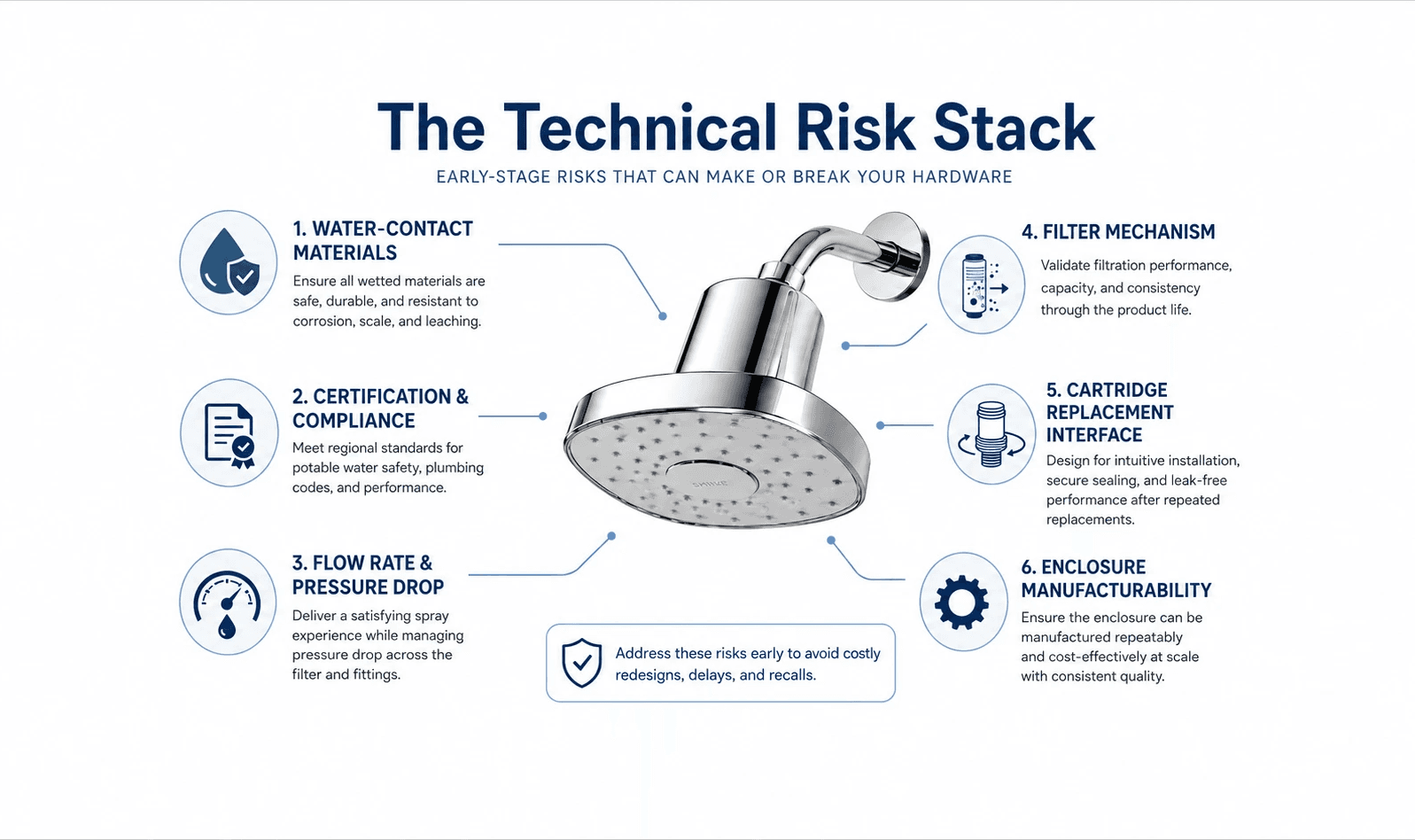
The Risk Stack: What Could Kill the Project Before It Started
Water Contact, Certification, and the Regulatory Layer
Filtered showerheads sit at an intersection that catches a lot of first-time founders off guard: they're consumer products, but they're also water-contact products. That means material selection isn't just a cost-and-aesthetics conversation — it's a compliance conversation. Plastics and elastomers need to be appropriate for continuous hot water exposure. Certain filter media require substantiated performance claims if you're going to make them on packaging. And depending on target markets, NSF/ANSI certification territory becomes a question that affects both development timeline and unit economics.
Geniotek identified this layer early, not because it was necessarily going to block the project, but because letting it surface late — during a tooling cycle or a retailer onboarding review — is exactly the kind of rework cost that kills hardware startups. When you're looking at hardware product development case studies across categories, this pattern repeats: the teams that win are the ones who map regulatory and certification risk in week two, not month eight.
The Filter Mechanism and Its Engineering Interdependencies
The second major risk was less visible but equally structural. A shower filter sounds simple. In practice, it involves flow rate management, pressure drop across the filter media, cartridge sealing geometry, and replacement interface design — all of which have to work together and all of which affect the end user's experience in ways that are hard to reverse once tooling is committed.
The team needed to understand, early, whether the filtration approach OPINE had in mind was compatible with acceptable flow rates for the target market, whether the cartridge replacement mechanism could be executed simply enough for a consumer audience, and whether the enclosure design could accommodate the internal geometry without creating a product that looked like it was designed from the inside out. These aren't problems you solve in a board meeting. They require physical prototypes and structured iteration.
How Geniotek Structured the Work
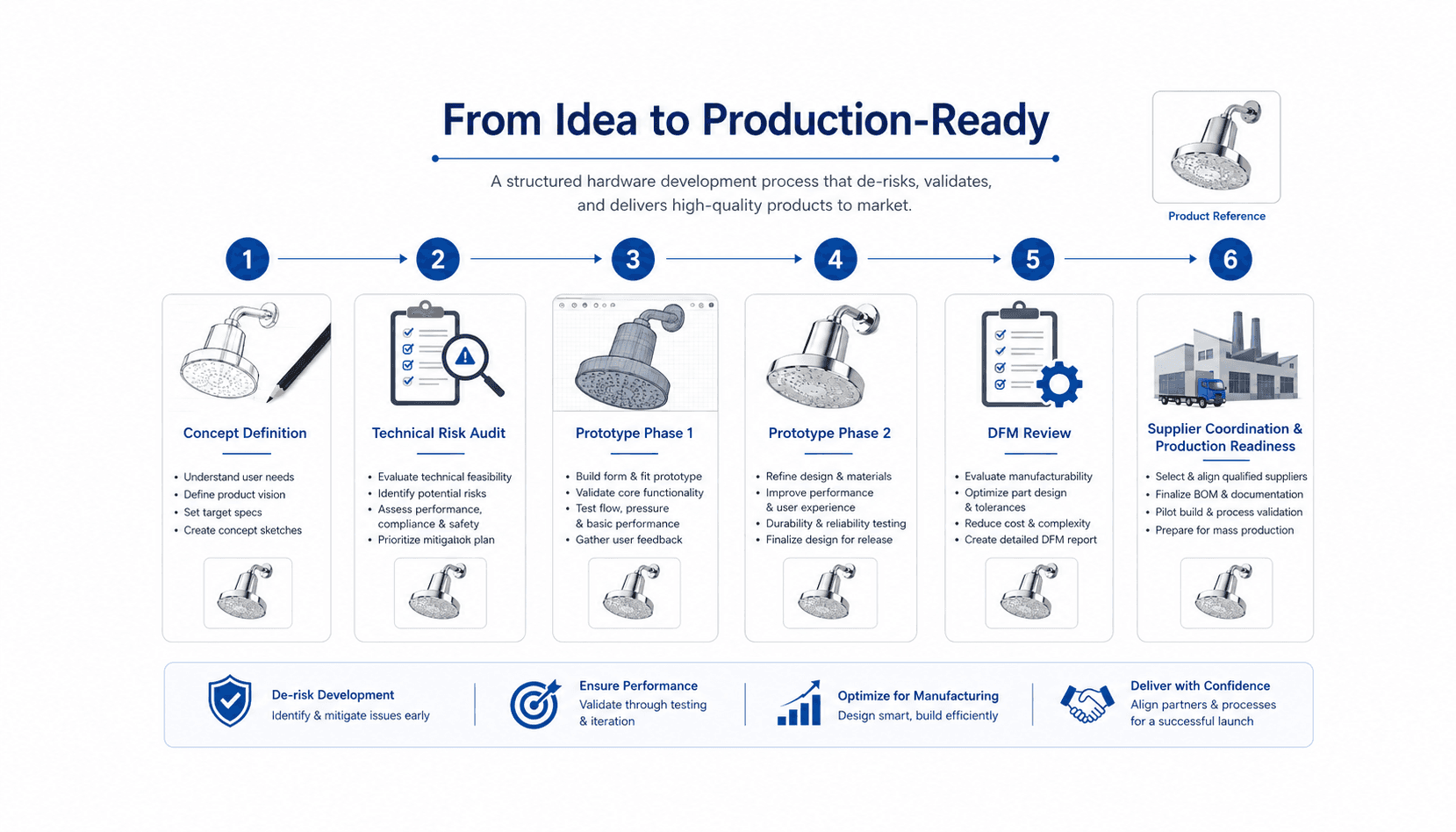
Concept Definition Before CAD
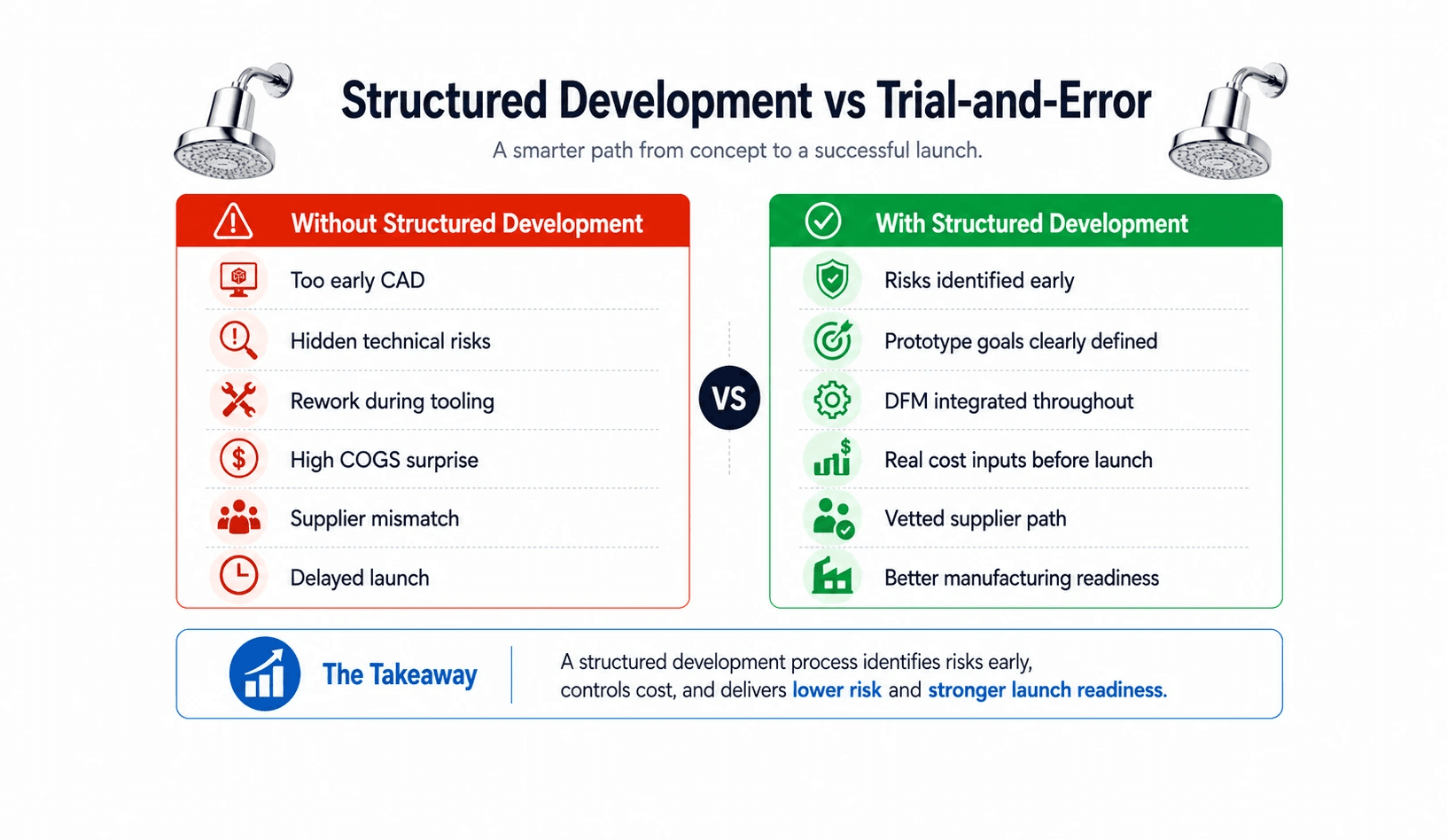
One of the patterns that separates productive prototype development companies from expensive ones is where they put the thinking. The teams that burn founders' money fastest are the ones that jump to CAD as soon as a brief lands, because CAD work feels like progress and billable hours are billable hours. Geniotek's approach runs the opposite direction: before any geometry is locked, the concept definition phase establishes the functional requirements, the constraint hierarchy, and the assumptions that most need to be stress-tested.
For OPINE, this meant getting explicit about what the product actually had to do versus what would be nice to have, which filter media options were genuinely viable given cost and performance targets, and where the first prototype needed to generate data versus where it was just a communication tool. If you haven't already mapped this for your own project, the process of learning how to validate a hardware product idea before committing to development spend is worth understanding in detail.
Prototype Phases and What Each One Was Designed to Answer
The OPINE prototyping work wasn't a single "let's build a version and see how it looks" exercise. Each phase was structured around specific unknowns. Early prototypes were focused on the internal mechanism — flow behavior, pressure drop, cartridge interface function — using production-approximate materials where it mattered and cheap process substitutes where it didn't. Later phases brought the enclosure design into the equation, integrating industrial design intent with the functional geometry the earlier rounds had validated.
This sequencing matters more than most founders realize. When you prototype the wrong things in the wrong order, you end up with beautiful enclosures that have to be redesigned when the internal mechanism changes, or functional mechanisms that never get properly integrated into a shippable form. The OPINE project avoided that trap by keeping phase objectives explicit and keeping communication between ID and engineering tight.
DFM and Supplier Coordination
Design for manufacturability review is where a lot of projects that looked fine on screen meet reality. Wall thicknesses that won't fill properly, undercuts that require expensive side actions, surface finishes that are specified but not achievable at the target tooling cost — these issues exist in a lot of prototypes that were never seriously reviewed against manufacturing constraints.
Geniotek ran DFM review as an integrated part of the process, not a final gate. Supplier coordination ran in parallel, which meant that by the time the design was development-complete, there were real cost inputs in the model and a realistic picture of what the supply chain actually looked like. This is how you avoid the situation — common enough to be a cliché in hardware startup war stories, and documented in channels like Foundr startup stories — where a founder gets to "done" and then discovers that their COGS doesn't support their price point.
What the Outcome Actually Looked Like
OPINE emerged from the engagement with something more valuable than a prototype: a production-ready design, a vetted manufacturing path, and a clear picture of the decisions that still needed to be made before launch. The supply chain wasn't a mystery. The tooling cost wasn't a guess. The regulatory questions were mapped, not deferred.
This is what "manufacturing readiness" actually means in practice. It's not a single deliverable. It's a state in which the founder can make informed decisions about launch timing, pricing, and capital deployment — because the unknowns have been converted into data.
Three Lessons for Hardware Founders
The OPINE engagement produces three transferable lessons that apply across hardware categories, not just consumer wellness products.
The first is that risk sequencing is more important than speed. Moving fast in hardware development is only valuable if you're moving fast on the right things in the right order. Speed on the wrong decisions compounds cost; structured pacing on the right ones compounds confidence.
The second is that DFM is not a final step. Design for manufacturability isn't a review you do when the design is "finished" — it's a constraint set that should inform design decisions throughout the process. Teams that treat it as a gate at the end pay for that choice in revision cycles.
The third is that supplier intelligence is a design input. Understanding what your supply chain can actually do — at what cost, at what tolerance, at what lead time — should shape how you design the product, not just how you source it. The teams that integrate this early build products that are manufacturable. The ones that don't spend months discovering why their design doesn't match reality.
Ready to Map Your Own Development Path?
If you're carrying a hardware idea and want to understand what a structured development process looks like for your specific product, Geniotek works with founders from concept through manufacturing readiness. You can explore more hardware product development case studies to see how other products have moved through this process, or get in touch directly to talk through where your project stands.