" height="21.943622918266314px" id="HqU1V_VXu" width="76.57577685890533px"/><path d="M 20.228 10.24 L 10.114 10.24 L 10.114 8.777 L 20.228 8.777 Z M 21.672 20.48 L 15.171 20.48 L 15.171 19.018 L 21.672 19.018 Z M 0 19.018 L 0 0 L 1.445 0 L 1.445 19.018 Z M 20.228 19.018 L 20.228 0 L 21.672 0 L 21.672 19.018 Z" fill="rgb(255, 255, 255)" height="20.480488152641314px" id="bfuCuMlPp" transform="translate(27.507 1.519)" width="21.672358558014366px"/><path d="M 42.622 19.018 L 42.622 0 L 44.067 0 L 44.067 19.018 Z M 54.903 8.777 L 54.903 0 L 56.348 0 L 56.348 8.777 Z M 75.131 8.777 L 75.131 0 L 76.575 0 L 76.575 8.777 Z M 70.796 19.018 L 70.796 10.241 L 72.241 10.241 L 72.241 19.018 Z M 59.238 19.018 L 59.238 10.241 L 60.683 10.241 L 60.683 19.018 Z M 1.445 0 L 1.445 20.481 L 0 20.481 L 0 0 Z M 11.559 20.481 L 1.445 20.481 L 1.445 19.018 L 11.559 19.018 Z M 21.672 10.24 L 10.114 10.24 L 10.114 8.777 L 21.672 8.777 Z" fill="rgb(255, 255, 255)" height="20.480826258659363px" id="TduQKyNcg" transform="translate(0 1.519)" width="76.57543472988937px"/><path d="M 10.114 9.07 L 10.114 0 L 11.559 0 L 11.559 9.07 Z M 0 19.311 L 0 10.533 L 1.445 10.533 L 1.445 19.311 Z M 10.114 20.774 L 10.114 13.459 L 11.559 13.459 L 11.559 20.774 Z M 4.334 20.774 L 4.334 13.458 L 5.779 13.458 L 5.779 20.774 Z M 5.78 13.459 L 10.114 13.459 L 10.114 14.922 L 5.78 14.922 Z M 5.78 19.311 L 10.114 19.311 L 10.114 20.774 L 5.78 20.774 Z M 79.032 2.487 L 92.035 2.487 L 92.035 3.95 L 79.032 3.95 Z M 96.37 2.487 L 109.373 2.487 L 109.373 3.95 L 96.37 3.95 Z M 113.708 2.487 L 126.711 2.487 L 126.711 3.95 L 113.708 3.95 Z M 135.38 2.487 L 148.384 2.487 L 148.384 3.95 L 135.38 3.95 Z M 86.256 8.339 L 92.035 8.339 L 92.035 9.802 L 86.256 9.802 Z M 97.815 8.339 L 110.818 8.339 L 110.818 9.802 L 97.815 9.802 Z M 80.477 15.653 L 93.48 15.653 L 93.48 17.116 L 80.477 17.116 Z M 97.815 15.653 L 110.818 15.653 L 110.818 17.116 L 97.815 17.116 Z M 79.032 15.653 L 79.032 3.95 L 80.477 3.95 L 80.477 15.653 Z M 96.37 15.653 L 96.37 3.95 L 97.815 3.95 L 97.815 15.653 Z M 113.708 17.116 L 113.708 3.95 L 115.153 3.95 L 115.153 17.116 Z M 135.38 15.653 L 135.38 3.95 L 136.825 3.95 L 136.825 15.653 Z M 152.718 15.653 L 152.718 2.487 L 154.163 2.487 L 154.163 15.653 Z M 170.056 15.653 L 170.056 2.487 L 171.5 2.487 L 171.5 15.653 Z M 187.394 15.653 L 187.394 2.487 L 188.839 2.487 L 188.839 15.653 Z" fill="rgb(255, 255, 255)" height="20.773521135658505px" id="jAG3tW2Le" transform="translate(10.169 1.182)" width="188.83858780606124px"/><path d="M 62.127 5.852 L 75.131 5.852 L 75.131 7.315 L 62.127 7.315 Z M 79.465 5.852 L 92.469 5.852 L 92.469 7.315 L 79.465 7.315 Z M 96.803 5.852 L 108.362 5.852 L 108.362 7.315 L 96.803 7.315 Z M 79.465 0 L 91.024 0 L 91.024 1.463 L 79.465 1.463 Z M 92.469 1.463 L 92.469 5.852 L 91.024 5.852 L 91.024 1.463 Z M 109.807 7.315 L 109.807 14.629 L 108.362 14.629 L 108.362 7.315 Z M 62.127 13.166 L 75.131 13.166 L 75.131 14.629 L 62.127 14.629 Z M 79.465 13.166 L 92.469 13.166 L 92.469 14.629 L 79.465 14.629 Z M 34.675 14.629 L 34.675 1.463 L 36.12 1.463 L 36.12 14.629 Z M 56.348 13.166 L 56.348 1.463 L 57.793 1.463 L 57.793 13.166 Z M 44.789 13.166 L 57.793 13.166 L 57.793 14.629 L 44.789 14.629 Z M 39.01 14.629 L 39.01 2.926 L 40.455 2.926 L 40.455 14.629 Z M 39.01 1.463 L 39.01 0 L 40.455 0 L 40.455 1.463 Z M 0 13.166 L 0 5.852 L 1.445 5.852 L 1.445 13.166 Z M 17.338 5.852 L 17.338 1.463 L 18.782 1.463 L 18.782 5.852 Z M 106.917 0 L 108.361 0 L 108.361 1.463 L 106.917 1.463 Z M 105.472 1.463 L 106.917 1.463 L 106.917 2.926 L 105.472 2.926 Z M 104.027 2.926 L 105.472 2.926 L 105.472 4.389 L 104.027 4.389 Z M 102.583 4.389 L 104.027 4.389 L 104.027 5.852 L 102.583 5.852 Z" fill="rgb(255, 255, 255)" height="14.62930651858536px" id="yTdOA_r0t" transform="translate(102.194 3.714)" width="109.80650620205734px"/></g></svg>)
An opinion-led guide to why startup BOMs get too expensive too early, and which design, sourcing, and DFM decisions actually drive unnecessary cost before manufacturing starts.
There's a particular kind of heartbreak that startup founders don't warn each other about — the moment a factory quote comes back and the numbers make your stomach drop, not because manufacturing is expensive, but because you did this to yourself. Quietly. Incrementally. One beautifully over-specified component at a time. Most startup BOMs don't get ruined in production. They get ruined in Notion documents and late-night CAD sessions and feature brainstorms where nobody in the room had manufacturing experience and everyone was too excited to notice. This is about that. The upstream wreckage. The cost you built in before a single factory conversation started. And — gently, with some compassion — what to do instead.
The Spreadsheet That Looked Fine Until It Didn't
She found it at 11:47 PM on a Tuesday.
Not the factory quote — that came later, in an email her co-founder forwarded with no comment, just a subject line that read "thoughts?" and the quiet devastation of ellipses. What Maya found first was the BOM she'd built over eight months: colour-coded, commented, referenced across three Notion pages and a shared Figma file. It was beautiful. It was also about forty percent more expensive than it needed to be, and she had designed every dollar of waste into it herself, with good intentions, at two in the morning, while listening to a startup podcast on 1.5x speed.
That's the thing nobody says out loud. The startup BOM cost problem almost never starts with bad suppliers or greedy factories. It starts with decisions made in the dark — or maybe "in the dark" undersells how invisible these choices feel at the time — before the factory is even part of the conversation.
It starts with you.
Which is fine, actually. Survivable. But only if you look at it directly instead of hoping the next quote comes back lower.
The Quiet Accumulation
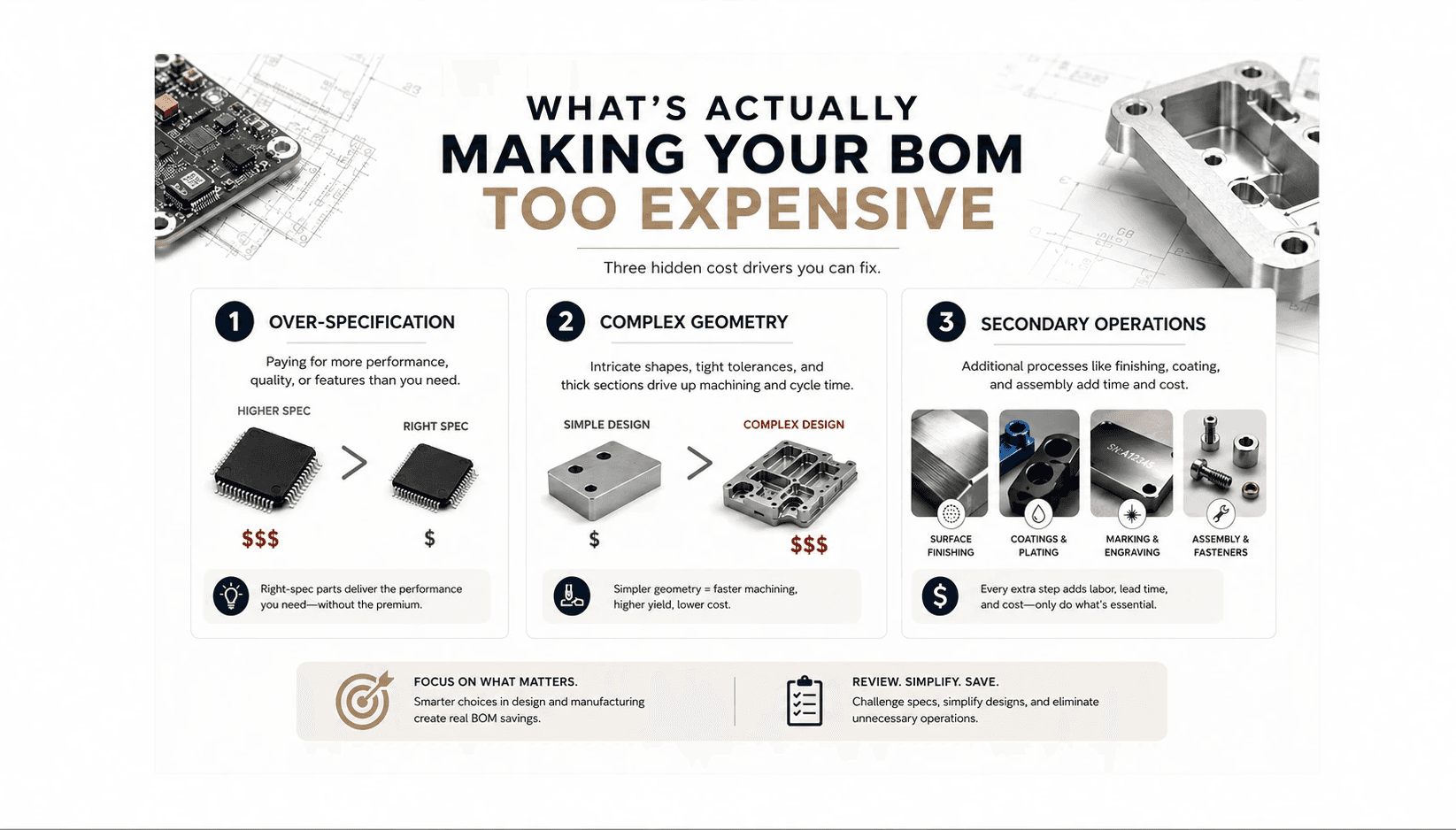
Here's how it typically unfolds. You spec a material that sounds right — aerospace-grade, military tolerance, something a supplier mentioned once at a trade show. A feature gets added because a beta user brought it up, and pulling it out later feels like admitting defeat. Your enclosure has a curved surface that your designer loves — and that requires a secondary machining operation nobody budgeted for. Then, maybe three months down the road, another component gets bumped to a higher-spec option because someone on the team was worried about an edge-case failure mode, the change seemed small at the time, and the BOM quietly expanded again without anyone scheduling a meeting.
Feature creep doesn't feel like cost accumulation. It feels like thoroughness.
Over-specced materials don't feel like waste. They feel like quality.
Complex geometry doesn't feel like a manufacturing problem. It feels like good design.
Until the quote lands. And then everything feels like Tuesday at 11:47 PM, staring at a spreadsheet that somehow turned against you while you were trying to build something worth building.

What's Actually Making Your BOM Too Expensive
Let's get specific, because generalities are easy and specificity is where the real work lives.
Over-Specification Is Not the Same as Quality
There's a version of this mistake that turns up in nearly every early hardware startup. A founder — usually sharp, usually detail-oriented, usually someone who cares too much rather than too little — specs a component to a tolerance or material grade the product doesn't functionally need. Not because it's better for the user. Because it feels safer. Because "we can always dial it back later." Because nobody wants to be the person who picked the cheaper option and watched it fail.
Manufacturing costs, though, don't scale in a straight line with quality. A component specced to tighter tolerances than necessary might run 30% higher in material cost and two to three times longer in machining time. Do that across twelve components and you've quietly baked $18 in unnecessary cost into every unit before a single sourcing conversation has happened (which is wild, honestly) — and that number compounds at volume in ways that can make or break a margin structure entirely.
The question to ask isn't is this good enough? The question is what does this component actually need to do, and what's the least expensive way to do exactly that?
Those are different questions. The second is harder to sit with, because it means releasing the version of the product that exists only in your head, where everything is already the best possible iteration of itself.
Geometry That Only an Engineer Could Love
Complex part geometry is — and said with genuine warmth here — one of the most expensive ways founders express anxiety about the unknown. When you don't know exactly how something will fail, you make it more complicated. Ribs where ribs aren't needed. Curved surfaces that could be flat. Undercuts that force multi-axis machining when two-axis would do the job. Custom brackets that could be off-the-shelf with a modest design tweak.
Each of these carries a real dollar cost. Undercuts can add 15–25% to machining time. Complex injection mold geometries can push tooling costs from $8,000 to $35,000. A surface finish that renders beautifully but serves no functional role might add four days of hand finishing per batch.
This is precisely where a product feasibility study completed before the design is locked can recover more money than almost any supplier negotiation will ever claw back.
Nobody Owned DFM — So Nobody Did It
Here's the uncomfortable one.
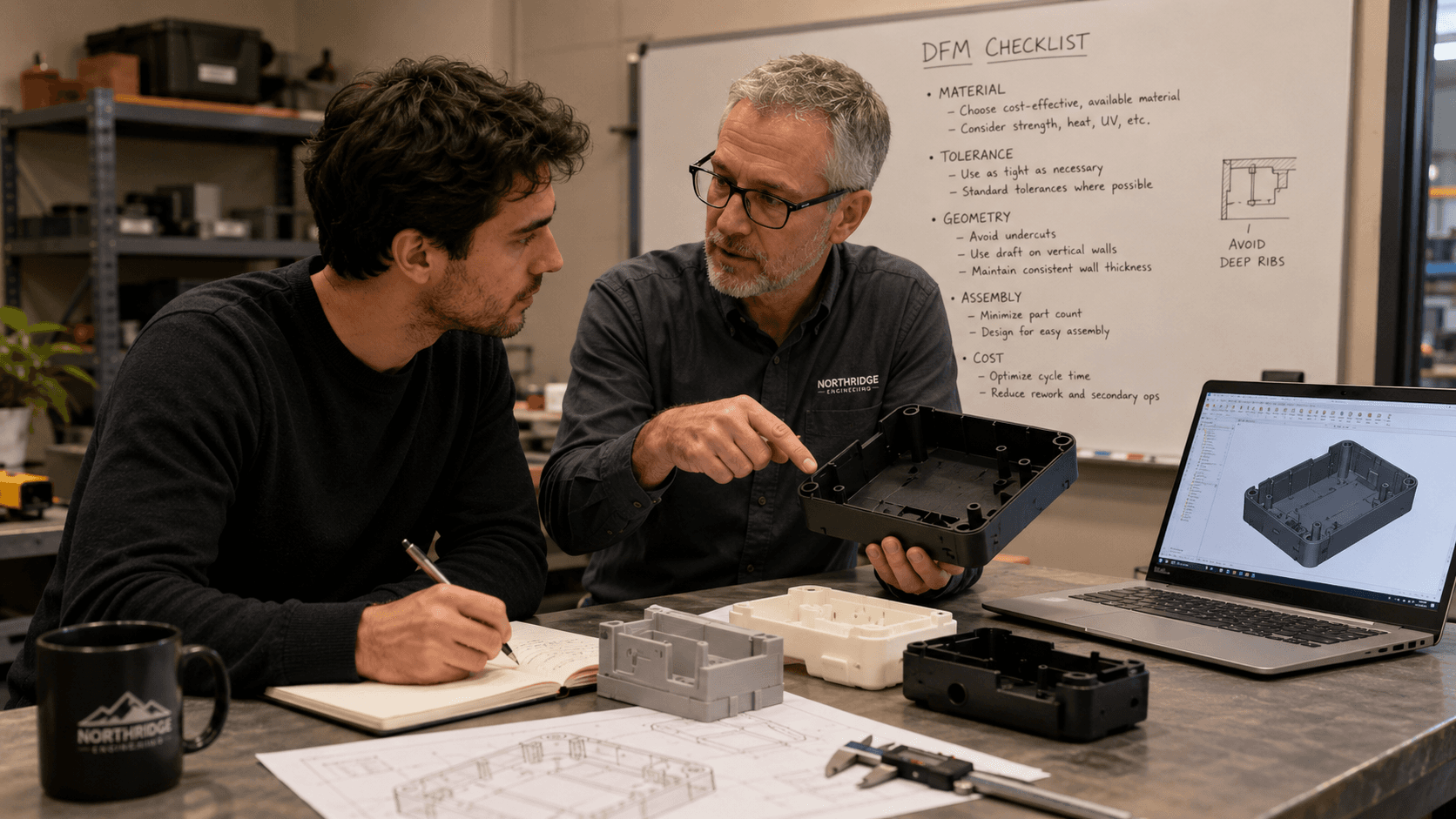
Most early-stage startups don't have a DFM owner. They have a designer, maybe a mechanical engineer, possibly a founder who watches a lot of manufacturing videos on YouTube. DFM — design for manufacturing — is the discipline of asking, at every design decision, how does this choice affect the factory? It's not a checklist you run at the end. It's a lens applied throughout. And when no one in the room holds that lens, the product accumulates cost the way a car accumulates rust — invisibly, continuously, until you're at the mechanic wondering how it got this bad.
The Foundr community talks endlessly about finding product-market fit. Fewer people talk about factory fit — designing something a factory can actually produce efficiently at the price point your margins require. Both matter. The second one tends to ambush you.
A Lower Quote Is Not a Better BOM
Even careful founders get tripped up here.
After the first quote comes back high, the instinct is to find a cheaper factory. Or push harder on price. Or wait until the supplier relationship warms up before applying pressure. Sometimes those moves recover a few percentage points. Sometimes the new quote genuinely looks better.
But if the underlying BOM is over-specified, over-featured, or geometrically complex, the problem hasn't been fixed. What's happened instead is finding a factory willing to absorb more risk or trim more corners to hit your number — and that's a different, slower kind of disaster.
A lower quote and a lower-cost BOM are not the same thing. One is a commercial outcome. The other is a structural decision made upstream: in design, in component selection, in how the team responded to the pressure of needing the product to be perfect before it was manufacturable.
The BOM cost reduction that actually holds comes from changing the design, not from changing the factory. The factory conversation should happen after the hard internal work is done — not as a way to sidestep it.
What's Worth Protecting (And What's Just Habit)
Not all BOM cost is waste. Some of it is genuinely load-bearing.
The cost worth protecting is cost tied directly to user experience, safety, regulatory compliance, or core product differentiation. A medical device requiring specific material biocompatibility. An enclosure engineered to protect electronics under defined environmental conditions. A component tolerance that prevents failure under real-world use.
Those costs stay. No argument there.
The cost that's often just habit: the specced-up component that's "just better," the feature no user has raised since the second beta round, the finish that photographs well in marketing materials but adds three days to production. The internal structural element designed for a product version that no longer exists.
The question — hard, worth asking with someone who won't soften the answer — is which category each line item actually belongs to. Not which category it feels like it belongs to. Where it actually lives.
Before Your Next BOM Review: A Checklist Worth Using
(Keep this. Actually use it. Not as a performance of due diligence, but as a thing that might genuinely save you eleven months of compounding regret.)
Go through every component and ask: does this material grade or tolerance directly affect function, safety, or compliance? If the answer is no, document why it was chosen and what revision would require. That documentation alone tends to surface assumptions nobody had bothered to examine.
Flag every custom part. For each one, ask whether an off-the-shelf alternative exists within 80% of the functional requirement. The remaining 20% gap is often bridgeable through a minor design adjustment. Sometimes it isn't. But the majority of the time, nobody has actually checked.
Identify every surface, joint, or geometry that requires secondary operations — machine finish, secondary machining, hand assembly, post-processing. These hide in line items that look small until volume arrives. When a secondary operation exists, ask why. Then ask whether the design could be revised to eliminate it without compromising the outcome.
Run the BOM past someone with real factory floor experience before finalizing it. Not a consultant who works from spreadsheets. Someone who has stood on a production floor and watched what happens when a part is harder to make than the drawing implies.
For every feature, ask: when did we last hear a user say they needed this? If the answer is "we haven't, but we assume they will," that's a design decision worth revisiting. Assumptions that live only in your head cost real money at the factory.

The Part Where Geniotek Comes In
Here’s what hardware development services actually look like when they’re working the way they should: the manufacturing conversation doesn’t begin after the design is finished. It runs alongside it — from early-stage development through production readiness — with someone whose entire job is to hold the factory lens even when the team is deep in feature decisions.
That’s the Geniotek model. Not a service that receives a finished design and attempts to retrofit manufacturability, but a partner present when the choices that drive BOM cost are actually being made. DFM isn’t a phase. Component selection isn’t a procurement task. These are design disciplines, and they work best when integrated into the development process rather than bolted on afterward.
Maya’s BOM got fixed. Not by finding a cheaper factory — she tried that first, and it recovered $0.60 per unit while introducing three new quality questions. It got fixed by returning to the design with someone who knew which levers to pull, ultimately finding $12 per unit in decisions that had always been avoidable.
Twelve dollars. Across projected first-year volume. That’s the number that made her sit quietly for a moment in a way that was equal parts grief and relief —
Grief for the months spent building something more expensive than it needed to be. Relief that she’d found it before the factory run, not after.
The spreadsheet still lives in Notion. It’s not beautiful anymore — it’s been revised, challenged, argued with, marked up in three colors by people who cared enough to fight with it. But it’s honest.
And honestly? That’s the version worth building from.