" height="21.943622918266314px" id="HqU1V_VXu" width="76.57577685890533px"/><path d="M 20.228 10.24 L 10.114 10.24 L 10.114 8.777 L 20.228 8.777 Z M 21.672 20.48 L 15.171 20.48 L 15.171 19.018 L 21.672 19.018 Z M 0 19.018 L 0 0 L 1.445 0 L 1.445 19.018 Z M 20.228 19.018 L 20.228 0 L 21.672 0 L 21.672 19.018 Z" fill="rgb(255, 255, 255)" height="20.480488152641314px" id="bfuCuMlPp" transform="translate(27.507 1.519)" width="21.672358558014366px"/><path d="M 42.622 19.018 L 42.622 0 L 44.067 0 L 44.067 19.018 Z M 54.903 8.777 L 54.903 0 L 56.348 0 L 56.348 8.777 Z M 75.131 8.777 L 75.131 0 L 76.575 0 L 76.575 8.777 Z M 70.796 19.018 L 70.796 10.241 L 72.241 10.241 L 72.241 19.018 Z M 59.238 19.018 L 59.238 10.241 L 60.683 10.241 L 60.683 19.018 Z M 1.445 0 L 1.445 20.481 L 0 20.481 L 0 0 Z M 11.559 20.481 L 1.445 20.481 L 1.445 19.018 L 11.559 19.018 Z M 21.672 10.24 L 10.114 10.24 L 10.114 8.777 L 21.672 8.777 Z" fill="rgb(255, 255, 255)" height="20.480826258659363px" id="TduQKyNcg" transform="translate(0 1.519)" width="76.57543472988937px"/><path d="M 10.114 9.07 L 10.114 0 L 11.559 0 L 11.559 9.07 Z M 0 19.311 L 0 10.533 L 1.445 10.533 L 1.445 19.311 Z M 10.114 20.774 L 10.114 13.459 L 11.559 13.459 L 11.559 20.774 Z M 4.334 20.774 L 4.334 13.458 L 5.779 13.458 L 5.779 20.774 Z M 5.78 13.459 L 10.114 13.459 L 10.114 14.922 L 5.78 14.922 Z M 5.78 19.311 L 10.114 19.311 L 10.114 20.774 L 5.78 20.774 Z M 79.032 2.487 L 92.035 2.487 L 92.035 3.95 L 79.032 3.95 Z M 96.37 2.487 L 109.373 2.487 L 109.373 3.95 L 96.37 3.95 Z M 113.708 2.487 L 126.711 2.487 L 126.711 3.95 L 113.708 3.95 Z M 135.38 2.487 L 148.384 2.487 L 148.384 3.95 L 135.38 3.95 Z M 86.256 8.339 L 92.035 8.339 L 92.035 9.802 L 86.256 9.802 Z M 97.815 8.339 L 110.818 8.339 L 110.818 9.802 L 97.815 9.802 Z M 80.477 15.653 L 93.48 15.653 L 93.48 17.116 L 80.477 17.116 Z M 97.815 15.653 L 110.818 15.653 L 110.818 17.116 L 97.815 17.116 Z M 79.032 15.653 L 79.032 3.95 L 80.477 3.95 L 80.477 15.653 Z M 96.37 15.653 L 96.37 3.95 L 97.815 3.95 L 97.815 15.653 Z M 113.708 17.116 L 113.708 3.95 L 115.153 3.95 L 115.153 17.116 Z M 135.38 15.653 L 135.38 3.95 L 136.825 3.95 L 136.825 15.653 Z M 152.718 15.653 L 152.718 2.487 L 154.163 2.487 L 154.163 15.653 Z M 170.056 15.653 L 170.056 2.487 L 171.5 2.487 L 171.5 15.653 Z M 187.394 15.653 L 187.394 2.487 L 188.839 2.487 L 188.839 15.653 Z" fill="rgb(255, 255, 255)" height="20.773521135658505px" id="jAG3tW2Le" transform="translate(10.169 1.182)" width="188.83858780606124px"/><path d="M 62.127 5.852 L 75.131 5.852 L 75.131 7.315 L 62.127 7.315 Z M 79.465 5.852 L 92.469 5.852 L 92.469 7.315 L 79.465 7.315 Z M 96.803 5.852 L 108.362 5.852 L 108.362 7.315 L 96.803 7.315 Z M 79.465 0 L 91.024 0 L 91.024 1.463 L 79.465 1.463 Z M 92.469 1.463 L 92.469 5.852 L 91.024 5.852 L 91.024 1.463 Z M 109.807 7.315 L 109.807 14.629 L 108.362 14.629 L 108.362 7.315 Z M 62.127 13.166 L 75.131 13.166 L 75.131 14.629 L 62.127 14.629 Z M 79.465 13.166 L 92.469 13.166 L 92.469 14.629 L 79.465 14.629 Z M 34.675 14.629 L 34.675 1.463 L 36.12 1.463 L 36.12 14.629 Z M 56.348 13.166 L 56.348 1.463 L 57.793 1.463 L 57.793 13.166 Z M 44.789 13.166 L 57.793 13.166 L 57.793 14.629 L 44.789 14.629 Z M 39.01 14.629 L 39.01 2.926 L 40.455 2.926 L 40.455 14.629 Z M 39.01 1.463 L 39.01 0 L 40.455 0 L 40.455 1.463 Z M 0 13.166 L 0 5.852 L 1.445 5.852 L 1.445 13.166 Z M 17.338 5.852 L 17.338 1.463 L 18.782 1.463 L 18.782 5.852 Z M 106.917 0 L 108.361 0 L 108.361 1.463 L 106.917 1.463 Z M 105.472 1.463 L 106.917 1.463 L 106.917 2.926 L 105.472 2.926 Z M 104.027 2.926 L 105.472 2.926 L 105.472 4.389 L 104.027 4.389 Z M 102.583 4.389 L 104.027 4.389 L 104.027 5.852 L 102.583 5.852 Z" fill="rgb(255, 255, 255)" height="14.62930651858536px" id="yTdOA_r0t" transform="translate(102.194 3.714)" width="109.80650620205734px"/></g></svg>)
A process-led article showing how hardware products move from prototype to mass production through readiness gates, DFM, supplier qualification, pilot work, and quality control.
The most dangerous moment in any hardware launch isn't when a prototype fails — it's when a team genuinely believes they're ready for mass production before they actually are. Moving from prototype to mass production requires more than a working sample; it demands design freezes, supplier qualification, pilot runs, and real quality gates. Skip any of these, and a $50,000 DFM oversight can balloon into a $500,000 tooling redo. This article walks through the readiness framework Geniotek uses to help hardware teams scale without a catastrophic and expensive surprise midway through their first production order.
There's a particular kind of confidence that shows up around week six of an engineering validation cycle. The prototype works. The team has tested it. Someone books a factory visit. Then — usually around 11 on a Thursday when the first supplier quotes land in the inbox — reality shows up uninvited.
Production is not a bigger prototype. It never was. The tolerances that a skilled technician could hand-file into place simply don't exist on a line churning through 3,000 units a shift. What held together in a lab, sustained by goodwill and institutional memory, tends to fall apart the moment it hits an injection mold or an SMT line. This gap — between something that works and something that can be built reliably at scale — is where most hardware meltdowns actually happen. Not at the prototype stage, not even at shipping, but right in the middle, when teams are already committed financially and emotionally and turning back is genuinely painful.
What follows is how we think about closing that gap, step by step, before a mass production purchase order ever gets approved.
Why Most Hardware Teams Hit the Wall at the Same Place
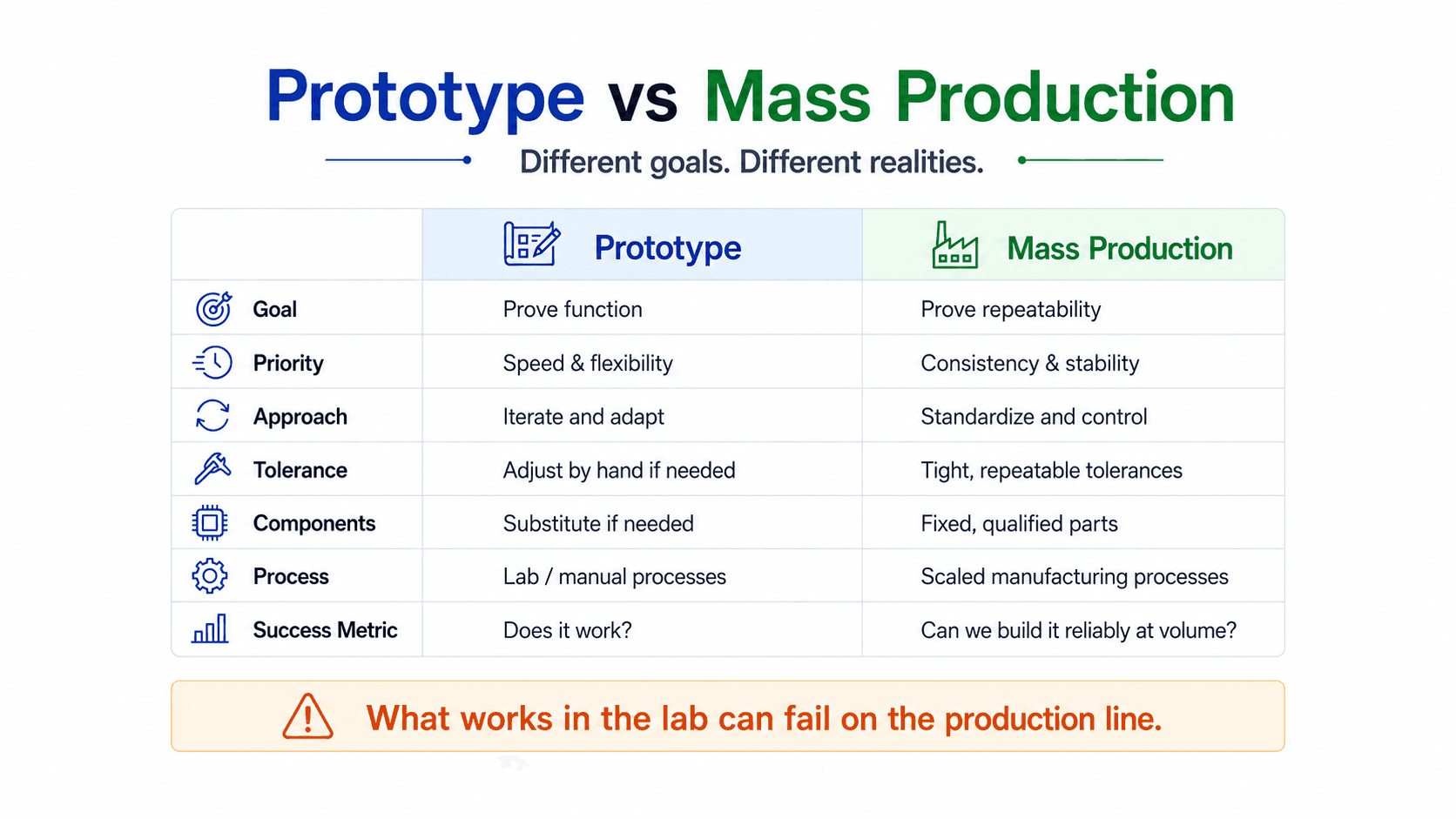
The problem isn't that founders are naive. Prototypes are designed to prove function, and production is designed to prove repeatability — and those are two genuinely different goals that reward different behaviors.
Prototyping rewards speed, creativity, and flexibility. If a part doesn't fit, you adjust it. If a component is out of stock, you swap in something close. You're proving a concept. Production, though, rewards rigidity. Same part. Same supplier. Same process settings. Same inspector. Variation is the enemy. Which means any flexibility baked into the prototype phase — the kind that felt like resourcefulness at the time — becomes a liability the moment you try to scale it.
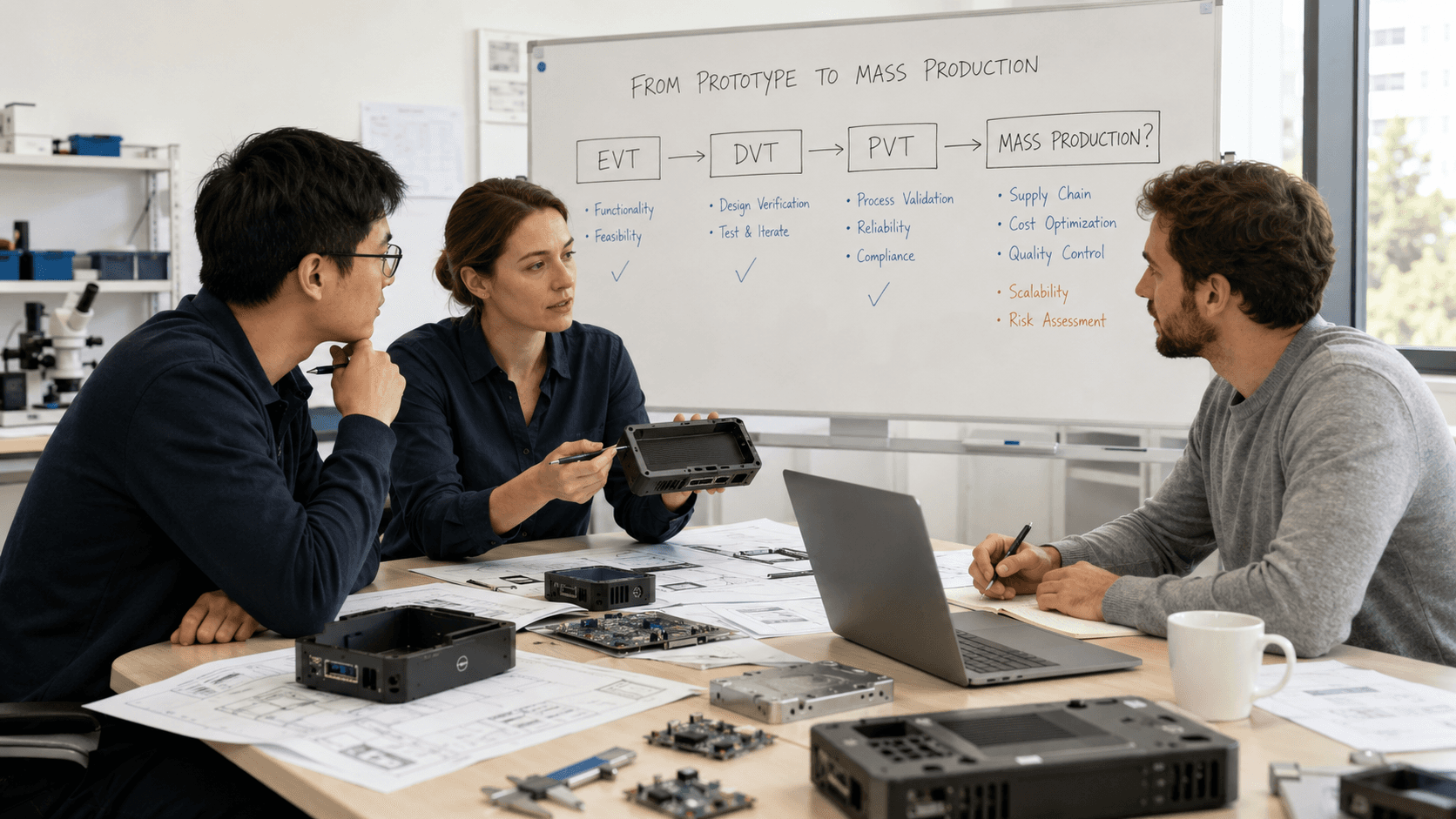
Oddly enough, we see this pattern repeat even with experienced hardware teams who have shipped products before. The EVT prototype passes its tests, the DVT rounds look clean, and someone makes the call that PVT is mostly a formality. It almost never is. Working through the EVT DVT PVT phases with genuine discipline — treating each phase as a gate rather than a checkpoint — is the difference between a controlled scale-up and a frantic one.

The Cost of Premature Confidence
Premature production readiness declarations tend to share a few characteristics. Tooling gets ordered before the design is frozen. Supplier contracts get signed before yield rates are confirmed. Marketing timelines start driving engineering decisions. And then, when a critical tolerance turns out to be unachievable at production quantities, the whole schedule collapses at once.
Roughly 40 percent of the production delays we're pulled in to help fix trace back to a design change that happened after tooling was ordered. Not dramatic changes — small ones. A wall thickness adjusted slightly for thermal performance, a connector placement shifted a single millimeter to improve assembly ergonomics. Each one reasonable in isolation. Together, they add up to retooling costs that nobody budgeted for, because everyone assumed the design was done.
The Readiness Gates We Run Before Approving a Mass Production Order
Readiness isn't a feeling. It's a list of conditions — each one verifiable, each one with a pass/fail criterion — that have to be met before we're willing to sign off on scaling. No single gate is heroic on its own. Together, they're how you keep a $200,000 production run from becoming a very expensive lesson.
Design freeze comes first. Not "mostly frozen" or "frozen except for the battery connector." Frozen. Every component specified. Every tolerance documented. Every assembly drawing signed off. If someone says "we might still tweak the housing," that's a flag (and in our experience, that phrase has preceded some truly painful retooling bills). Tooling and a live design are a combination that tends to end badly.
Design for Manufacturing review runs alongside the freeze. DFM isn't about criticizing the engineering team's work — it's about asking whether the design can actually be built the way a production process works, not the way a prototype workshop works. Wall thickness for injection molding. Pick-and-place accessibility for SMT. Fastener standardization to cut down on assembly time and error rates. These reviews, done early and honestly, are where expensive surprises get caught cheaply. We treat small-batch manufacturing runs as a live DFM stress test — if something's going to break at volume, it usually shows itself first around the 200-unit mark.
Supplier Qualification and the Pilot Run
Supplier qualification means more than pulling three quotes and picking the middle price. It means auditing process capabilities, reviewing quality management certifications, confirming that the machines actually running your parts are the machines they claimed would run your parts, and getting first-article inspection results in writing. A factory that produces beautiful samples can still struggle badly with consistency at scale if their process controls aren't tight.
The pilot production run is where everything either holds together or reveals itself. Run a meaningful batch — not ten units, and not a hundred if your production order is for 10,000 — and measure the yield. Measure the cycle time. Measure the defect types and their frequencies. This is also where trial production quality control does its most important work: catching systematic issues before they're systematic across tens of thousands of units.
Pilot failures are not bad news. They're exactly what pilots are for. A 12 percent defect rate on a pilot is fixable. That same rate discovered after a full production run is a crisis.

What Scale-Up Failures Actually Look Like Up Close
Most scale-up failures don't arrive as a single dramatic event. Come to think of it, that's precisely what makes them harder to catch — no single warning feels urgent enough to stop the line.
Component availability is one of the most underestimated risks. A prototype can often be built with whatever's on hand. Production can't. If a critical IC carries a 16-week lead time and your product launch is eleven weeks out, that's a problem to solve during the planning phase, not the week before your PO ships. We maintain a component risk register for every product we take through hardware mass production, flagging anything with constrained supply, limited second-source options, or end-of-life risk.
Assembly process issues are another category. Parts that go together neatly in a prototype jig might need three extra seconds per unit on a production line because the snap-fit is slightly too stiff. At 5,000 units, three seconds is four hours of labor. At $45 per hour for skilled assembly, you've added $180 to your COGS without changing a single component — which is wild, honestly. Small inefficiencies compound. That's arithmetic, not bad luck.
Why the Same Owner Needs to See Both Prototype and Production
Something that gets skipped in a lot of hardware development conversations: the team that builds your prototype should have visibility into your production setup. Not necessarily the same technicians, but the same engineering owner who understands why every decision got made the way it did.
When a separate manufacturing team inherits a product they didn't design, they're reading documentation. Not reading the three weeks of reasoning that went into a particular assembly sequence. Context gets lost. And when a production issue surfaces — a fit problem, an electrical anomaly, an unexplained yield drop — the person most capable of diagnosing it quickly is the one who made the original design decisions, not someone reading the spec sheet for the first time.
Keeping prototype and production under the same engineering ownership isn't always organizationally convenient. It is almost always worth it.
What Founders Should Have Before a Production Order Goes Out
Clear outputs matter. Ambiguity at this stage is expensive.
Before any mass production PO gets approved, the founding team should have four things in writing. A risk list — every known technical, supply chain, and process risk, with mitigation status. Release conditions: the exact pass/fail criteria used to approve the pilot run. Control points: the in-line and outgoing quality checks that will run during production, with acceptance criteria. And backup plans: alternative suppliers, substitute components, and escalation contacts if something breaks mid-run.
This is not paperwork for its own sake. It's the difference between a production problem that gets solved in two days and one that stops your line for three weeks while people try to remember what the original design intent actually was.
Taking a hardware product from prototype to mass production without a meltdown is genuinely achievable. It requires the right readiness gates, honest pilot data, quality controls that catch problems early, and engineering continuity between development and production. None of that is magic. All of it is process. And process, applied consistently, is what separates the hardware teams that ship on time from the ones still explaining delays to their investors six months after their original launch date.