" width="211.99999530565634px"><path d="M 0 0 L 21.672 0 L 21.672 1.445 L 0 1.445 Z M 27.452 0 L 49.124 0 L 49.124 1.445 L 27.452 1.445 Z M 54.903 0 L 76.576 0 L 76.576 1.445 L 54.903 1.445 Z M 54.903 10.114 L 76.576 10.114 L 76.576 11.558 L 54.903 11.558 Z M 27.452 20.228 L 39.01 20.228 L 39.01 21.672 L 27.452 21.672 Z M 59.238 20.228 L 72.241 20.228 L 72.241 21.672 L 59.238 21.672 Z M 39.01 10.114 L 39.01 20.227 L 37.566 20.227 L 37.566 10.114 Z" fill="rgb(26, 26, 26)" height="21.672358586906324px" id="gK_Mh2pDw" width="76.57578110701563px"/><path d="M 20.228 10.113 L 10.114 10.113 L 10.114 8.669 L 20.228 8.669 Z M 21.672 20.227 L 15.171 20.227 L 15.171 18.783 L 21.672 18.783 Z M 0 18.783 L 0 0 L 1.445 0 L 1.445 18.783 Z M 20.228 18.783 L 20.228 0 L 21.672 0 L 21.672 18.783 Z" fill="rgb(26, 26, 26)" height="20.227311744808098px" id="nN12tbtQP" transform="translate(27.507 1.5)" width="21.672358586906363px"/><path d="M 42.622 18.783 L 42.622 0 L 44.067 0 L 44.067 18.783 Z M 54.903 8.669 L 54.903 0 L 56.348 0 L 56.348 8.669 Z M 75.131 8.669 L 75.131 0 L 76.575 0 L 76.575 8.669 Z M 70.796 18.783 L 70.796 10.114 L 72.241 10.114 L 72.241 18.783 Z M 59.238 18.783 L 59.238 10.114 L 60.683 10.114 L 60.683 18.783 Z M 1.445 0 L 1.445 20.228 L 0 20.228 L 0 0 Z M 11.559 20.228 L 1.445 20.228 L 1.445 18.783 L 11.559 18.783 Z M 21.672 10.114 L 10.114 10.114 L 10.114 8.669 L 21.672 8.669 Z" fill="rgb(26, 26, 26)" height="20.227645530818847px" id="X8QQTyDlD" transform="translate(0 1.5)" width="76.57544238817589px"/><path d="M 10.114 8.958 L 10.114 0 L 11.559 0 L 11.559 8.958 Z M 0 19.072 L 0 10.403 L 1.445 10.403 L 1.445 19.072 Z M 10.114 20.517 L 10.114 13.292 L 11.559 13.292 L 11.559 20.517 Z M 4.334 20.517 L 4.334 13.292 L 5.779 13.292 L 5.779 20.517 Z M 5.78 13.292 L 10.114 13.292 L 10.114 14.737 L 5.78 14.737 Z M 5.78 19.072 L 10.114 19.072 L 10.114 20.517 L 5.78 20.517 Z M 79.032 2.456 L 92.036 2.456 L 92.036 3.901 L 79.032 3.901 Z M 96.37 2.456 L 109.373 2.456 L 109.373 3.901 L 96.37 3.901 Z M 113.708 2.456 L 126.711 2.456 L 126.711 3.901 L 113.708 3.901 Z M 135.38 2.456 L 148.384 2.456 L 148.384 3.901 L 135.38 3.901 Z M 86.256 8.236 L 92.035 8.236 L 92.035 9.681 L 86.256 9.681 Z M 97.815 8.236 L 110.818 8.236 L 110.818 9.681 L 97.815 9.681 Z M 80.477 15.46 L 93.48 15.46 L 93.48 16.904 L 80.477 16.904 Z M 97.815 15.46 L 110.818 15.46 L 110.818 16.904 L 97.815 16.904 Z M 79.032 15.46 L 79.032 3.901 L 80.477 3.901 L 80.477 15.46 Z M 96.37 15.46 L 96.37 3.901 L 97.815 3.901 L 97.815 15.46 Z M 113.708 16.905 L 113.708 3.901 L 115.153 3.901 L 115.153 16.905 Z M 135.38 15.46 L 135.38 3.901 L 136.825 3.901 L 136.825 15.46 Z M 152.718 15.46 L 152.718 2.456 L 154.163 2.456 L 154.163 15.46 Z M 170.056 15.46 L 170.056 2.456 L 171.5 2.456 L 171.5 15.46 Z M 187.394 15.46 L 187.394 2.456 L 188.839 2.456 L 188.839 15.46 Z" fill="rgb(26, 26, 26)" height="20.51672236573591px" id="FK6xE1Vot" transform="translate(10.169 1.167)" width="188.838611199974px"/><path d="M 62.127 5.78 L 75.131 5.78 L 75.131 7.224 L 62.127 7.224 Z M 79.465 5.78 L 92.469 5.78 L 92.469 7.224 L 79.465 7.224 Z M 96.803 5.78 L 108.362 5.78 L 108.362 7.224 L 96.803 7.224 Z M 79.465 0 L 91.024 0 L 91.024 1.445 L 79.465 1.445 Z M 92.469 1.445 L 92.469 5.78 L 91.024 5.78 L 91.024 1.445 Z M 109.806 7.224 L 109.806 14.448 L 108.362 14.448 L 108.362 7.224 Z M 62.127 13.003 L 75.131 13.003 L 75.131 14.448 L 62.127 14.448 Z M 79.465 13.003 L 92.469 13.003 L 92.469 14.448 L 79.465 14.448 Z M 34.675 14.448 L 34.675 1.445 L 36.12 1.445 L 36.12 14.448 Z M 56.348 13.003 L 56.348 1.445 L 57.793 1.445 L 57.793 13.003 Z M 44.789 13.003 L 57.793 13.003 L 57.793 14.448 L 44.789 14.448 Z M 39.01 14.448 L 39.01 2.89 L 40.455 2.89 L 40.455 14.448 Z M 39.01 1.445 L 39.01 0 L 40.455 0 L 40.455 1.445 Z M 0 13.003 L 0 5.779 L 1.445 5.779 L 1.445 13.003 Z M 17.338 5.78 L 17.338 1.445 L 18.782 1.445 L 18.782 5.78 Z M 106.917 0 L 108.361 0 L 108.361 1.445 L 106.917 1.445 Z M 105.472 1.445 L 106.917 1.445 L 106.917 2.89 L 105.472 2.89 Z M 104.027 2.89 L 105.472 2.89 L 105.472 4.334 L 104.027 4.334 Z M 102.583 4.334 L 104.027 4.334 L 104.027 5.779 L 102.583 5.779 Z" fill="rgb(26, 26, 26)" height="14.448460816632046px" id="P87EDhxsn" transform="translate(102.193 3.668)" width="109.80649478685751px"/></g></svg>)
A founder-friendly guide to hardware product development cost, covering concept audit, industrial design, prototyping, DFM, tooling, pilot runs, and the decisions that change budget fastest.
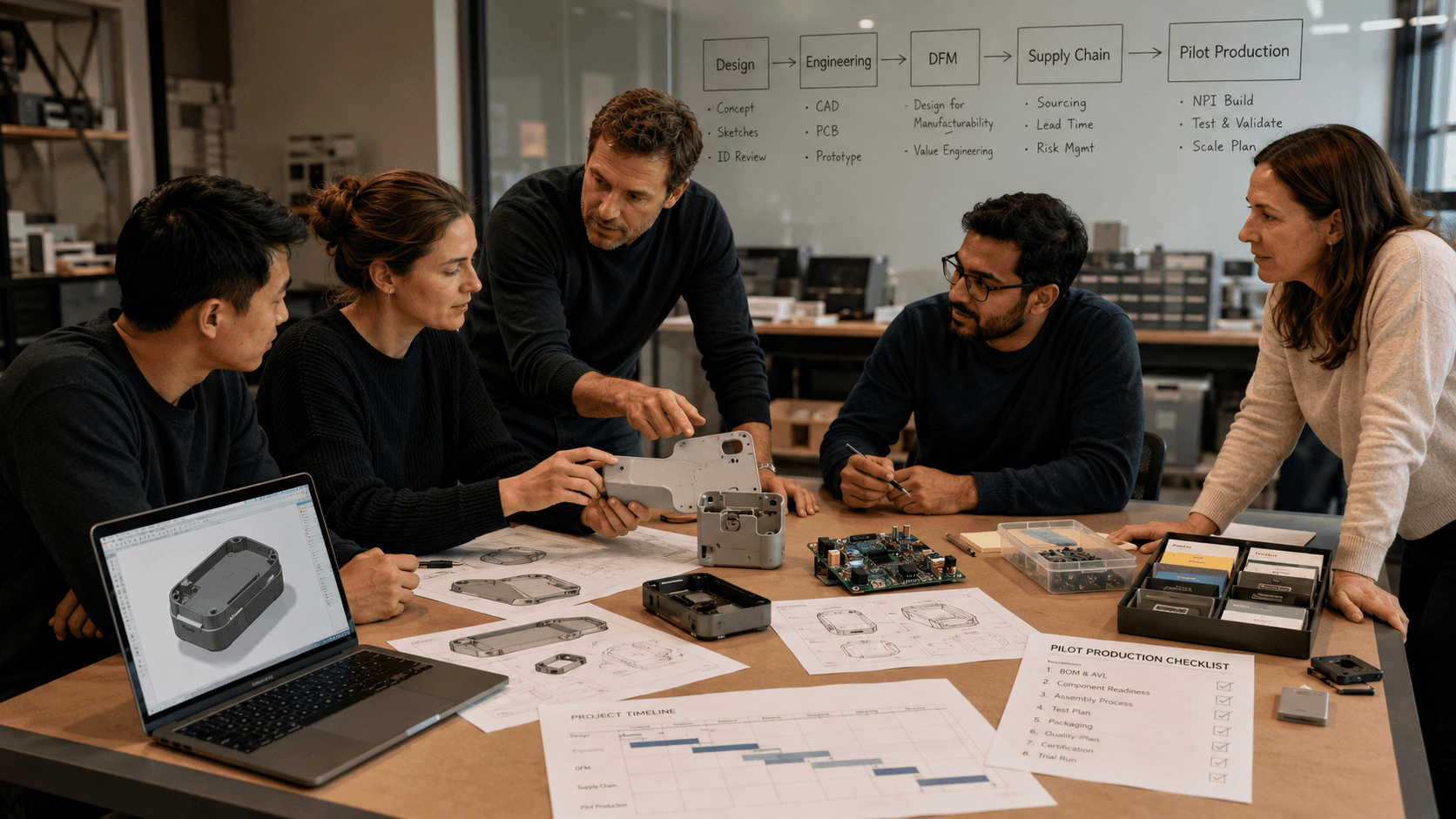
Hardware product development cost is not a single number — it's a stack of decisions. Most founders aren't scared off by one large quote; they lose control gradually, across concept, design, engineering, prototyping, DFM, tooling, and pilot production. A realistic budget for a simple connected consumer product sits somewhere between $40,000 and $120,000 before your first real production run. Complex products — multi-sensor, regulated, mechanically intricate — can push $250,000 or beyond. The variables that move the number fastest are rework cycles, certification scope, and how many times you switch suppliers mid-project. Understanding the cost architecture before you commit is the only reliable way to stay in control.
Hardware is one of those domains where "how much does it cost?" is genuinely hard to answer without wanting to immediately ask three questions back. Not because engineers are being evasive — but because the cost isn't really a price. It's an outcome of decisions, and some of those decisions haven't been made yet when founders first ask.
Which, come to think of it, is exactly the right moment to understand the full picture.
Breaking Down Hardware Product Development Cost by Stage
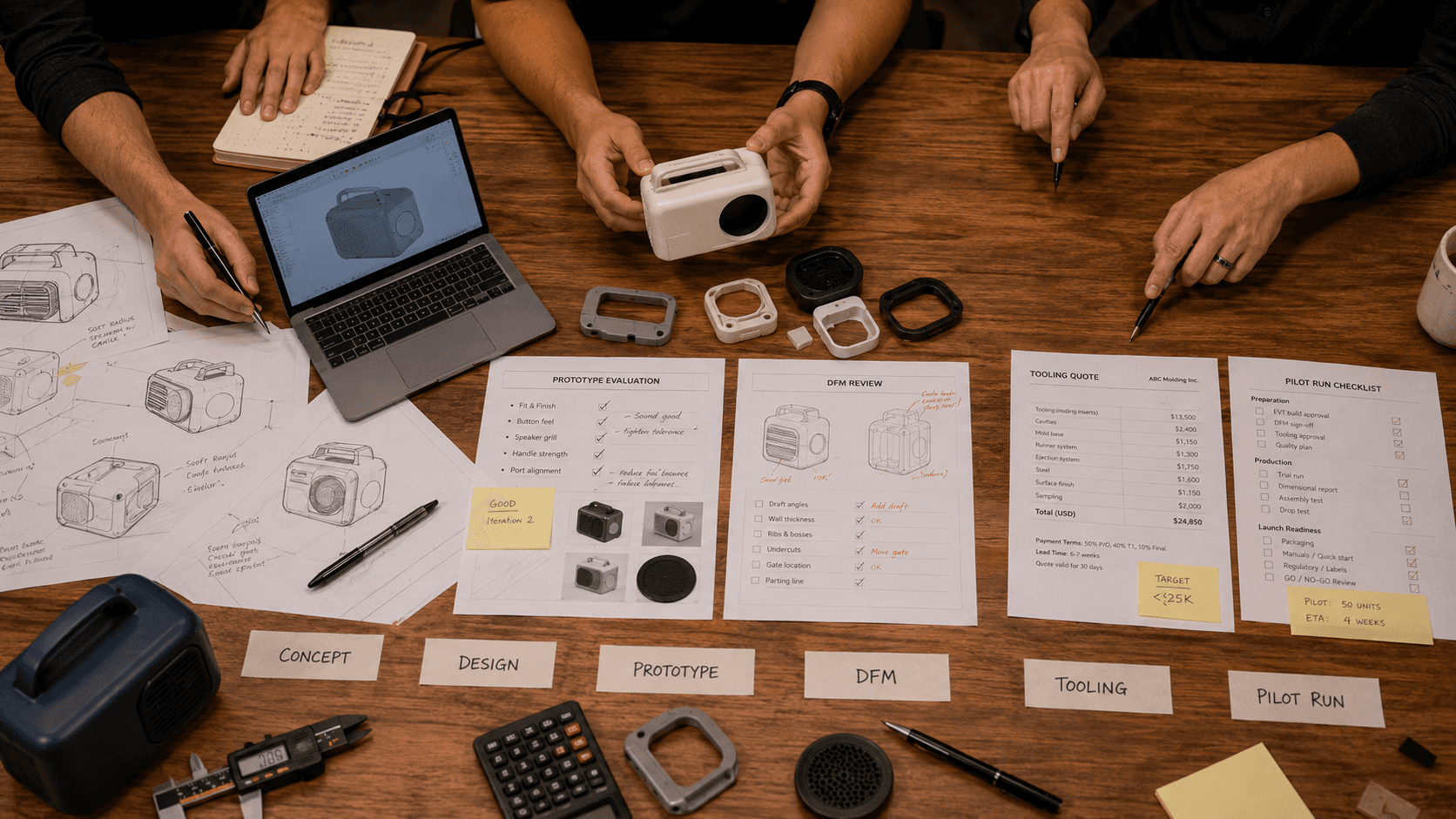
The cleanest way to think about hardware product development cost is to stop treating it as one number and start treating it as a sequence. Each phase carries its own budget logic, its own failure mode, and its own leverage point for saving money — or accidentally burning it.
Concept Audit and Feasibility
Before anyone opens CAD software or touches a breadboard, there's a phase that's easy to skip and expensive to have skipped. A product feasibility study typically runs between $2,000 and $8,000 depending on scope, and it answers the questions that will otherwise bite you in month seven: Is the physics actually workable? Are the target components available? Does the regulatory path exist?
Founders who bypass this phase don't save $5,000. They burn $5,000 worth of engineering hours later uncovering problems that were findable on day one.
Industrial Design and Engineering
Industrial design — the work that shapes how a product looks, feels, and how a human interacts with it — usually lands between $8,000 and $30,000 for a focused consumer product. Mechanical engineering on top of that adds another $10,000 to $40,000. Electronics and firmware design swing most wildly: a simple BLE sensor is a different world from something with a display, haptics, wireless charging, and a companion app.
Here's something that catches a lot of first-time founders off guard: the engineering phase rarely falls apart because of talent. It collapses because of communication drag — a thousand small misalignments between what the founder pictured, what the industrial designer drew, and what the ME understood. Roughly 40 percent of the rework budget in early-stage hardware projects traces back to this gap, not technical error.
Prototype Development Cost
Prototype development cost deserves its own heading because it's the phase most misrepresented in founder folklore. "I got a prototype made for $3,000" is technically true for a rough looks-like model — full stop. It is not true for a works-like-looks-like prototype that can actually validate your design.
Functional prototypes for a moderately complex product typically run $15,000 to $50,000, and that often covers two or three iterations, because the first one will teach you something the second one needs to fix. The cost isn't just the physical parts; it's the engineer hours interpreting what broke and why. Plan for at least two prototype rounds. Budget for three.
DFM and Tooling
Design for manufacturing — DFM — is the phase where an engineer goes through your design specifically hunting for things that will make manufacturing slow, expensive, or inconsistent at scale. Sounds unglamorous. It is also, per dollar spent, probably the highest-leverage activity in the entire development cycle.
DFM cost itself is relatively modest — often $3,000 to $12,000 depending on complexity. But skipping it isn't free; the bill shows up in your tooling. Tooling for injection-moulded plastic parts typically runs $5,000 to $30,000 per tool, and if your design wasn't properly DFM'd, you'll be reworking those tools — or in the worst case, scrapping them entirely. That $8,000 you saved on DFM can easily balloon into a $25,000 tooling revision.

The Variables That Push Product Development Cost Sideways
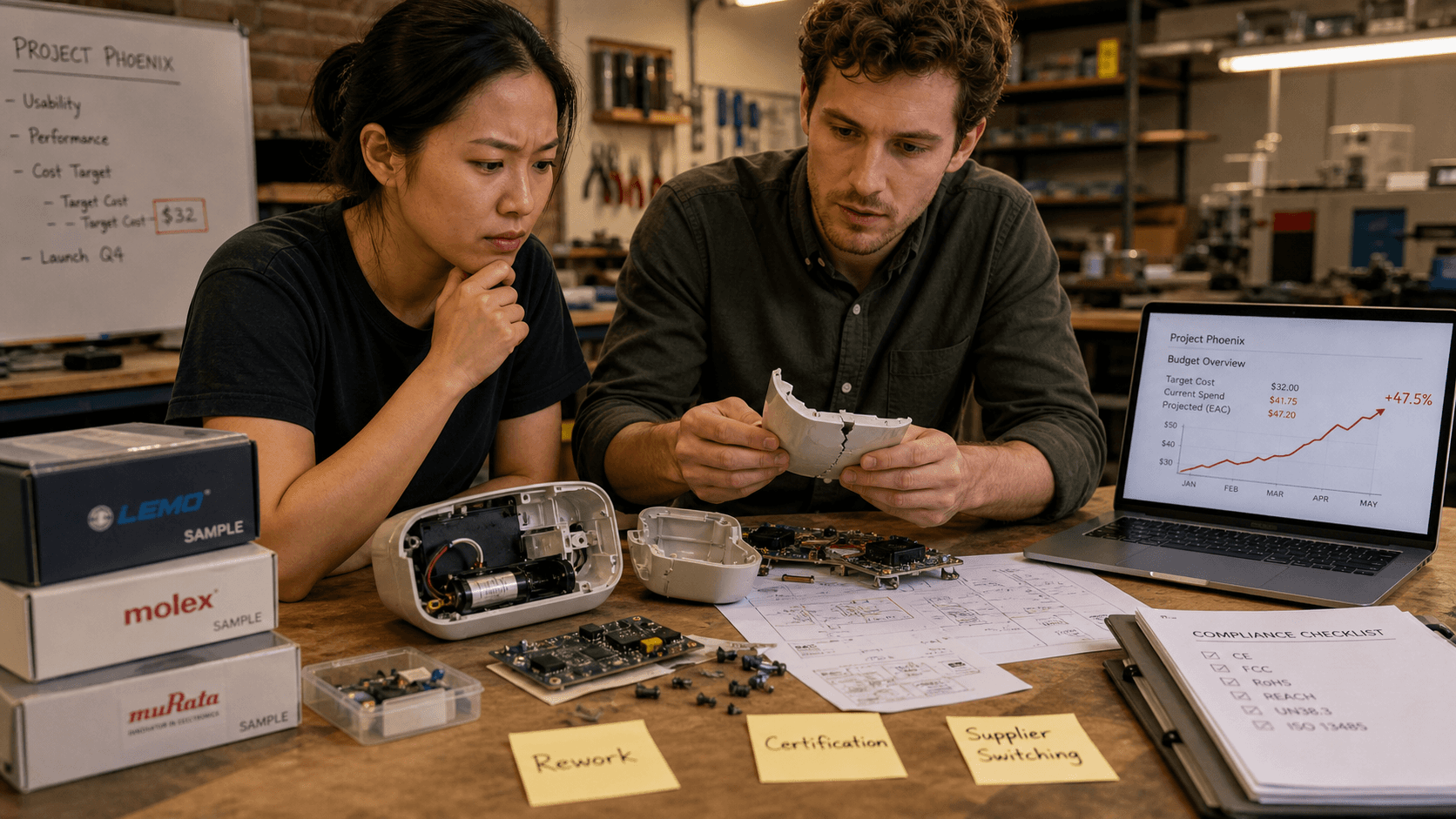
Budget overruns in hardware rarely come from one dramatic mistake. They accumulate. Slowly. Usually on a Tuesday afternoon when someone realises a component specified six weeks ago is now on a 26-week lead time and the whole BOM needs rethinking.
Complexity is the obvious culprit. A product with more parts, tighter tolerances, or novel materials costs more to design and prototype — but at least complexity is visible upfront. Founders can see it coming. The variables that blindside people are subtler.
Certification scope is one. If your product needs FCC, CE, UL, or FDA clearance — and many consumer electronics need more than one — certification testing and the engineering to prop it up can add $15,000 to $80,000 to a project. The number itself isn't the surprise. The surprise is that certification failures require design changes, and design changes after tooling is cut are disproportionately expensive.
Supplier switching mid-project is another. Swapping your CM or a key component vendor partway through development is essentially paying twice for alignment — twice for NRE, twice for sample review, twice for the learning curve. It happens more than founders expect, often because early vendor selection was rushed.
And then there's rework. Every prototype cycle that goes back for corrections consumes engineering time, physical manufacturing time, and — the part people forget — decision-making time. A single rework loop that feels like "just a few tweaks" can eat two to four weeks and $5,000 to $15,000 in a project that had neither to spare.
Budget Bands by Founder Type
Not everyone reading this is building the same thing, and realistic budget ranges shift considerably depending on where you're starting from.
Inventors and Solo Founders
If you're an inventor with a single product concept and no team, your first meaningful milestone is a validated functional prototype — not a launch-ready product. Budget $20,000 to $60,000 to get there responsibly, with real engineering behind it rather than a freelance patchwork. Resources like Foundr offer useful founder storytelling on early-stage product journeys if you want a sense of how others have navigated this phase (which can feel pretty isolating, honestly). Be honest with yourself: if your budget is under $20,000, you're almost certainly looking at a proof-of-concept, not a launch-ready prototype.
Early-Stage Startups
Startups with a seed round or angel backing are often targeting a pilot production run of 500 to 2,000 units. That full journey — from refined concept through pilot — realistically costs $80,000 to $200,000, factoring in design iterations, tooling, certification groundwork, and the inevitable surprises. The range is wide because product complexity is wide.
Growing Brands Adding SKUs
For a brand that has already launched one product and is developing line extensions, the cost structure shifts — lower design-from-scratch expense, often reused tooling, faster prototyping. There's a false economy trap here, though. Assuming a second product costs half as much as the first because the brand "already has the infrastructure" tends to underestimate new certification requirements and component qualification.
Shortcuts That Are Fine Versus Shortcuts That Cost You Later
Some cost-cutting in hardware development is intelligent. Some is deferred expense — money you'll pay later, with interest.
Acceptable shortcuts include using off-the-shelf enclosures for early prototypes, choosing a BLE module over a custom RF circuit at first, and running DFM in parallel with final engineering rather than strictly sequentially when schedule pressure is real. These are smart tradeoffs that experienced engineers make all the time.
Expensive shortcuts — the ones that look like savings and aren't — include skipping feasibility work, picking a manufacturer based purely on quoted price rather than capability fit, compressing prototype cycles to save time, and deferring regulatory research until you're ready to ship. That last one is particularly costly. Discovering at launch that your product needs a pre-market submission to a regulatory body is not a two-week problem.
Worth naming one more: DIY project management when the project is actually complex enough to require coordination across industrial design, ME, EE, firmware, and supply chain simultaneously. Works occasionally. Fails expensively when it doesn't — and the failure mode is usually slow, accumulating, and invisible until you're already eleven months deep and well behind.
When an Integrated Partner Changes the Math
There's a point in hardware development where the coordination cost of managing separate vendors — one for ID, one for ME, one for EE, one for the CM — starts to outpace whatever savings the fragmented approach was generating. That point arrives earlier than most founders expect, usually around the DFM-to-tooling transition.
An integrated hardware development services partner doesn't just handle execution; it changes the communication architecture of the project. Decisions get made faster. Errors get caught at the boundary between disciplines rather than after the fact. Rework drops — not to zero, but meaningfully.
This isn't a pitch for any particular model. It's a structural observation: for products with moderate-to-high complexity, the all-in cost of an integrated engagement often lands lower than the apparent savings of a fragmented team, once you account for the rework, delays, and coordination drag that fragmentation introduces.
The right time to weigh that route is before you've already split the work across four vendors and are halfway through a prototype cycle that isn't going well —
Hardware product development cost is ultimately what you make it — through the quality of your early decisions, your tolerance for skipping validation steps, and how honestly you've scoped the complexity of what you're building. Get those things right, and the numbers become manageable. Get them wrong, and no budget is ever quite enough.