" height="21.943622918266314px" id="HqU1V_VXu" width="76.57577685890533px"/><path d="M 20.228 10.24 L 10.114 10.24 L 10.114 8.777 L 20.228 8.777 Z M 21.672 20.48 L 15.171 20.48 L 15.171 19.018 L 21.672 19.018 Z M 0 19.018 L 0 0 L 1.445 0 L 1.445 19.018 Z M 20.228 19.018 L 20.228 0 L 21.672 0 L 21.672 19.018 Z" fill="rgb(255, 255, 255)" height="20.480488152641314px" id="bfuCuMlPp" transform="translate(27.507 1.519)" width="21.672358558014366px"/><path d="M 42.622 19.018 L 42.622 0 L 44.067 0 L 44.067 19.018 Z M 54.903 8.777 L 54.903 0 L 56.348 0 L 56.348 8.777 Z M 75.131 8.777 L 75.131 0 L 76.575 0 L 76.575 8.777 Z M 70.796 19.018 L 70.796 10.241 L 72.241 10.241 L 72.241 19.018 Z M 59.238 19.018 L 59.238 10.241 L 60.683 10.241 L 60.683 19.018 Z M 1.445 0 L 1.445 20.481 L 0 20.481 L 0 0 Z M 11.559 20.481 L 1.445 20.481 L 1.445 19.018 L 11.559 19.018 Z M 21.672 10.24 L 10.114 10.24 L 10.114 8.777 L 21.672 8.777 Z" fill="rgb(255, 255, 255)" height="20.480826258659363px" id="TduQKyNcg" transform="translate(0 1.519)" width="76.57543472988937px"/><path d="M 10.114 9.07 L 10.114 0 L 11.559 0 L 11.559 9.07 Z M 0 19.311 L 0 10.533 L 1.445 10.533 L 1.445 19.311 Z M 10.114 20.774 L 10.114 13.459 L 11.559 13.459 L 11.559 20.774 Z M 4.334 20.774 L 4.334 13.458 L 5.779 13.458 L 5.779 20.774 Z M 5.78 13.459 L 10.114 13.459 L 10.114 14.922 L 5.78 14.922 Z M 5.78 19.311 L 10.114 19.311 L 10.114 20.774 L 5.78 20.774 Z M 79.032 2.487 L 92.035 2.487 L 92.035 3.95 L 79.032 3.95 Z M 96.37 2.487 L 109.373 2.487 L 109.373 3.95 L 96.37 3.95 Z M 113.708 2.487 L 126.711 2.487 L 126.711 3.95 L 113.708 3.95 Z M 135.38 2.487 L 148.384 2.487 L 148.384 3.95 L 135.38 3.95 Z M 86.256 8.339 L 92.035 8.339 L 92.035 9.802 L 86.256 9.802 Z M 97.815 8.339 L 110.818 8.339 L 110.818 9.802 L 97.815 9.802 Z M 80.477 15.653 L 93.48 15.653 L 93.48 17.116 L 80.477 17.116 Z M 97.815 15.653 L 110.818 15.653 L 110.818 17.116 L 97.815 17.116 Z M 79.032 15.653 L 79.032 3.95 L 80.477 3.95 L 80.477 15.653 Z M 96.37 15.653 L 96.37 3.95 L 97.815 3.95 L 97.815 15.653 Z M 113.708 17.116 L 113.708 3.95 L 115.153 3.95 L 115.153 17.116 Z M 135.38 15.653 L 135.38 3.95 L 136.825 3.95 L 136.825 15.653 Z M 152.718 15.653 L 152.718 2.487 L 154.163 2.487 L 154.163 15.653 Z M 170.056 15.653 L 170.056 2.487 L 171.5 2.487 L 171.5 15.653 Z M 187.394 15.653 L 187.394 2.487 L 188.839 2.487 L 188.839 15.653 Z" fill="rgb(255, 255, 255)" height="20.773521135658505px" id="jAG3tW2Le" transform="translate(10.169 1.182)" width="188.83858780606124px"/><path d="M 62.127 5.852 L 75.131 5.852 L 75.131 7.315 L 62.127 7.315 Z M 79.465 5.852 L 92.469 5.852 L 92.469 7.315 L 79.465 7.315 Z M 96.803 5.852 L 108.362 5.852 L 108.362 7.315 L 96.803 7.315 Z M 79.465 0 L 91.024 0 L 91.024 1.463 L 79.465 1.463 Z M 92.469 1.463 L 92.469 5.852 L 91.024 5.852 L 91.024 1.463 Z M 109.807 7.315 L 109.807 14.629 L 108.362 14.629 L 108.362 7.315 Z M 62.127 13.166 L 75.131 13.166 L 75.131 14.629 L 62.127 14.629 Z M 79.465 13.166 L 92.469 13.166 L 92.469 14.629 L 79.465 14.629 Z M 34.675 14.629 L 34.675 1.463 L 36.12 1.463 L 36.12 14.629 Z M 56.348 13.166 L 56.348 1.463 L 57.793 1.463 L 57.793 13.166 Z M 44.789 13.166 L 57.793 13.166 L 57.793 14.629 L 44.789 14.629 Z M 39.01 14.629 L 39.01 2.926 L 40.455 2.926 L 40.455 14.629 Z M 39.01 1.463 L 39.01 0 L 40.455 0 L 40.455 1.463 Z M 0 13.166 L 0 5.852 L 1.445 5.852 L 1.445 13.166 Z M 17.338 5.852 L 17.338 1.463 L 18.782 1.463 L 18.782 5.852 Z M 106.917 0 L 108.361 0 L 108.361 1.463 L 106.917 1.463 Z M 105.472 1.463 L 106.917 1.463 L 106.917 2.926 L 105.472 2.926 Z M 104.027 2.926 L 105.472 2.926 L 105.472 4.389 L 104.027 4.389 Z M 102.583 4.389 L 104.027 4.389 L 104.027 5.852 L 102.583 5.852 Z" fill="rgb(255, 255, 255)" height="14.62930651858536px" id="yTdOA_r0t" transform="translate(102.194 3.714)" width="109.80650620205734px"/></g></svg>)
A practical breakdown of why hardware startups lose so much time during the DFM stage, from late design changes and supplier feedback loops to tooling risk, tolerance issues, and missing readiness checks.
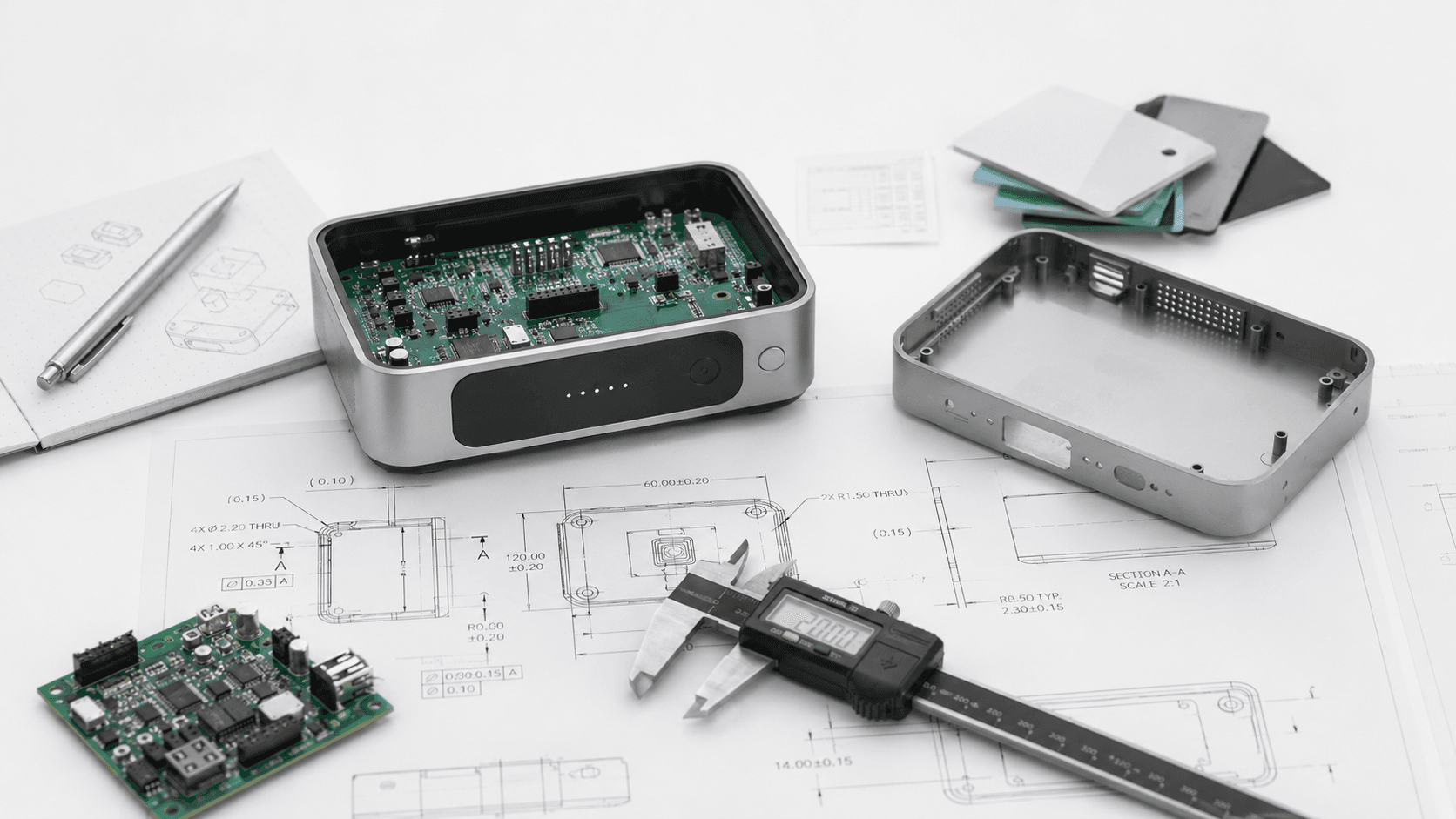
Most hardware founders think delays hit at mass production. They're wrong. The damage is done earlier — at the Design for Manufacturing (DFM) stage — when a working prototype meets the hard constraints of repeatable production. Tolerances that passed in a prototype lab fail at scale. Materials get substituted without geometry updates. Tooling locks in before QC standards are written. Each supplier feedback loop costs 2–6 weeks and pulls your BOM, lead time, and cost structure in a new direction. The fix isn't moving faster. It's entering DFM with a frozen design, a confirmed BOM, and defined test standards. You'll never recover time lost to rework you could have prevented before the first tool cut.
The Prototype Passed. The Factory Disagreed.
For every hardware founder who watched a beautiful prototype become a 4-month delay — this is what actually happened.
Your prototype worked. The enclosure snapped together in your workshop. The PCB passed bench testing. You showed it to investors, photographed it for a crowdfunding page, and told your team you were 8 weeks from production.
Then DFM started.
Your contract manufacturer ran the model through their production engineers. Within 72 hours, you had 23 change requests sitting in your inbox. Wall thicknesses too thin for injection molding. A tolerance stack on three mating parts that made consistent assembly statistically impossible. A component in your BOM carrying a 14-week lead time nobody had flagged.
Each change request triggered a redesign. Each redesign triggered a new round of supplier feedback. Each feedback loop cost 2–4 weeks.
That's not bad luck. That's the default outcome when a team ships a prototype-optimized design into a manufacturing-optimized process.
DFM is the pressure test between a design that works once and a design that works 10,000 times in a row without a human babysitting every unit. Most designs fail that test. The question is when you find out — before tooling, or after you've cut $80,000 in molds.

Six Places DFM Destroys Your Timeline
The delays don't come from one catastrophic mistake. They come from six overlapping problems surfacing simultaneously.
1. Tolerances that were fine in CAD are impossible in production.
A 0.05mm positional tolerance looks precise on a drawing. On a production line running 500 units a day, it means 30–40% of parts fail first-pass assembly. Your manufacturer has two options: tighten their process (expensive, slow) or ask you to loosen the spec (redesign, another loop). One startup running a consumer IoT enclosure discovered their lid-to-body fit needed a tolerance their molder physically couldn't hold on ABS at that wall thickness. Six weeks lost. One geometry change.
2. Material substitutions cascade into geometry problems.
Suppliers run out of materials. Lead times shift. A grade of PC-ABS you specified goes on allocation. The substitute has a 12% higher shrink rate. Your snap-fit geometry — designed around the original material — now produces units that either crack on assembly or pop open in shipping. Nobody catches this until 400 parts are scrapped.
3. Assembly methods nobody documented.
When your design calls for a specific torque sequence, a particular bonding fixture, or a hand-assembly step that varies by operator, and none of that is written down, your manufacturer will guess. Their guess will be optimized for their throughput, not your product spec.
4. Tooling constraints that lock you into bad decisions.
Injection molds commit you. Once steel is cut, every change carries a dollar cost and a time cost. A draft angle overlooked in CAD review becomes a $12,000 tool modification. Teams that rush to tooling because they're behind schedule pay for that urgency twice — once in the tool modification, again in the weeks lost while the mold shop reworks the steel.
5. BOM changes mid-DFM.
A component gets EOL'd. A supplier offers a cheaper alternative. Engineering swaps a resistor and forgets to update the assembly drawing. Multiply these micro-changes across a 200-line BOM and you get a document set that no longer matches the physical product. Your CM is building to the old spec. Your QC team is checking against a third version. Nobody agrees on what "correct" looks like.
6. No defined test standards.
This one ends careers. When QC criteria aren't written before DFM starts, the factory sets their own. Their threshold for cosmetic defects might be more lenient than yours. Their functional test might skip a load condition you consider critical. You find out during first article inspection — or worse, after customer returns start arriving.
These six problems don't hit sequentially. They hit in parallel, tangled together, each pulling on the others. That's why design for manufacturing delays compound so fast in small-batch manufacturing.
The Supplier Feedback Loop Is a Tax on Unpreparedness
Think of DFM feedback loops like compound interest — except it's working against you.
Every change request your manufacturer sends back starts a clock. Your engineering team reviews it, revises the design, and sends updated files. The manufacturer reviews the update. If it introduces a new problem — and it often does — the loop restarts.
One loop: 2–4 weeks. Three loops: 6–12 weeks. Five loops, which is not unusual for a first-time hardware product: 10–20 weeks of delay before a single production unit ships (and by then, your launch window may have moved on without you).
The physics analogy holds here. Newton's first law: an object in motion stays in motion. A DFM review that starts with unresolved design questions stays in revision. The only force that stops it is preparation applied before the review begins.
Each loop also costs more than time. Tooling quotes go stale. Component pricing shifts. Your contract manufacturer's production window fills with other clients. You negotiate a new slot — at a worse price, with a longer lead time.
Here's the thing: the teams that move fastest through DFM are not the ones with the most talented engineers. They're the ones who finished their readiness work before the first supplier conversation. This is why understanding your EVT DVT PVT phases before entering manufacturing isn't optional — it's the difference between a 6-week DFM review and a 6-month one.


The Pre-DFM Readiness Checklist
Enter that first supplier conversation with all five of these in place, and you'll never negotiate a DFM timeline from a position of weakness again.
Freeze critical dimensions before DFM begins. Identify the 10–15 dimensions that determine fit, function, and assembly. Lock them. Any change to a frozen dimension requires a formal ECO with sign-off. No casual updates in Slack.
Confirm every line of your BOM — availability, lead time, substitutes. Call your top 5 component distributors before DFM starts. Get current lead times in writing. Identify which components have qualified substitutes and which are single-source risks.
Define your QC standards in writing. Cosmetic defect criteria with photographs. Functional test parameters with pass/fail thresholds. Packaging drop test requirements. Leave it unwritten and your manufacturer will decide for you.
Prepare your supplier questions in advance. Don't wait for feedback — ask first. What are their standard tolerances for this process? What surface finishes do they recommend? What assembly constraints do they flag most often with this geometry?
Run a DFM pre-check with your own engineering team. Before sending files to the CM, have one engineer who didn't design the part review it against a manufacturing checklist. Wall thickness, draft angles, undercuts, tolerance stack — check it internally first. Bring trial production quality control thinking in as early as the design review stage.
This is the bridge between prototype validation and tooling commitment. The hardware teams that treat this bridge as optional are the ones explaining delays to their investors six months later.
What You Do Next
DFM delays are not a manufacturing problem. They are a preparation problem.
The 70% statistic isn't a condemnation of contract manufacturers or a sign that hardware is uniquely broken. It measures how many teams arrive at DFM without completing the work that belongs to the stage before it.
Your next step is one of two things.
If you're pre-DFM: run the readiness checklist above before your first supplier call. Freeze your critical dimensions this week. Get your BOM confirmed. Write your QC criteria before anyone asks you for them.
Already in DFM and watching the loops stack up? Stop negotiating timelines and start triaging. Identify which change requests are blocking tooling and solve those first. Everything else is secondary until the tooling questions are closed.
Delays don't fix themselves. Preparation prevents them.