" height="21.943622918266314px" id="HqU1V_VXu" width="76.57577685890533px"/><path d="M 20.228 10.24 L 10.114 10.24 L 10.114 8.777 L 20.228 8.777 Z M 21.672 20.48 L 15.171 20.48 L 15.171 19.018 L 21.672 19.018 Z M 0 19.018 L 0 0 L 1.445 0 L 1.445 19.018 Z M 20.228 19.018 L 20.228 0 L 21.672 0 L 21.672 19.018 Z" fill="rgb(255, 255, 255)" height="20.480488152641314px" id="bfuCuMlPp" transform="translate(27.507 1.519)" width="21.672358558014366px"/><path d="M 42.622 19.018 L 42.622 0 L 44.067 0 L 44.067 19.018 Z M 54.903 8.777 L 54.903 0 L 56.348 0 L 56.348 8.777 Z M 75.131 8.777 L 75.131 0 L 76.575 0 L 76.575 8.777 Z M 70.796 19.018 L 70.796 10.241 L 72.241 10.241 L 72.241 19.018 Z M 59.238 19.018 L 59.238 10.241 L 60.683 10.241 L 60.683 19.018 Z M 1.445 0 L 1.445 20.481 L 0 20.481 L 0 0 Z M 11.559 20.481 L 1.445 20.481 L 1.445 19.018 L 11.559 19.018 Z M 21.672 10.24 L 10.114 10.24 L 10.114 8.777 L 21.672 8.777 Z" fill="rgb(255, 255, 255)" height="20.480826258659363px" id="TduQKyNcg" transform="translate(0 1.519)" width="76.57543472988937px"/><path d="M 10.114 9.07 L 10.114 0 L 11.559 0 L 11.559 9.07 Z M 0 19.311 L 0 10.533 L 1.445 10.533 L 1.445 19.311 Z M 10.114 20.774 L 10.114 13.459 L 11.559 13.459 L 11.559 20.774 Z M 4.334 20.774 L 4.334 13.458 L 5.779 13.458 L 5.779 20.774 Z M 5.78 13.459 L 10.114 13.459 L 10.114 14.922 L 5.78 14.922 Z M 5.78 19.311 L 10.114 19.311 L 10.114 20.774 L 5.78 20.774 Z M 79.032 2.487 L 92.035 2.487 L 92.035 3.95 L 79.032 3.95 Z M 96.37 2.487 L 109.373 2.487 L 109.373 3.95 L 96.37 3.95 Z M 113.708 2.487 L 126.711 2.487 L 126.711 3.95 L 113.708 3.95 Z M 135.38 2.487 L 148.384 2.487 L 148.384 3.95 L 135.38 3.95 Z M 86.256 8.339 L 92.035 8.339 L 92.035 9.802 L 86.256 9.802 Z M 97.815 8.339 L 110.818 8.339 L 110.818 9.802 L 97.815 9.802 Z M 80.477 15.653 L 93.48 15.653 L 93.48 17.116 L 80.477 17.116 Z M 97.815 15.653 L 110.818 15.653 L 110.818 17.116 L 97.815 17.116 Z M 79.032 15.653 L 79.032 3.95 L 80.477 3.95 L 80.477 15.653 Z M 96.37 15.653 L 96.37 3.95 L 97.815 3.95 L 97.815 15.653 Z M 113.708 17.116 L 113.708 3.95 L 115.153 3.95 L 115.153 17.116 Z M 135.38 15.653 L 135.38 3.95 L 136.825 3.95 L 136.825 15.653 Z M 152.718 15.653 L 152.718 2.487 L 154.163 2.487 L 154.163 15.653 Z M 170.056 15.653 L 170.056 2.487 L 171.5 2.487 L 171.5 15.653 Z M 187.394 15.653 L 187.394 2.487 L 188.839 2.487 L 188.839 15.653 Z" fill="rgb(255, 255, 255)" height="20.773521135658505px" id="jAG3tW2Le" transform="translate(10.169 1.182)" width="188.83858780606124px"/><path d="M 62.127 5.852 L 75.131 5.852 L 75.131 7.315 L 62.127 7.315 Z M 79.465 5.852 L 92.469 5.852 L 92.469 7.315 L 79.465 7.315 Z M 96.803 5.852 L 108.362 5.852 L 108.362 7.315 L 96.803 7.315 Z M 79.465 0 L 91.024 0 L 91.024 1.463 L 79.465 1.463 Z M 92.469 1.463 L 92.469 5.852 L 91.024 5.852 L 91.024 1.463 Z M 109.807 7.315 L 109.807 14.629 L 108.362 14.629 L 108.362 7.315 Z M 62.127 13.166 L 75.131 13.166 L 75.131 14.629 L 62.127 14.629 Z M 79.465 13.166 L 92.469 13.166 L 92.469 14.629 L 79.465 14.629 Z M 34.675 14.629 L 34.675 1.463 L 36.12 1.463 L 36.12 14.629 Z M 56.348 13.166 L 56.348 1.463 L 57.793 1.463 L 57.793 13.166 Z M 44.789 13.166 L 57.793 13.166 L 57.793 14.629 L 44.789 14.629 Z M 39.01 14.629 L 39.01 2.926 L 40.455 2.926 L 40.455 14.629 Z M 39.01 1.463 L 39.01 0 L 40.455 0 L 40.455 1.463 Z M 0 13.166 L 0 5.852 L 1.445 5.852 L 1.445 13.166 Z M 17.338 5.852 L 17.338 1.463 L 18.782 1.463 L 18.782 5.852 Z M 106.917 0 L 108.361 0 L 108.361 1.463 L 106.917 1.463 Z M 105.472 1.463 L 106.917 1.463 L 106.917 2.926 L 105.472 2.926 Z M 104.027 2.926 L 105.472 2.926 L 105.472 4.389 L 104.027 4.389 Z M 102.583 4.389 L 104.027 4.389 L 104.027 5.852 L 102.583 5.852 Z" fill="rgb(255, 255, 255)" height="14.62930651858536px" id="yTdOA_r0t" transform="translate(102.194 3.714)" width="109.80650620205734px"/></g></svg>)
Learn how to get a hardware prototype made, from appearance models and functional builds to testing, cost expectations, supplier choices, and what should happen before tooling.
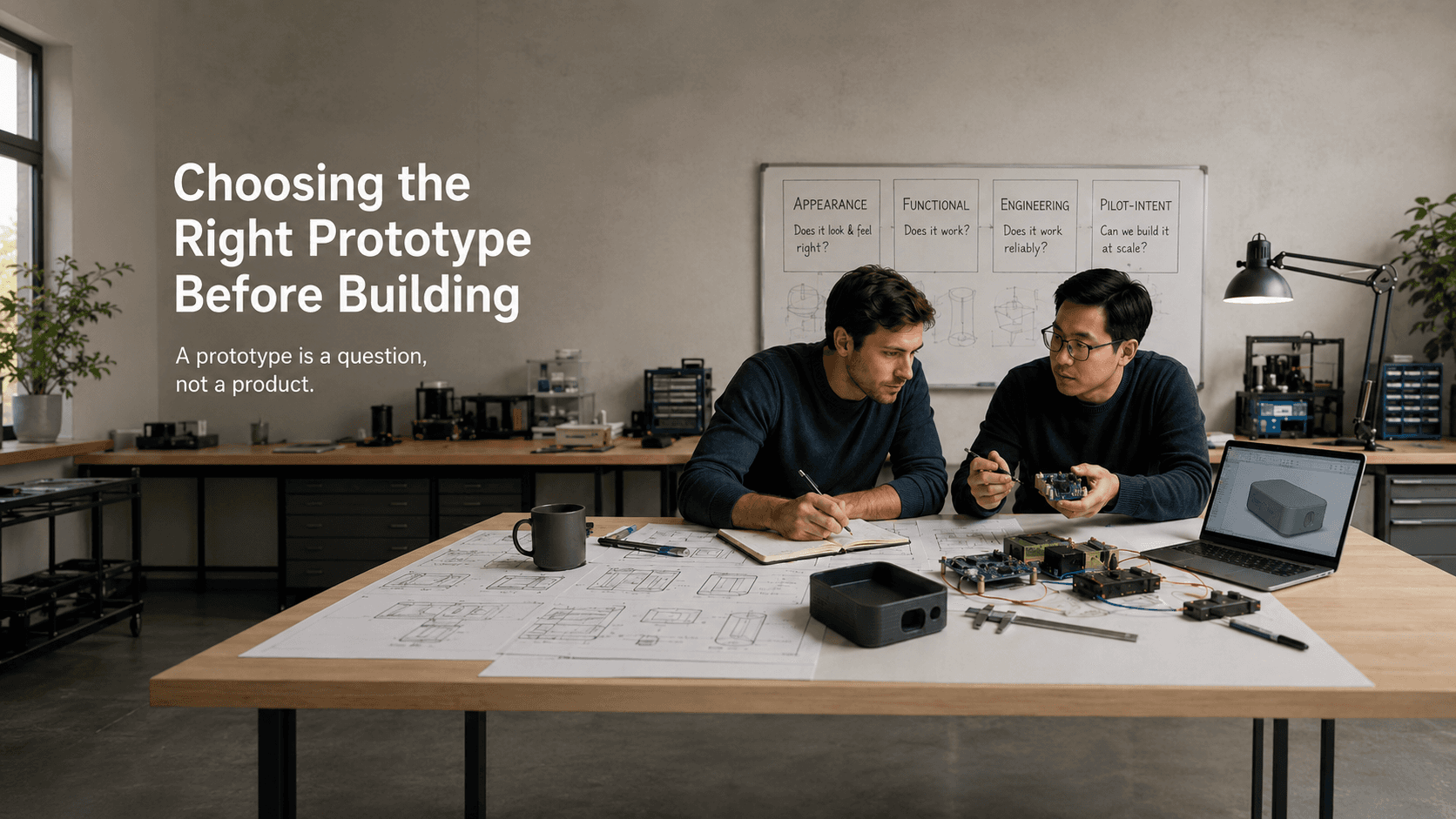
Most hardware projects don't fail because the product was a bad idea. They fail because the team built the wrong kind of prototype at the wrong time. There are four distinct prototype types — appearance, functional, engineering, and pilot-intent — and confusing them costs real money. Before you place any prototype order, you need clarity on what you're testing, not just what you're building. A prototype is a question, not a product. The clearer the question, the cheaper and faster the answer. For most first-time hardware founders, the biggest leverage isn't finding a better supplier. It's deciding what you actually need to prove before spending anything.
The Prototype You're Imagining Isn't the Only One
In 1968, Boeing competed for the U.S. Air Force's massive transport aircraft contract against Lockheed and Douglas. Lockheed won with a full-scale mockup — a physical model of the C-5 Galaxy built to impress decision-makers. Boeing, for all its engineering capability, partly lost the room. The mockup wasn't the airplane. But it changed who got the contract.
That story has a lesson most hardware founders miss: different prototypes serve completely different audiences and answer completely different questions. Confusing them is one of the most expensive mistakes in product development.
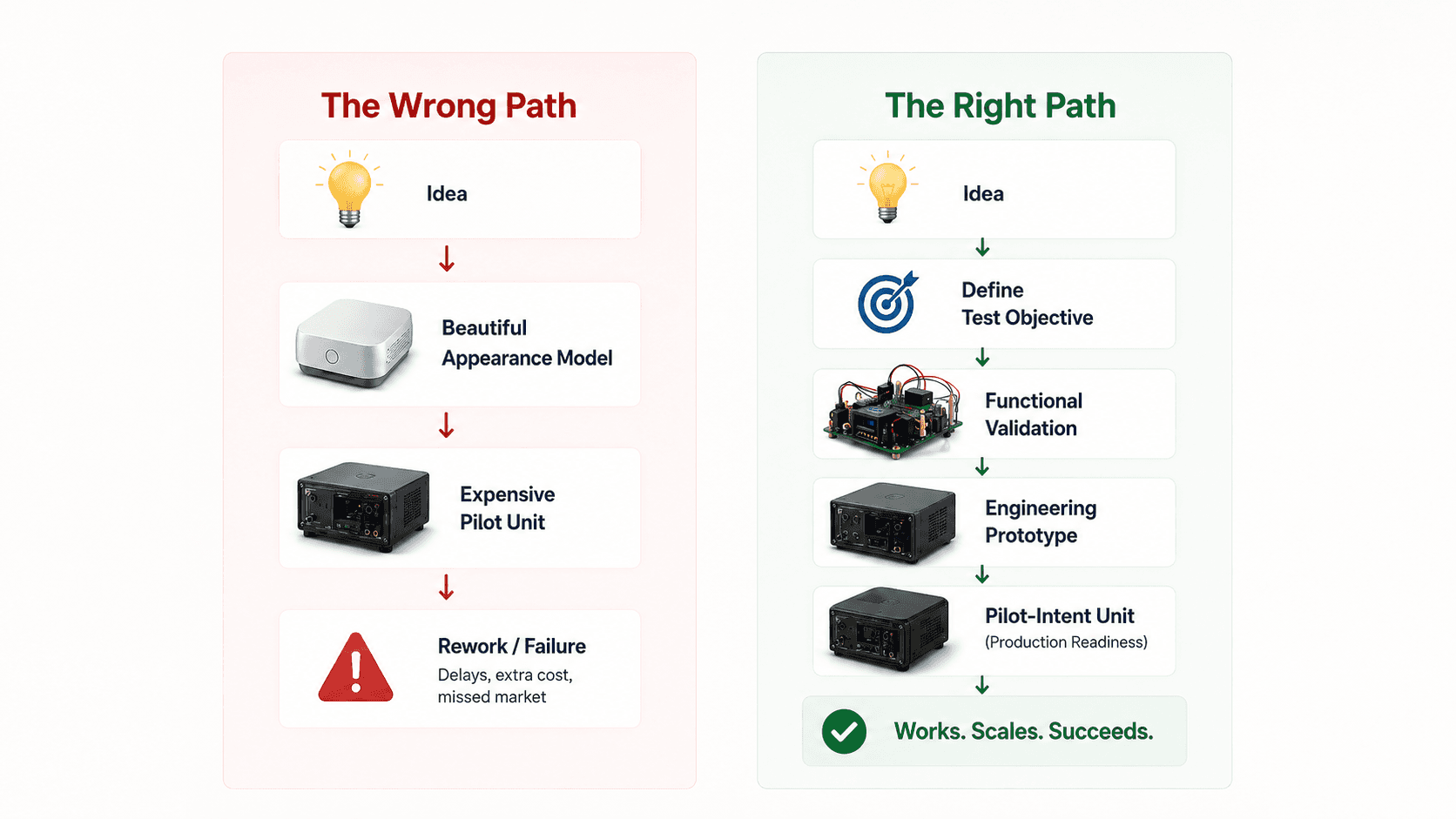
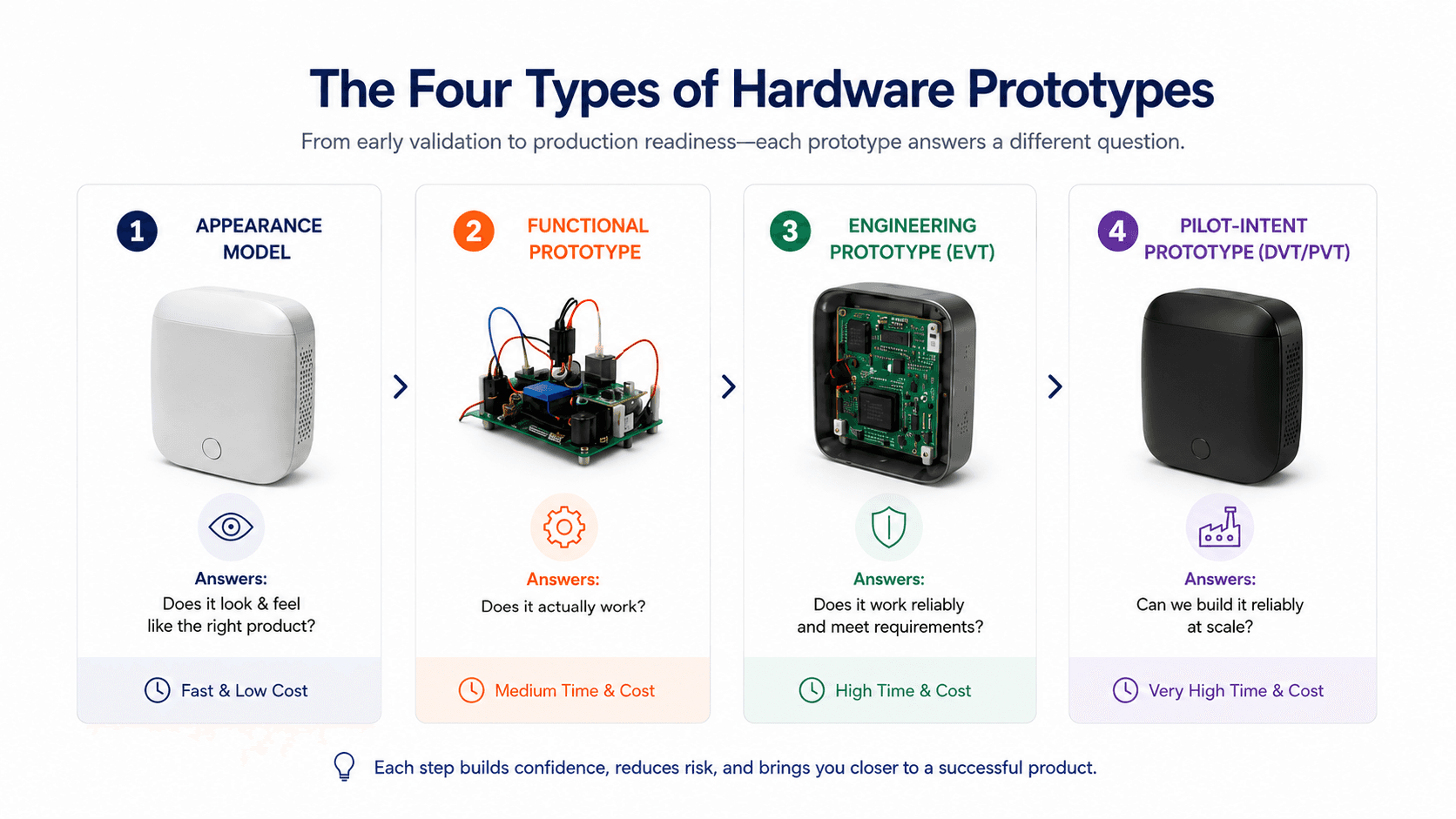
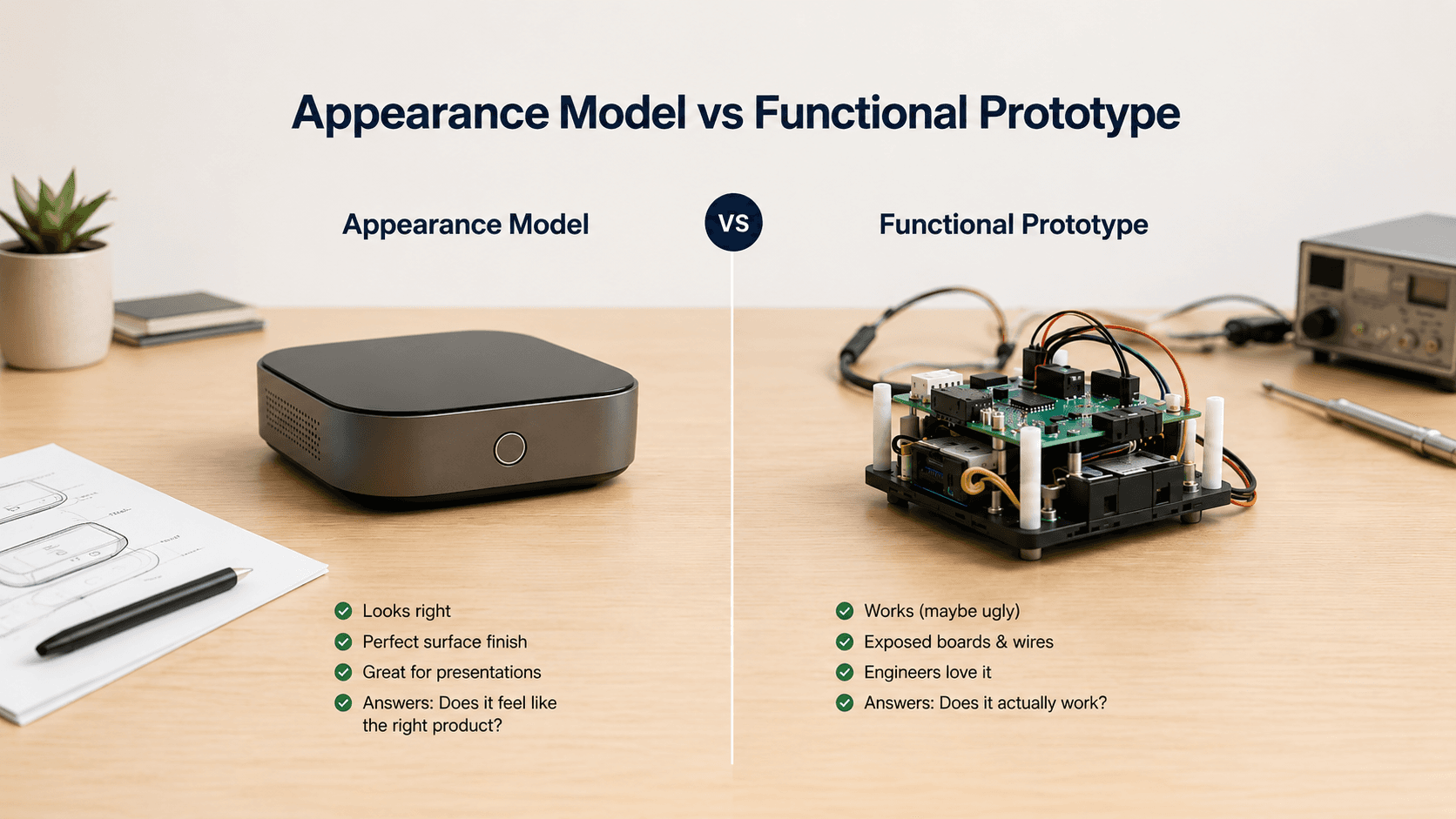
When most people think about getting a prototype made, they imagine something that looks like the finished product — something you can hold at a pitch meeting or photograph for a crowdfunding page. That's called an appearance model. It's CNC machined or 3D printed, painted, finished, and wrapped. It looks exactly right and does absolutely nothing. For most consumer products, you can get one from a product design studio in two to three weeks for somewhere between $2,000 and $6,000. It answers one question: does this feel like the right object?
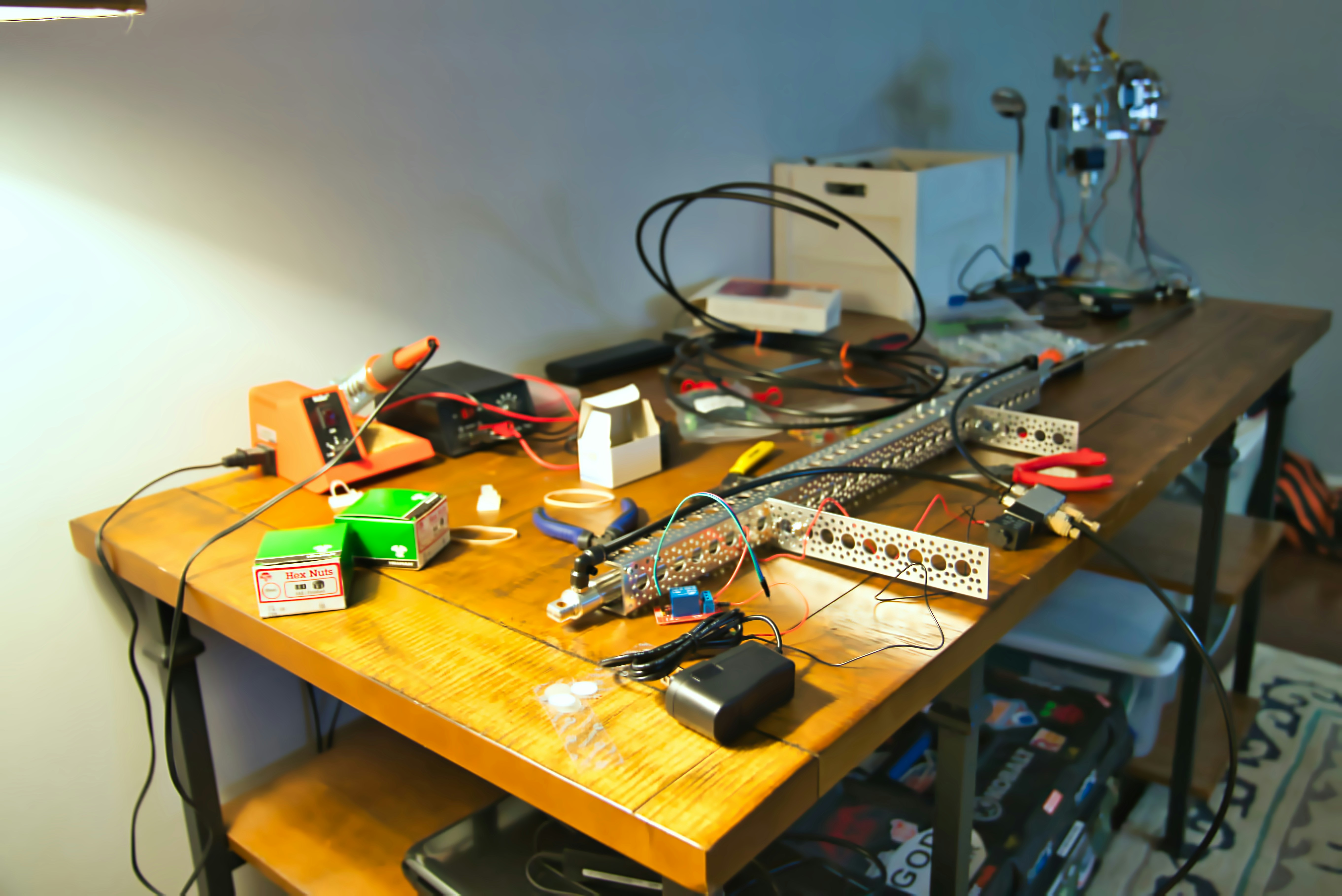
A functional prototype is the opposite. It's usually ugly. Development boards, hot glue, jumper wires, and exposed PCBs. But it runs. It answers a different, more important question: does this actually work? These are the prototypes engineers love and salespeople hate.
Then there's the engineering prototype — sometimes called an EVT (engineering validation test) unit. This one starts to look and work like the final product simultaneously. The enclosure is close to final geometry. The electronics are on a real PCB. The firmware handles real use cases. This is usually the most expensive and time-consuming stage. And finally, the pilot-intent prototype (DVT or PVT in manufacturing language) is essentially an early production unit. You're no longer asking whether it works. You're asking whether the factory can make it reliably.
Most project failures happen because teams skip from appearance model to pilot-intent prototype, skipping the hard validation work in between. The thing looks great. Nothing works. Everyone is surprised.
Understanding prototype development for hardware products — specifically what each stage is meant to prove — is the most important thing you can do before spending a dollar.
What Has to Be Ready Before You Place an Order
Thomas Edison reportedly said that his laboratory’s job was to find out what the world needs and then proceed to invent it. I think what he actually meant was this: you can’t build a useful prototype without a clear problem statement. The prototype is downstream of the thinking, not a substitute for it.
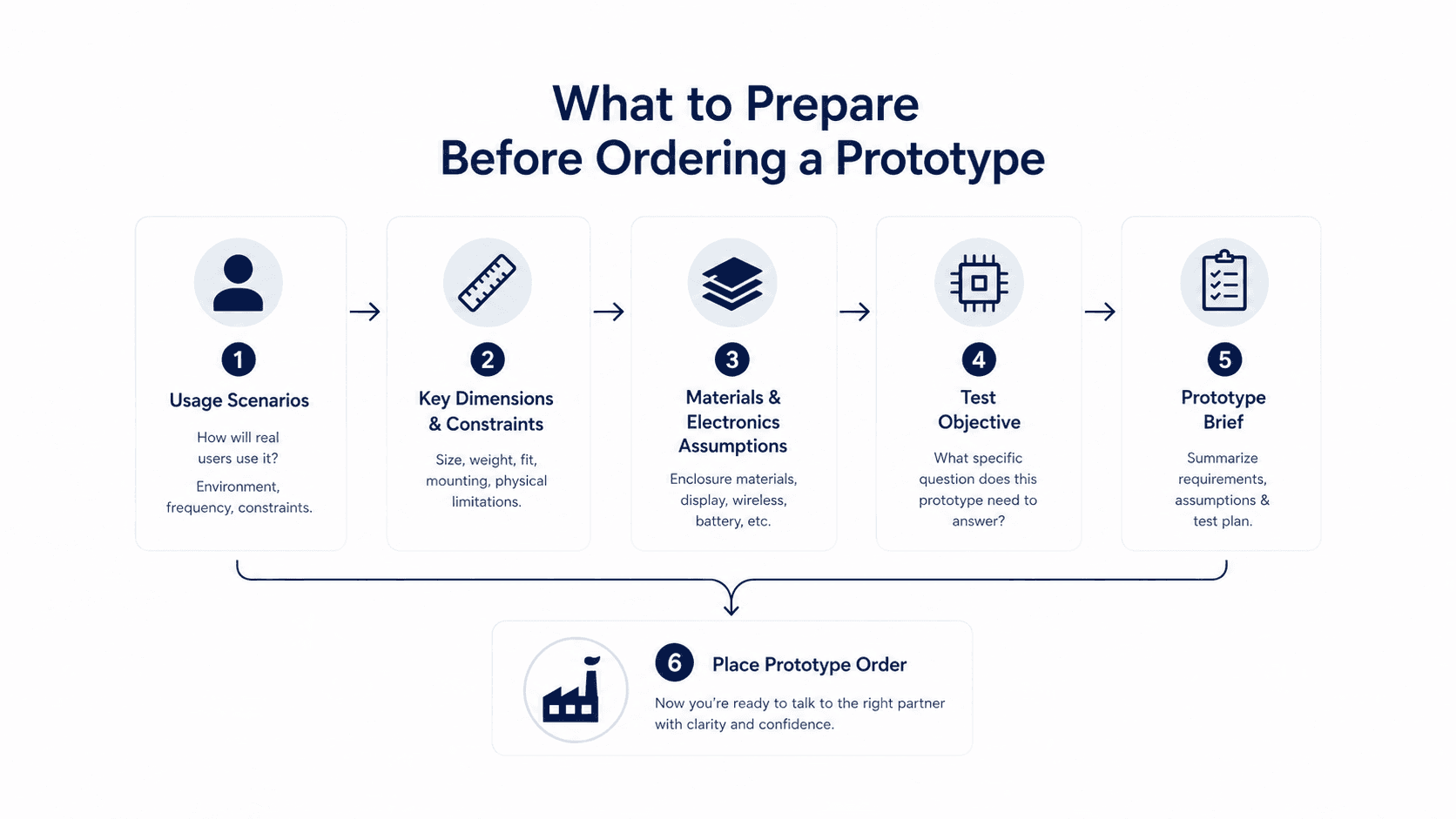
Before you contact any prototype development company, there are five things you need to have resolved — not perfectly, but well enough to communicate.
Usage scenarios. How will a real person use this? In what environment? With what frequency? A prototype for a medical device used in a clinical setting needs to survive sterilization cycles. A prototype for a kid’s toy needs to survive a four-year-old. These constraints should drive every material and design choice before you ever open a CAD file.
Key dimensions and constraints. You don’t need final engineering drawings. But you need to know whether this product fits in a jacket pocket or sits on a kitchen counter. Whether it mounts to a wall or rides on a person. Physical constraints eliminate huge swaths of design options early and cheaply.
Materials and electronics assumptions. Are you assuming injection-molded plastic enclosures? Aluminum? Silicone? Is there a display? Wireless connectivity? A battery? Each assumption has cascading effects on cost, lead time, and what kind of shop can help you.
Your test objective. This is the most important one, and most people skip it. What specific question does this prototype need to answer before you’ll consider it a success? If you can’t write the test plan before the prototype is built, you probably don’t know what you’re building yet.
Getting this clarity upfront usually cuts prototype time in half. The prototype development process is expensive when it’s also doing the job of figuring out what the product should be. Those are two different activities.
Why Cost and Time Vary So Wildly
A functional prototype for a simple IoT sensor might cost $800 and take two weeks. A functional prototype for a medical wearable might cost $80,000 and take six months. Both are called “functional prototypes.” The gap isn’t waste or inefficiency. It’s the complexity of the question being asked.
I think of it like building a bridge to cross a stream versus building one to cross the Mississippi. Both are bridges. The word tells you almost nothing about the scope.
Several factors drive prototype cost more than most people expect. Regulatory requirements (FDA, FCC, CE) change what must be documented, tested, and validated at each stage. Custom mechanical tooling — even soft tooling for silicone parts — adds thousands before a single unit is made. Specialty materials like medical-grade polymers or aerospace-rated adhesives carry lead times and price premiums. And engineering time, which is often underestimated, is frequently the largest cost component of all.
The IDEO design thinking methodology has long emphasized rapid, low-fidelity iteration precisely because high-fidelity prototypes cost so much per learning. Build the cheapest thing that answers the question. Then go up a level of fidelity. Most teams do the opposite.
Where to Get It Made: A Realistic Comparison
Local Shop or Freelancer
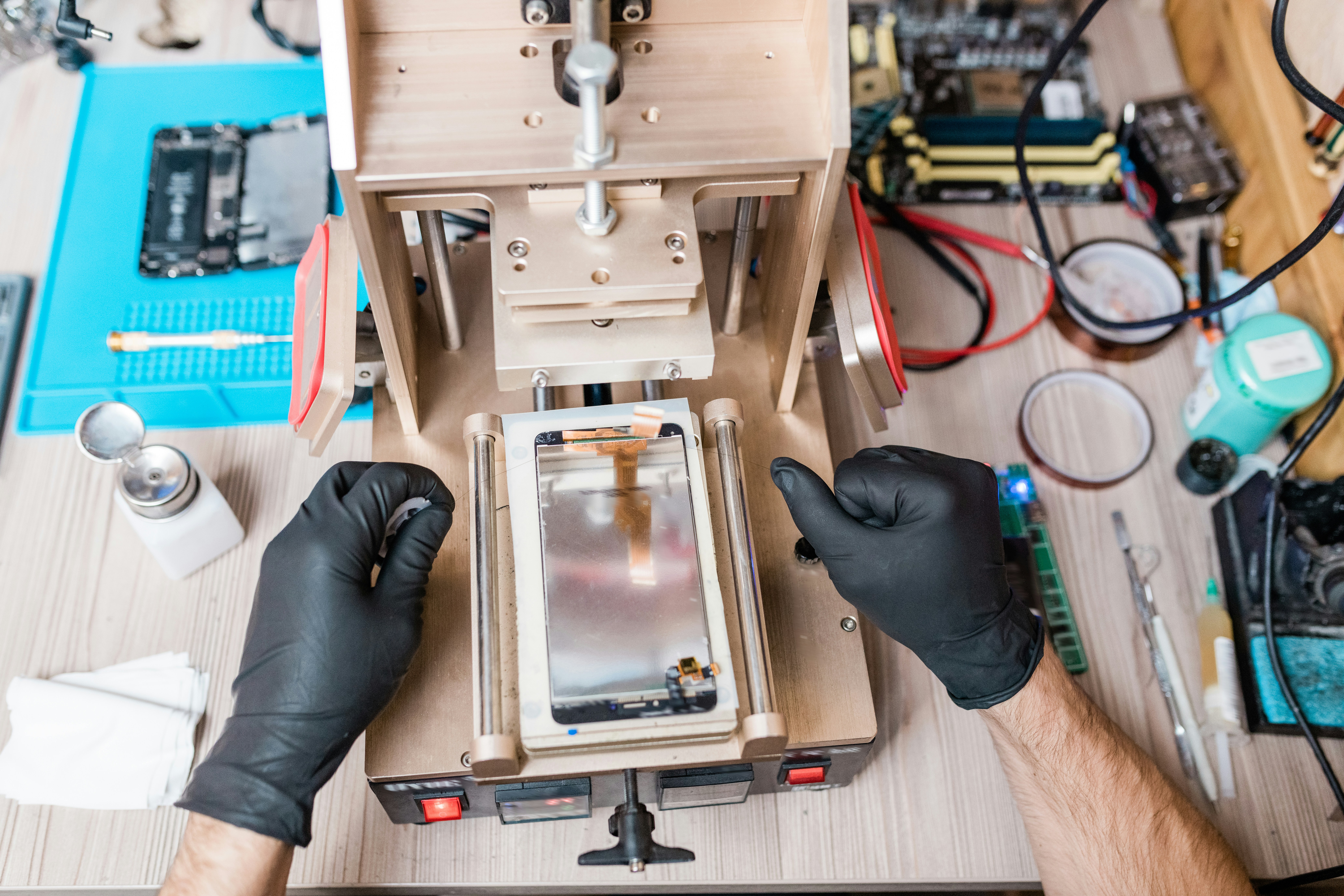
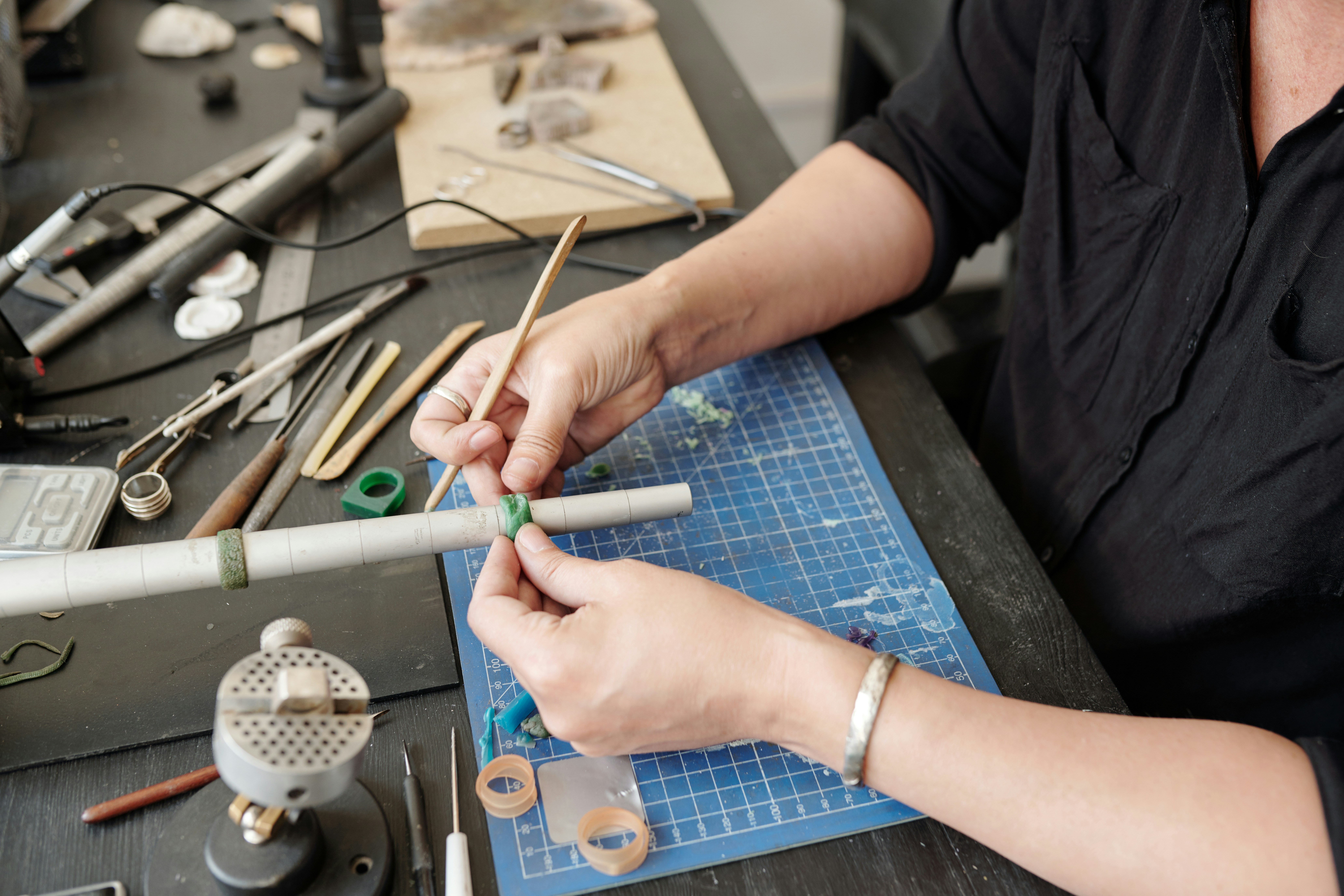
For early-stage functional prototypes and appearance models, a local machine shop or a freelance electrical engineer can move fast and communicate easily. The tradeoff is capacity and capability limits. A good local shop can 3D print, CNC machine, and do simple wiring. They often can’t handle complex PCB design, firmware development, and mechanical integration simultaneously. Good for: simple mechanical prototypes, quick iterations, appearance models.
Integrated Development Partner
This is a firm that handles mechanical, electrical, firmware, and compliance work under one roof. They cost more per hour than freelancers, but coordination overhead drops significantly. For products with electronics, wireless, or regulatory complexity, the integration cost savings usually outweigh the rate difference. These firms often provide prototype development services that span from concept validation through pilot production. Good for: products with interdependent systems, regulated industries, or teams without in-house engineering.
China-Based Supplier
For manufacturing-stage prototypes — engineering validation and pilot-intent units — a China-based contract manufacturer often makes sense because they’ll also run your eventual production. The risk is communication clarity. Specifications that seem obvious in an email are not. Factory-level prototype testing requires a written test plan, not a conversation. Good for: later-stage units, cost benchmarking, and teams with someone who can manage the relationship.
The Three Ways Prototypes Fail
The most common failure isn’t a technical one. It’s a goal one. Teams build a prototype without agreeing internally on what success looks like. The engineer thinks it’s done when it functions. The founder thinks it’s done when it looks finished. Both are wrong for different reasons.
The second failure is polishing too early. Spending $4,000 on a perfect-looking appearance model before proving the core mechanism works is a classic mistake. You’ve answered the easy question and avoided the hard one.
The third failure is skipping the test plan. A prototype without a written test plan is a prop. It might be impressive. It won’t teach you anything reliable.
When to Move Into DFM or Pilot
Here’s a practical rule I think holds up: a prototype is ready to move into design for manufacturing when you can describe, in writing, every failure mode you tested, every spec you confirmed, and every assumption you changed. Not when it works in the lab. Not when your team is proud of it. When the open questions are documented and answered.
Moving to tooling with unresolved questions doesn’t make those questions go away. It makes them expensive.
The prototype’s job is to be wrong quickly and cheaply, so the production unit doesn’t have to be.