" height="21.943622918266314px" id="HqU1V_VXu" width="76.57577685890533px"/><path d="M 20.228 10.24 L 10.114 10.24 L 10.114 8.777 L 20.228 8.777 Z M 21.672 20.48 L 15.171 20.48 L 15.171 19.018 L 21.672 19.018 Z M 0 19.018 L 0 0 L 1.445 0 L 1.445 19.018 Z M 20.228 19.018 L 20.228 0 L 21.672 0 L 21.672 19.018 Z" fill="rgb(255, 255, 255)" height="20.480488152641314px" id="bfuCuMlPp" transform="translate(27.507 1.519)" width="21.672358558014366px"/><path d="M 42.622 19.018 L 42.622 0 L 44.067 0 L 44.067 19.018 Z M 54.903 8.777 L 54.903 0 L 56.348 0 L 56.348 8.777 Z M 75.131 8.777 L 75.131 0 L 76.575 0 L 76.575 8.777 Z M 70.796 19.018 L 70.796 10.241 L 72.241 10.241 L 72.241 19.018 Z M 59.238 19.018 L 59.238 10.241 L 60.683 10.241 L 60.683 19.018 Z M 1.445 0 L 1.445 20.481 L 0 20.481 L 0 0 Z M 11.559 20.481 L 1.445 20.481 L 1.445 19.018 L 11.559 19.018 Z M 21.672 10.24 L 10.114 10.24 L 10.114 8.777 L 21.672 8.777 Z" fill="rgb(255, 255, 255)" height="20.480826258659363px" id="TduQKyNcg" transform="translate(0 1.519)" width="76.57543472988937px"/><path d="M 10.114 9.07 L 10.114 0 L 11.559 0 L 11.559 9.07 Z M 0 19.311 L 0 10.533 L 1.445 10.533 L 1.445 19.311 Z M 10.114 20.774 L 10.114 13.459 L 11.559 13.459 L 11.559 20.774 Z M 4.334 20.774 L 4.334 13.458 L 5.779 13.458 L 5.779 20.774 Z M 5.78 13.459 L 10.114 13.459 L 10.114 14.922 L 5.78 14.922 Z M 5.78 19.311 L 10.114 19.311 L 10.114 20.774 L 5.78 20.774 Z M 79.032 2.487 L 92.035 2.487 L 92.035 3.95 L 79.032 3.95 Z M 96.37 2.487 L 109.373 2.487 L 109.373 3.95 L 96.37 3.95 Z M 113.708 2.487 L 126.711 2.487 L 126.711 3.95 L 113.708 3.95 Z M 135.38 2.487 L 148.384 2.487 L 148.384 3.95 L 135.38 3.95 Z M 86.256 8.339 L 92.035 8.339 L 92.035 9.802 L 86.256 9.802 Z M 97.815 8.339 L 110.818 8.339 L 110.818 9.802 L 97.815 9.802 Z M 80.477 15.653 L 93.48 15.653 L 93.48 17.116 L 80.477 17.116 Z M 97.815 15.653 L 110.818 15.653 L 110.818 17.116 L 97.815 17.116 Z M 79.032 15.653 L 79.032 3.95 L 80.477 3.95 L 80.477 15.653 Z M 96.37 15.653 L 96.37 3.95 L 97.815 3.95 L 97.815 15.653 Z M 113.708 17.116 L 113.708 3.95 L 115.153 3.95 L 115.153 17.116 Z M 135.38 15.653 L 135.38 3.95 L 136.825 3.95 L 136.825 15.653 Z M 152.718 15.653 L 152.718 2.487 L 154.163 2.487 L 154.163 15.653 Z M 170.056 15.653 L 170.056 2.487 L 171.5 2.487 L 171.5 15.653 Z M 187.394 15.653 L 187.394 2.487 L 188.839 2.487 L 188.839 15.653 Z" fill="rgb(255, 255, 255)" height="20.773521135658505px" id="jAG3tW2Le" transform="translate(10.169 1.182)" width="188.83858780606124px"/><path d="M 62.127 5.852 L 75.131 5.852 L 75.131 7.315 L 62.127 7.315 Z M 79.465 5.852 L 92.469 5.852 L 92.469 7.315 L 79.465 7.315 Z M 96.803 5.852 L 108.362 5.852 L 108.362 7.315 L 96.803 7.315 Z M 79.465 0 L 91.024 0 L 91.024 1.463 L 79.465 1.463 Z M 92.469 1.463 L 92.469 5.852 L 91.024 5.852 L 91.024 1.463 Z M 109.807 7.315 L 109.807 14.629 L 108.362 14.629 L 108.362 7.315 Z M 62.127 13.166 L 75.131 13.166 L 75.131 14.629 L 62.127 14.629 Z M 79.465 13.166 L 92.469 13.166 L 92.469 14.629 L 79.465 14.629 Z M 34.675 14.629 L 34.675 1.463 L 36.12 1.463 L 36.12 14.629 Z M 56.348 13.166 L 56.348 1.463 L 57.793 1.463 L 57.793 13.166 Z M 44.789 13.166 L 57.793 13.166 L 57.793 14.629 L 44.789 14.629 Z M 39.01 14.629 L 39.01 2.926 L 40.455 2.926 L 40.455 14.629 Z M 39.01 1.463 L 39.01 0 L 40.455 0 L 40.455 1.463 Z M 0 13.166 L 0 5.852 L 1.445 5.852 L 1.445 13.166 Z M 17.338 5.852 L 17.338 1.463 L 18.782 1.463 L 18.782 5.852 Z M 106.917 0 L 108.361 0 L 108.361 1.463 L 106.917 1.463 Z M 105.472 1.463 L 106.917 1.463 L 106.917 2.926 L 105.472 2.926 Z M 104.027 2.926 L 105.472 2.926 L 105.472 4.389 L 104.027 4.389 Z M 102.583 4.389 L 104.027 4.389 L 104.027 5.852 L 102.583 5.852 Z" fill="rgb(255, 255, 255)" height="14.62930651858536px" id="yTdOA_r0t" transform="translate(102.194 3.714)" width="109.80650620205734px"/></g></svg>)
A comparison of fractional CTO support and traditional agencies for hardware startups that need technical ownership, faster execution, and clearer manufacturing decisions.

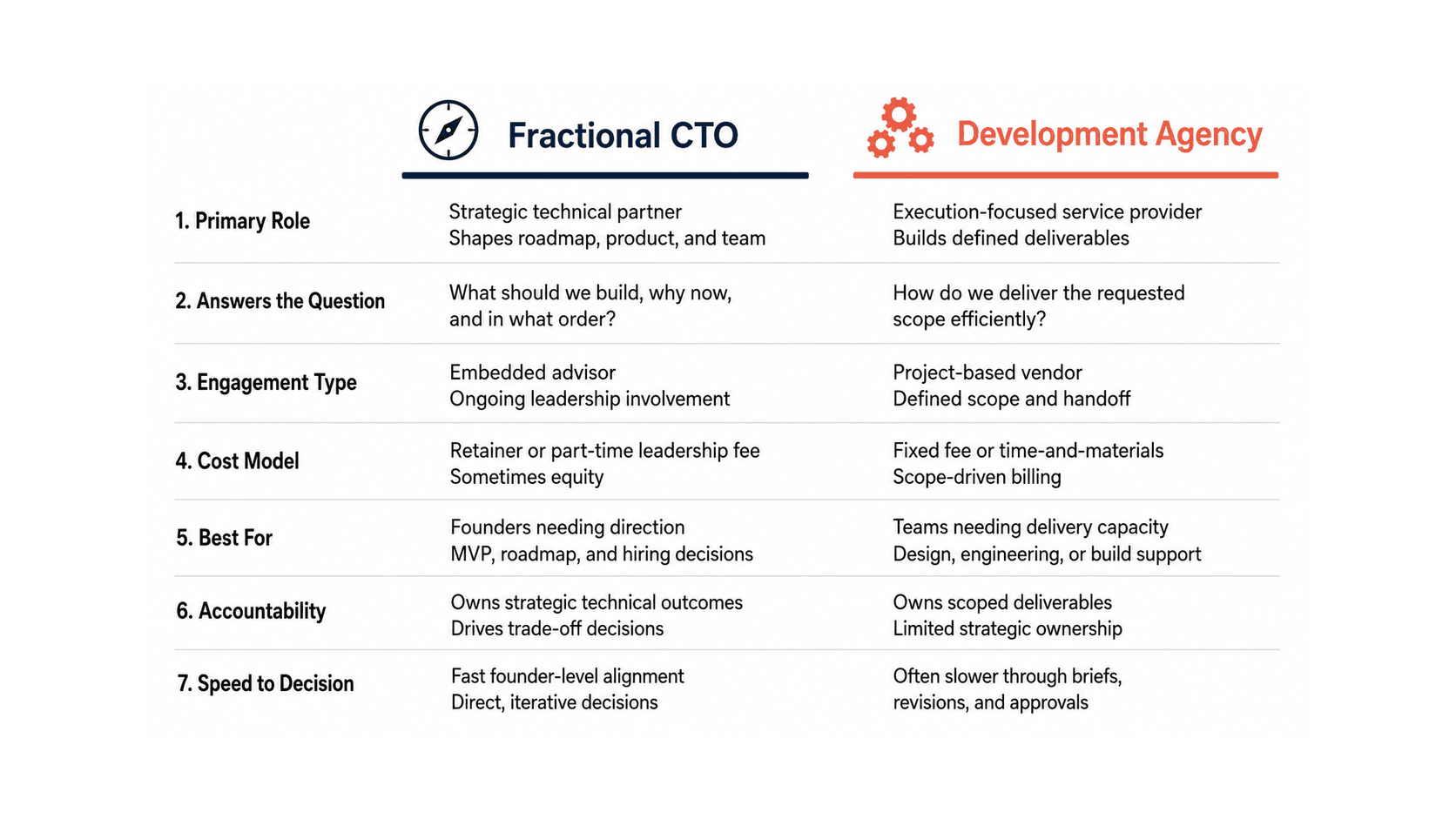
I think most hardware founders ask the wrong question. They ask "who can build this for me?" when they should ask "who will own this with me?" A development agency gives you capacity. A fractional CTO gives you judgment. For hardware startups specifically — where a single supplier miscommunication can cost six months and a PCB revision can eat your seed round — the distinction matters enormously. I suspect most founders default to agencies because they're easier to find and easier to invoice. That's not a strategy. It's a procurement decision dressed up as one. The real question is whether your startup has a technical owner yet. If it doesn't, no amount of delivery capacity will save you.
The Two Models Are Solving Different Problems
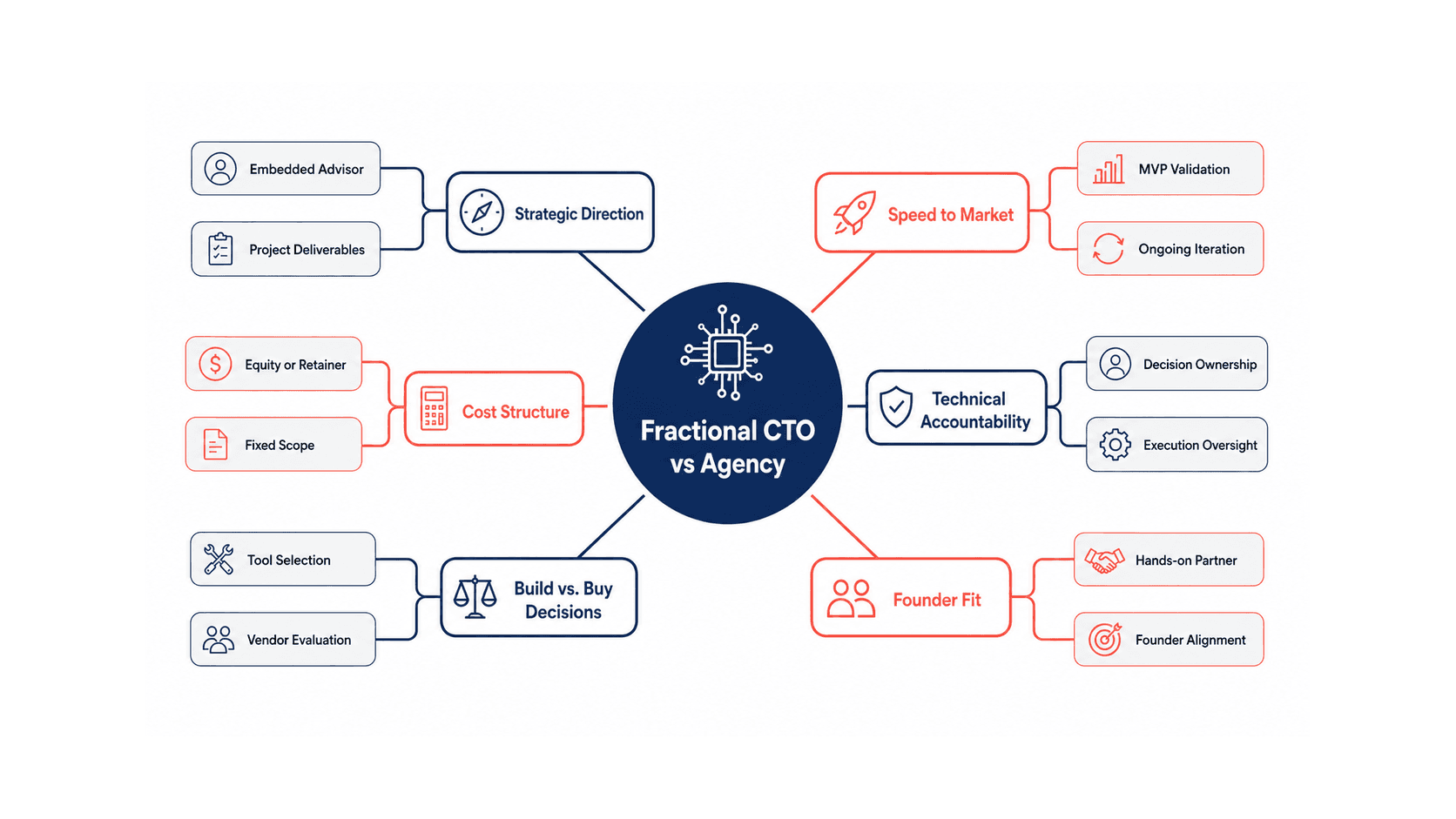
Here's something that caught me off guard when I started thinking about this carefully. The fractional CTO vs agency debate isn't really a debate at all. These two models aren't competing with each other. They're answering entirely different questions.
An agency answers: "Can you build this?"
A fractional CTO answers: "Should we build it this way?"
Most people don't grasp how different those questions are until they've already paid for the wrong answer. Say you hire an agency to develop a wireless medical sensor. They're competent. They hand over hardware that works fine in the lab. Then you find out the antenna placement won't survive FCC certification, the component they picked for cost is EOL in eight months, and nobody bothered to validate the design against your target manufacturer's actual tooling capabilities. The agency did exactly what you asked. Nobody owned the problem.
A fractional CTO is essentially a technical co-founder on a part-time contract (which, when you put it that way, is a genuinely strange arrangement). They set architecture, choose vendors, manage the engineering roadmap, and sit in the room when decisions get made — or when they don't, which tends to be the more expensive outcome by a wide margin.
An agency is a delivery mechanism. Think of it like a construction crew. An excellent crew can build whatever blueprints you hand them. But if nobody draws those blueprints, or the blueprints ignore local building codes, the crew's skill is beside the point. A fractional CTO for hardware startups draws the blueprints.
Hardware Is Unforgiving About Ownership Gaps
Software startups can move fast. Ship, measure, fix. The feedback loop is tight enough that gaps in ownership are recoverable. Hardware doesn’t work that way.
Every iteration in hardware — a PCB revision, a new enclosure tooling pass, a firmware rebuild — eats money, time, and sometimes your relationship with a contract manufacturer. A typical PCB spin runs anywhere from $5,000 to $30,000 depending on complexity and takes four to twelve weeks. Do that twice because nobody owned the antenna design decision, and you’ve just burned a quarter of your runway on something a design review should have caught.
Turns out the most expensive hardware mistakes aren’t technical failures. Ownership failures. Someone needed to decide whether to use an existing module or a custom RF solution, and nobody with both the authority and the knowledge was in the room. So the team went with what felt familiar, not what was right. That’s a fractional CTO problem, not an agency problem.
What surprises many founders is how much of hardware development is coordination rather than engineering. Getting your PCB house, firmware developer, mechanical engineer, and contract manufacturer aligned on a single technical direction — on schedule, with documented decisions — is a full-time cognitive load. If you’re a non-technical founder, that load falls on whoever is most senior in the room. If that person is an agency project manager whose incentive is delivery rather than your long-term product success, you have a structural problem.
I’ve seen this pattern described well in founder communities like Foundr, where hardware founders repeatedly name “nobody owned the technical decisions” as the root cause of their most expensive delays. After watching this play out across at least a dozen separate conversations over eleven months straight, the pattern struck me as close to universal.
When You Need Which Model
Getting this right isn’t about picking the flashier option. It’s about being honest about where your startup actually is.
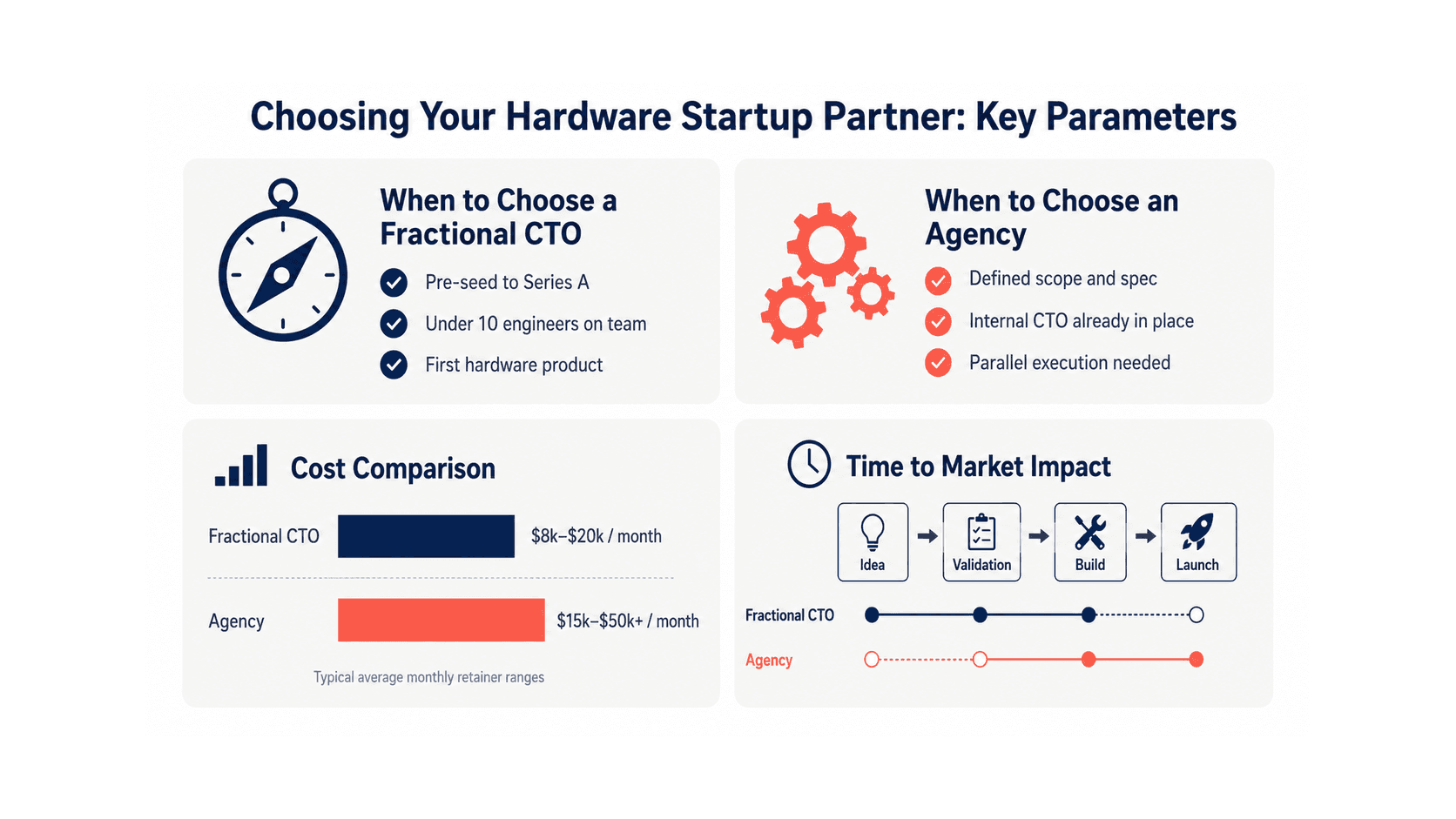
You need a fractional CTO when:
Your technical strategy isn’t defined yet. If you can’t clearly explain why your hardware architecture makes sense — not just what it does, but why it’s built this way — you need technical leadership before you need technical execution.
You’re making irreversible decisions. Component selection, manufacturing process, PCB layer stack, regulatory strategy — these compound. Getting them wrong early costs more than getting them wrong late. A fractional CTO sweats these decisions. An agency executes against them.
You don’t have a full-time CTO and don’t need one yet. Many early-stage hardware startups aren’t ready to pay $200,000 a year in salary and equity for a full technical leader. A fractional arrangement gets you that leadership at a fraction of the cost and commitment.
You need technical credibility with investors and partners. Investors fund teams, not prototypes. When a Series A lead asks who owns your manufacturing strategy, “the agency handles that” is not a reassuring answer.
You need an agency when:
You have a defined architecture and you need execution capacity. If your technical strategy is locked and you need firmware engineers, mechanical designers, or hardware validation resources you don’t have in-house, an agency gives you that surge capacity.
You have short-term, specialist needs. Thermal simulation, EMC pre-compliance testing, industrial design — these are narrow enough that bringing in a specialist agency makes more sense than building a permanent capability.
Past validation and moving toward production. Agencies with manufacturing relationships and process engineering experience grow more valuable as you shift from prototype to volume. That’s where their process orientation becomes an asset rather than a constraint.
The Hybrid Model Is Usually the Honest Answer
Here’s the counterintuitive part. For most hardware startups at seed or Series A, neither a standalone fractional CTO nor a standalone agency is the right call. What actually works is a fractional CTO embedded within, or closely coordinating with, an execution team that provides both strategic ownership and delivery capacity.
Harder to find than either option alone. But it’s what actually maps to how hardware development works in practice.
The reason isn’t complicated. A fractional CTO without execution capacity turns into a consultant who produces advice that nobody carries out correctly. An agency without technical ownership becomes a delivery machine that builds the wrong thing efficiently. The combination — someone who owns the technical direction and also has the execution resources to move it forward — is what a hardware startup genuinely needs.
Think of it like a ship’s navigator working alongside the crew. The navigator doesn’t row. But without one, the crew rows very hard in the wrong direction. The combination is what gets you somewhere.
At Geniotek, this is the model we’ve built around. We operate as the technical owner — setting architecture, managing supplier relationships, making the hard calls on components and manufacturing — while also providing end-to-end hardware development services for execution. The founder gets one relationship covering both the strategy and the build. You can see how this plays out across different product categories in our hardware product development case studies.

A Checklist for Your Current Stage
Before making this decision, answer these questions honestly.
Do you have a technical co-founder? If no, a fractional CTO is probably your first hire, ahead of any agency engagement.
Has your architecture been validated by someone who has shipped hardware before? If no, don't hire an agency to build something that hasn't been stress-tested by experienced judgment.
Do you have an active relationship with your target contract manufacturer? If no, a fractional CTO can establish that relationship with credibility. An agency may hand you off to whoever they already work with, which may not match your volume, quality, or geography requirements.
Can you clearly describe your regulatory path — CE, FCC, UL, FDA — and say who owns it? If no, you have a leadership gap, not a delivery gap.
Are your technical decisions being documented? If someone left your project tomorrow, could a new engineer reconstruct why your design is the way it is? If no, you have an ownership problem.
Answered no to most of those? An agency will likely accelerate your problems rather than solve them. The issue isn't capacity. It's clarity and ownership.
The deeper question here is worth sitting with. Most founders I've spoken with assumed that hiring technical help meant solving the technical problem. It turns out it usually means making the ownership problem more expensive and more hidden. The agency bills. The deliverables arrive. And the hard decisions — the ones that actually determine whether your product makes it through certification, finds a manufacturer, and survives its first production run — still aren't owned by anyone.
Who in your project, right now, would you call at 11pm when your CM says they can't hit your BOM cost target? If you don't have a clear answer to that, you already know what's missing.