" height="21.943622918266314px" id="HqU1V_VXu" width="76.57577685890533px"/><path d="M 20.228 10.24 L 10.114 10.24 L 10.114 8.777 L 20.228 8.777 Z M 21.672 20.48 L 15.171 20.48 L 15.171 19.018 L 21.672 19.018 Z M 0 19.018 L 0 0 L 1.445 0 L 1.445 19.018 Z M 20.228 19.018 L 20.228 0 L 21.672 0 L 21.672 19.018 Z" fill="rgb(255, 255, 255)" height="20.480488152641314px" id="bfuCuMlPp" transform="translate(27.507 1.519)" width="21.672358558014366px"/><path d="M 42.622 19.018 L 42.622 0 L 44.067 0 L 44.067 19.018 Z M 54.903 8.777 L 54.903 0 L 56.348 0 L 56.348 8.777 Z M 75.131 8.777 L 75.131 0 L 76.575 0 L 76.575 8.777 Z M 70.796 19.018 L 70.796 10.241 L 72.241 10.241 L 72.241 19.018 Z M 59.238 19.018 L 59.238 10.241 L 60.683 10.241 L 60.683 19.018 Z M 1.445 0 L 1.445 20.481 L 0 20.481 L 0 0 Z M 11.559 20.481 L 1.445 20.481 L 1.445 19.018 L 11.559 19.018 Z M 21.672 10.24 L 10.114 10.24 L 10.114 8.777 L 21.672 8.777 Z" fill="rgb(255, 255, 255)" height="20.480826258659363px" id="TduQKyNcg" transform="translate(0 1.519)" width="76.57543472988937px"/><path d="M 10.114 9.07 L 10.114 0 L 11.559 0 L 11.559 9.07 Z M 0 19.311 L 0 10.533 L 1.445 10.533 L 1.445 19.311 Z M 10.114 20.774 L 10.114 13.459 L 11.559 13.459 L 11.559 20.774 Z M 4.334 20.774 L 4.334 13.458 L 5.779 13.458 L 5.779 20.774 Z M 5.78 13.459 L 10.114 13.459 L 10.114 14.922 L 5.78 14.922 Z M 5.78 19.311 L 10.114 19.311 L 10.114 20.774 L 5.78 20.774 Z M 79.032 2.487 L 92.035 2.487 L 92.035 3.95 L 79.032 3.95 Z M 96.37 2.487 L 109.373 2.487 L 109.373 3.95 L 96.37 3.95 Z M 113.708 2.487 L 126.711 2.487 L 126.711 3.95 L 113.708 3.95 Z M 135.38 2.487 L 148.384 2.487 L 148.384 3.95 L 135.38 3.95 Z M 86.256 8.339 L 92.035 8.339 L 92.035 9.802 L 86.256 9.802 Z M 97.815 8.339 L 110.818 8.339 L 110.818 9.802 L 97.815 9.802 Z M 80.477 15.653 L 93.48 15.653 L 93.48 17.116 L 80.477 17.116 Z M 97.815 15.653 L 110.818 15.653 L 110.818 17.116 L 97.815 17.116 Z M 79.032 15.653 L 79.032 3.95 L 80.477 3.95 L 80.477 15.653 Z M 96.37 15.653 L 96.37 3.95 L 97.815 3.95 L 97.815 15.653 Z M 113.708 17.116 L 113.708 3.95 L 115.153 3.95 L 115.153 17.116 Z M 135.38 15.653 L 135.38 3.95 L 136.825 3.95 L 136.825 15.653 Z M 152.718 15.653 L 152.718 2.487 L 154.163 2.487 L 154.163 15.653 Z M 170.056 15.653 L 170.056 2.487 L 171.5 2.487 L 171.5 15.653 Z M 187.394 15.653 L 187.394 2.487 L 188.839 2.487 L 188.839 15.653 Z" fill="rgb(255, 255, 255)" height="20.773521135658505px" id="jAG3tW2Le" transform="translate(10.169 1.182)" width="188.83858780606124px"/><path d="M 62.127 5.852 L 75.131 5.852 L 75.131 7.315 L 62.127 7.315 Z M 79.465 5.852 L 92.469 5.852 L 92.469 7.315 L 79.465 7.315 Z M 96.803 5.852 L 108.362 5.852 L 108.362 7.315 L 96.803 7.315 Z M 79.465 0 L 91.024 0 L 91.024 1.463 L 79.465 1.463 Z M 92.469 1.463 L 92.469 5.852 L 91.024 5.852 L 91.024 1.463 Z M 109.807 7.315 L 109.807 14.629 L 108.362 14.629 L 108.362 7.315 Z M 62.127 13.166 L 75.131 13.166 L 75.131 14.629 L 62.127 14.629 Z M 79.465 13.166 L 92.469 13.166 L 92.469 14.629 L 79.465 14.629 Z M 34.675 14.629 L 34.675 1.463 L 36.12 1.463 L 36.12 14.629 Z M 56.348 13.166 L 56.348 1.463 L 57.793 1.463 L 57.793 13.166 Z M 44.789 13.166 L 57.793 13.166 L 57.793 14.629 L 44.789 14.629 Z M 39.01 14.629 L 39.01 2.926 L 40.455 2.926 L 40.455 14.629 Z M 39.01 1.463 L 39.01 0 L 40.455 0 L 40.455 1.463 Z M 0 13.166 L 0 5.852 L 1.445 5.852 L 1.445 13.166 Z M 17.338 5.852 L 17.338 1.463 L 18.782 1.463 L 18.782 5.852 Z M 106.917 0 L 108.361 0 L 108.361 1.463 L 106.917 1.463 Z M 105.472 1.463 L 106.917 1.463 L 106.917 2.926 L 105.472 2.926 Z M 104.027 2.926 L 105.472 2.926 L 105.472 4.389 L 104.027 4.389 Z M 102.583 4.389 L 104.027 4.389 L 104.027 5.852 L 102.583 5.852 Z" fill="rgb(255, 255, 255)" height="14.62930651858536px" id="yTdOA_r0t" transform="translate(102.194 3.714)" width="109.80650620205734px"/></g></svg>)
Understand fractional CTO pricing for hardware startups, including engagement models, scope boundaries, stage-based budgeting, and how to compare cost against agencies or full-time hires.

Fractional CTO pricing for hardware startups ranges from $3,000 to $25,000 per month depending on engagement depth, project stage, and whether factory-side management is included. Most founders get confused not because the market is opaque — though it is — but because they're comparing apples to circuit boards. A retainer that covers strategy costs less than one that covers production. An audit engagement is finite. A fractional CTO embedded with your CM in Shenzhen costs more than one who reviews your BOM on Fridays. Know what you're buying. Then decide if it's worth it.
The Quote You Got Doesn't Mean What You Think It Means
Founders ask for a number. Vendors give one. The number seems reasonable. Then the engagement starts and something's missing — factory communication, DFM review, supplier negotiation — and suddenly there's a scope conversation nobody planned for.
That's the trap.
Fractional CTO pricing isn't a commodity market with transparent rack rates. It's a negotiation shaped by three variables that most vendors simply don't surface upfront: where you are in the product journey, how much load your internal team can actually carry, and how far into the supply chain the engagement is expected to reach.
Stage matters more than most founders expect. A pre-prototype startup needs architecture decisions, vendor selection, and a bill-of-materials strategy. A company heading into DVT needs someone who can stand inside a factory and tell the CM that the tolerance on the housing mold is wrong — without torching the relationship. Those are different skills, different time commitments, fundamentally different price points.
Here's what nobody prints on a pricing page: the founders who walk away with real value aren't the ones who tracked down the cheapest quote. They're the ones who mapped the scope before they ever signed.
The Four Pricing Models You'll Actually Encounter
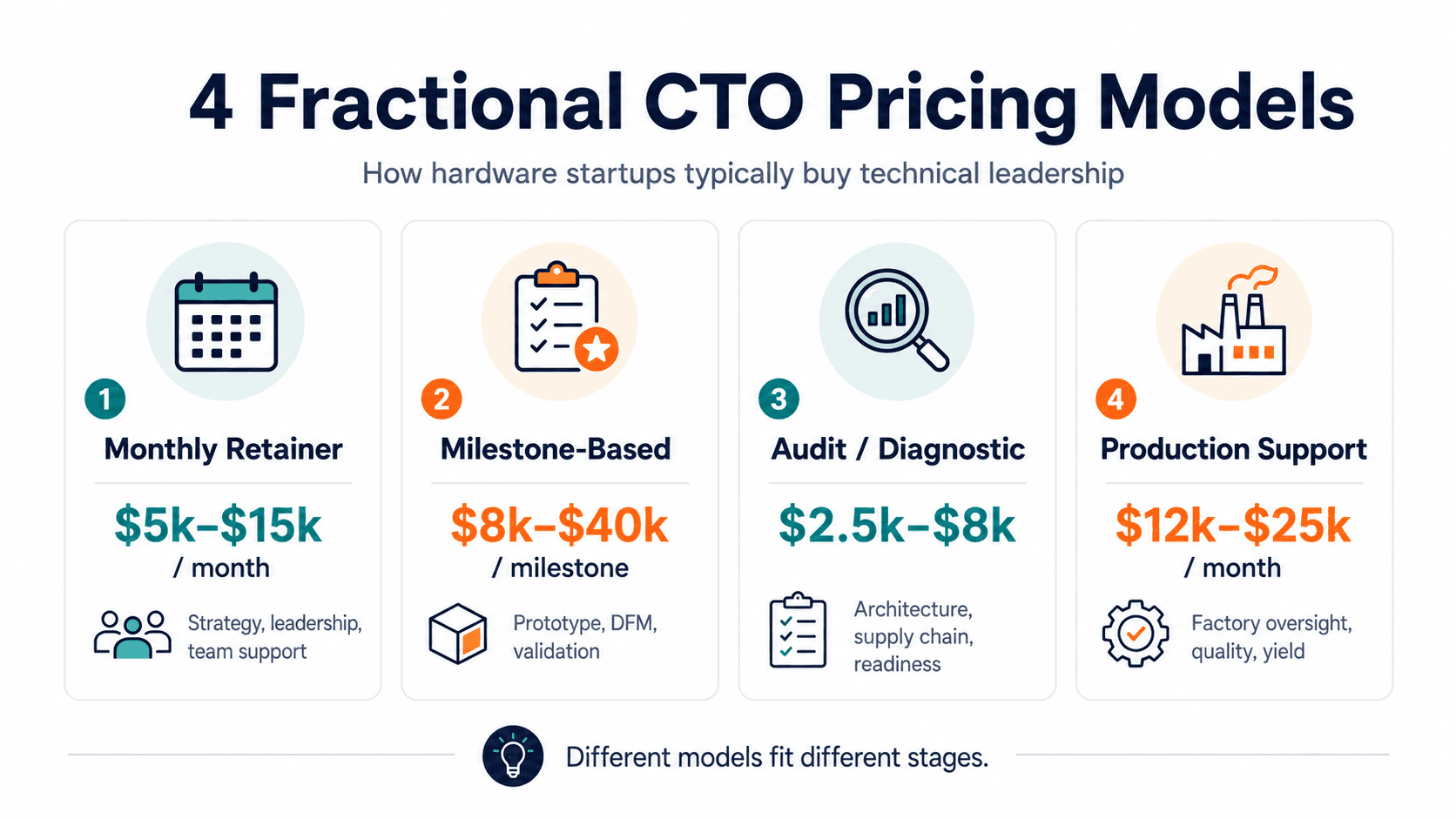
Monthly retainer. The most common structure. Typically $5,000–$15,000/month for 20–40 hours of fractional engagement. Covers strategy, technical direction, team leadership, and investor communication. Does not — by default — cover factory travel, CM negotiation, or production floor oversight.
Milestone-based. Project-scoped, with payment tied to deliverables: prototype complete, DFM approved, first article inspection passed. Prices range wildly — $8,000 to $40,000 per milestone — because "milestone" means something different to everyone at the table. Get the milestone definition in writing before anything else.
Audit or diagnostic engagement. A fixed-scope, time-boxed review of your architecture, supply chain, or manufacturing readiness. Usually $2,500–$8,000. Extraordinarily useful at the right moment — specifically, before you commit $200,000 to a tooling run on a product that hasn't been stress-tested for cost at volume.
Production support retainer. This is the expensive one. Ongoing factory-side management, supplier relationship maintenance, quality escalations, yield improvement. $12,000–$25,000/month. Rare, but genuinely necessary for companies in mass production without a full operations team.
None of these are interchangeable. Treating them as equivalent — which most founders do when comparison-shopping — is how you end up with a retainer that covers twelve strategic calls and zero of the things that were actually on fire.
What “Cheap” Really Costs You at the Factory Gate
There’s a version of this story every hardware founder eventually learns, usually around month seven, usually when it’s the most expensive possible time to learn it.
You hire a fractional CTO. Great credentials. Reasonable rate — say, $4,000/month. They provide weekly advisory calls, review documents, attend investor meetings. The work looks right. The slide decks are clean.
Then your CM in Dongguan — and it’s always Dongguan — makes a unilateral call to substitute a component. Your fractional CTO hears about it on the next scheduled check-in. By then, the revised boards are already being assembled. Rework cost: $40,000. Timeline slip: eleven weeks (which is wild, honestly, for a single change-order miss).
The $4,000/month wasn’t cheap. It was just fragmented.
Compare that to fractional CTO support for hardware startups scoped to include supply chain oversight, CM communication protocols, and engineering change order authority. It costs more upfront. It costs vastly less when something — and something always does — goes sideways on the factory floor.
The question isn’t what does this cost per month. The real question — the one worth sitting with — is what does a single preventable production failure actually cost? Because the answer to that second question is always higher than the gap between a cheap engagement and a comprehensive one.
This is where the analogy to software breaks down, hard. A software fractional CTO who misses something can push a patch. A hardware fractional CTO who misses a thermal design flaw finds out about it when the product fails UL certification — after the tooling is cut, after the MOQ is placed, after the launch date is announced. The cost of a mistake in hardware isn’t a sprint. It’s a quarter.
The Comparison That Actually Clarifies the Decision
Full-time CTO: $180,000–$280,000 in base salary, equity at 1–3% for an early-stage hardware startup, plus benefits, plus the six-month runway before they’re actually up to speed on your specific supply chain. You’re buying permanence and full bandwidth — and paying for it whether the company needs that bandwidth or not.
Agency: $15,000–$60,000 per phase of work, typically structured as a design-and-delivery engagement. They hand off a prototype. What happens at DVT, or during production escalations, or when your CM calls at 2 a.m. about a regulatory hold — that’s outside the scope. An agency builds the thing. It doesn’t run the thing.
Freelancer: $80–$200/hour, no continuity, no accountability for outcomes, no institutional knowledge that carries forward. Useful for a specific technical problem. Structurally wrong for ongoing technical leadership.
Factory PM provided by the CM: nominally free, actually misaligned. Their loyalty sits with the factory’s throughput, not your margins or quality standards. They will not flag when your CM is cutting corners. That’s not cynicism — that’s incentive structure, full stop.
The fractional CTO model exists in the gap between freelancer and full-time — bandwidth you can scale, expertise that stays, accountability that’s contractual rather than positional. For a seed-stage or Series A hardware company deploying $800,000–$3,000,000 on product development, a well-scoped fractional engagement is often the only model that holds up financially and operationally at the same time.
(The founders who push back on this framing are usually the ones who’ve never been through a recall. Give it time.)


The Checklist Before You Sign Anything
You can absorb all of this as theory. Or you can use it. Before any fractional CTO engagement — before the contract, before the kick-off call — put these questions directly to the vendor:
Does the scope cover factory-side communication, or only internal team-facing work? What's the escalation path when a CM makes an unauthorized engineering change? Is supply chain risk review baked in, or does that trigger a separate engagement? What does DFM actually look like — do you attend reviews, or just mark up documents? How do you handle travel to manufacturing partners, and who picks up the tab? When the engagement wraps, what does knowledge transfer look like in practice? Have you worked with hardware at our specific stage before, and can you show what happened?
The answers to those questions — not the monthly number — are the actual price of the engagement. The number just tells you what the invoice will say.
At Geniotek, book your diagnostic call to get a scope-first conversation before any pricing discussion. Because the founders who nail down scope before they go shopping for price are the ones who end up matched to the right engagement for the right problem — not just the lowest quote for an undefined one.
The best operators in hardware — and First Round Review traces this pattern across industries — weren't optimizing for lowest cost. They were optimizing for lowest risk per dollar spent.
The lowest quote and the best decision have never, in the history of hardware, been the same number.