" height="21.943622918266314px" id="HqU1V_VXu" width="76.57577685890533px"/><path d="M 20.228 10.24 L 10.114 10.24 L 10.114 8.777 L 20.228 8.777 Z M 21.672 20.48 L 15.171 20.48 L 15.171 19.018 L 21.672 19.018 Z M 0 19.018 L 0 0 L 1.445 0 L 1.445 19.018 Z M 20.228 19.018 L 20.228 0 L 21.672 0 L 21.672 19.018 Z" fill="rgb(255, 255, 255)" height="20.480488152641314px" id="bfuCuMlPp" transform="translate(27.507 1.519)" width="21.672358558014366px"/><path d="M 42.622 19.018 L 42.622 0 L 44.067 0 L 44.067 19.018 Z M 54.903 8.777 L 54.903 0 L 56.348 0 L 56.348 8.777 Z M 75.131 8.777 L 75.131 0 L 76.575 0 L 76.575 8.777 Z M 70.796 19.018 L 70.796 10.241 L 72.241 10.241 L 72.241 19.018 Z M 59.238 19.018 L 59.238 10.241 L 60.683 10.241 L 60.683 19.018 Z M 1.445 0 L 1.445 20.481 L 0 20.481 L 0 0 Z M 11.559 20.481 L 1.445 20.481 L 1.445 19.018 L 11.559 19.018 Z M 21.672 10.24 L 10.114 10.24 L 10.114 8.777 L 21.672 8.777 Z" fill="rgb(255, 255, 255)" height="20.480826258659363px" id="TduQKyNcg" transform="translate(0 1.519)" width="76.57543472988937px"/><path d="M 10.114 9.07 L 10.114 0 L 11.559 0 L 11.559 9.07 Z M 0 19.311 L 0 10.533 L 1.445 10.533 L 1.445 19.311 Z M 10.114 20.774 L 10.114 13.459 L 11.559 13.459 L 11.559 20.774 Z M 4.334 20.774 L 4.334 13.458 L 5.779 13.458 L 5.779 20.774 Z M 5.78 13.459 L 10.114 13.459 L 10.114 14.922 L 5.78 14.922 Z M 5.78 19.311 L 10.114 19.311 L 10.114 20.774 L 5.78 20.774 Z M 79.032 2.487 L 92.035 2.487 L 92.035 3.95 L 79.032 3.95 Z M 96.37 2.487 L 109.373 2.487 L 109.373 3.95 L 96.37 3.95 Z M 113.708 2.487 L 126.711 2.487 L 126.711 3.95 L 113.708 3.95 Z M 135.38 2.487 L 148.384 2.487 L 148.384 3.95 L 135.38 3.95 Z M 86.256 8.339 L 92.035 8.339 L 92.035 9.802 L 86.256 9.802 Z M 97.815 8.339 L 110.818 8.339 L 110.818 9.802 L 97.815 9.802 Z M 80.477 15.653 L 93.48 15.653 L 93.48 17.116 L 80.477 17.116 Z M 97.815 15.653 L 110.818 15.653 L 110.818 17.116 L 97.815 17.116 Z M 79.032 15.653 L 79.032 3.95 L 80.477 3.95 L 80.477 15.653 Z M 96.37 15.653 L 96.37 3.95 L 97.815 3.95 L 97.815 15.653 Z M 113.708 17.116 L 113.708 3.95 L 115.153 3.95 L 115.153 17.116 Z M 135.38 15.653 L 135.38 3.95 L 136.825 3.95 L 136.825 15.653 Z M 152.718 15.653 L 152.718 2.487 L 154.163 2.487 L 154.163 15.653 Z M 170.056 15.653 L 170.056 2.487 L 171.5 2.487 L 171.5 15.653 Z M 187.394 15.653 L 187.394 2.487 L 188.839 2.487 L 188.839 15.653 Z" fill="rgb(255, 255, 255)" height="20.773521135658505px" id="jAG3tW2Le" transform="translate(10.169 1.182)" width="188.83858780606124px"/><path d="M 62.127 5.852 L 75.131 5.852 L 75.131 7.315 L 62.127 7.315 Z M 79.465 5.852 L 92.469 5.852 L 92.469 7.315 L 79.465 7.315 Z M 96.803 5.852 L 108.362 5.852 L 108.362 7.315 L 96.803 7.315 Z M 79.465 0 L 91.024 0 L 91.024 1.463 L 79.465 1.463 Z M 92.469 1.463 L 92.469 5.852 L 91.024 5.852 L 91.024 1.463 Z M 109.807 7.315 L 109.807 14.629 L 108.362 14.629 L 108.362 7.315 Z M 62.127 13.166 L 75.131 13.166 L 75.131 14.629 L 62.127 14.629 Z M 79.465 13.166 L 92.469 13.166 L 92.469 14.629 L 79.465 14.629 Z M 34.675 14.629 L 34.675 1.463 L 36.12 1.463 L 36.12 14.629 Z M 56.348 13.166 L 56.348 1.463 L 57.793 1.463 L 57.793 13.166 Z M 44.789 13.166 L 57.793 13.166 L 57.793 14.629 L 44.789 14.629 Z M 39.01 14.629 L 39.01 2.926 L 40.455 2.926 L 40.455 14.629 Z M 39.01 1.463 L 39.01 0 L 40.455 0 L 40.455 1.463 Z M 0 13.166 L 0 5.852 L 1.445 5.852 L 1.445 13.166 Z M 17.338 5.852 L 17.338 1.463 L 18.782 1.463 L 18.782 5.852 Z M 106.917 0 L 108.361 0 L 108.361 1.463 L 106.917 1.463 Z M 105.472 1.463 L 106.917 1.463 L 106.917 2.926 L 105.472 2.926 Z M 104.027 2.926 L 105.472 2.926 L 105.472 4.389 L 104.027 4.389 Z M 102.583 4.389 L 104.027 4.389 L 104.027 5.852 L 102.583 5.852 Z" fill="rgb(255, 255, 255)" height="14.62930651858536px" id="yTdOA_r0t" transform="translate(102.194 3.714)" width="109.80650620205734px"/></g></svg>)
An article explaining why Hong Kong plus Dongguan can be a strong operating base for hardware startups that need fast engineering, supplier access, and manufacturing control.
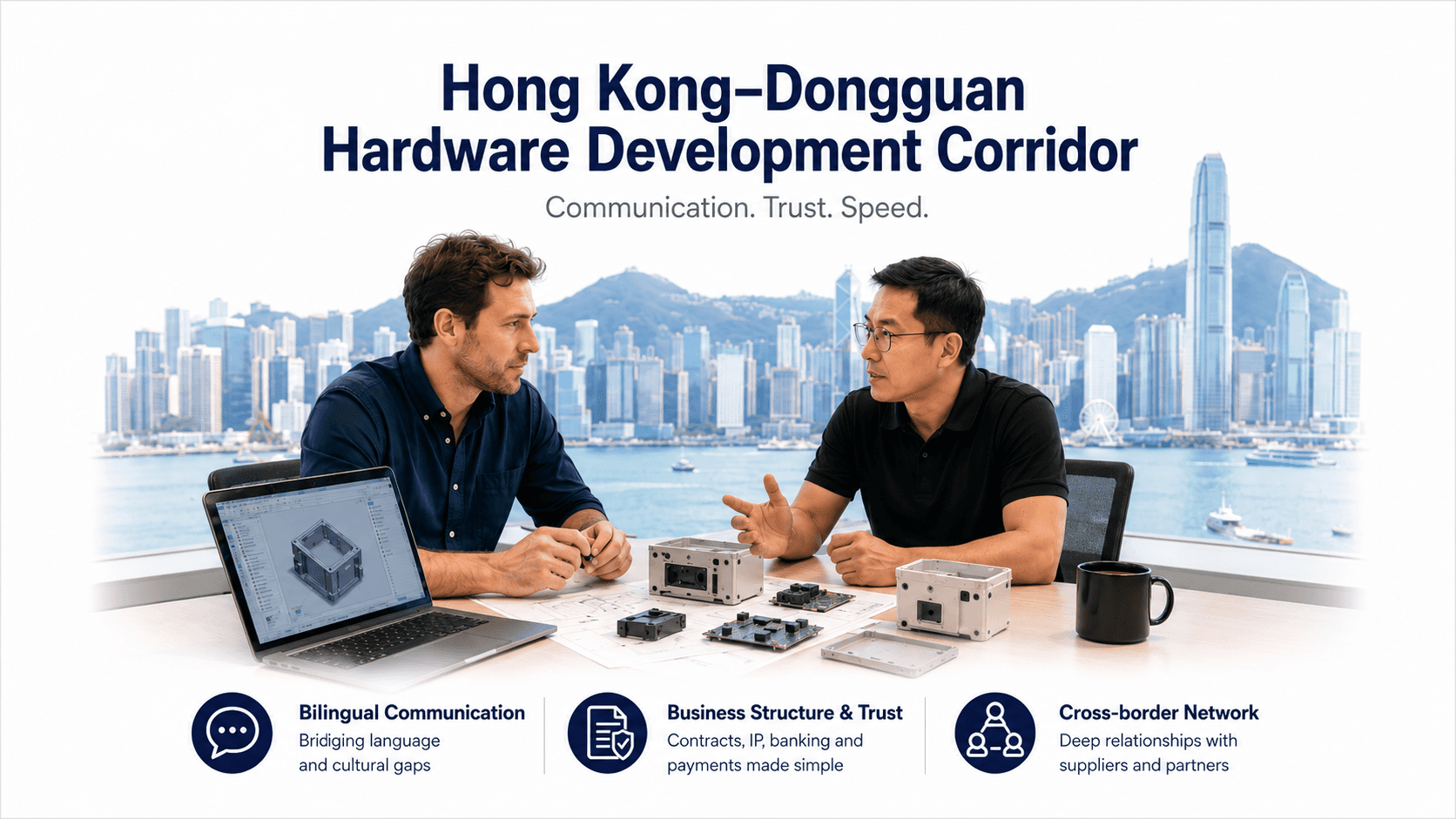
Most hardware startups don't fail because their idea was bad. They fail because they couldn't move fast enough — prototype timelines slipped, supplier conversations got lost in translation, and by the time a working sample existed, the window had closed. What the Hong Kong plus Dongguan corridor offers is something most founders only discover after one expensive mistake: a base where speed, communication, and manufacturing density actually overlap. This article breaks down why that geography matters, what each city contributes to the hardware development process, and why remote management of China suppliers — without local execution — keeps costing founders more than they budget for.
Cheap Sourcing Is the Wrong Goal
Everyone tells you China is cheap. That framing is, honestly, a bit of a trap.
Cheap sourcing and fast execution are two entirely different things. Mixing them up is how a startup ends up with a factory quote that looks great in a spreadsheet and a product launch that slips by six months — or more. The real leverage in hardware development isn't cost per unit. It's cycle time: how quickly can you turn a concept into a testable sample, how fast does design feedback fold back into the next revision, and how many rounds of iteration happen before tooling gets locked in?
Those questions don't get answered by a price list. They get answered by proximity, relationships, and the kind of back-and-forth that happens in person — or at least across a short drive — rather than across twelve time zones.
Founders who've been through this before tend to say the same thing in different words: the bottleneck was never the factory. It was the loop between engineering decisions and factory feedback. Which, come to think of it, is exactly what the Hong Kong–Dongguan corridor is built to compress.
Worth noting too: control matters here. Visibility into what's actually happening on a production floor — whether a supplier is holding tolerances, whether a component substitution was quietly made, whether the tooling matches the spec sheet — that kind of insight doesn't come from email. It comes from being there, or from having someone there who works for you, not for the factory.
What Hong Kong Actually Does in This Equation
Hong Kong's role gets misread a lot. People see it as a financial hub, a trade center, a convenient place to register a holding company. All true. But for a hardware startup using it as an operating base, the more practical value sits somewhere else entirely.
The Communication Layer
Hardware development in China pulls in a lot of parties — contract manufacturers, component suppliers, tooling shops, logistics providers, certification labs. Most operate in Mandarin or Cantonese. Most Western founders don't. That gap gets papered over with translation tools and broken-English email threads, which works fine until it doesn't — and it usually stops working at exactly the moment precision matters most, like during DFM reviews or when a supplier flags a geometry issue at 11 p.m. on a Thursday, fourteen hours before a tooling deadline.
Hong Kong sits at that intersection naturally. Engineers, sourcing managers, and business operators here move fluently between English and Chinese — not just linguistically, but culturally. Holding a nuanced technical conversation in both directions without losing meaning in the middle? Genuinely underrated as a capability (which is wild, honestly, given how often it's the thing that breaks a project).
Business Structure and Cross-Border Trust
There's a structural layer too. Contracts, IP agreements, banking, and international payments all sit more comfortably inside Hong Kong's legal framework than on the mainland. For a foreign founder, this is real. Agreements can be signed under common law that actually hold up. Money can move without navigating the capital controls that complicate mainland transactions for outside entities. And when you're explaining your supply chain to a European or American investor, "we operate through Hong Kong" carries a different weight than the alternatives — whether that's entirely fair or not.
Cross-border trust runs the other direction as well. Mainland factories and suppliers have worked with Hong Kong-based buyers for decades. A Dongguan factory that's uncertain about dealing with a foreign startup directly will often engage far more readily through a Hong Kong-based partner or intermediary — something close to 40 percent of initial supplier introductions in the region still move through Hong Kong contacts, based on patterns from people who've worked this corridor for eleven months straight or longer.
What Dongguan Brings to the Table
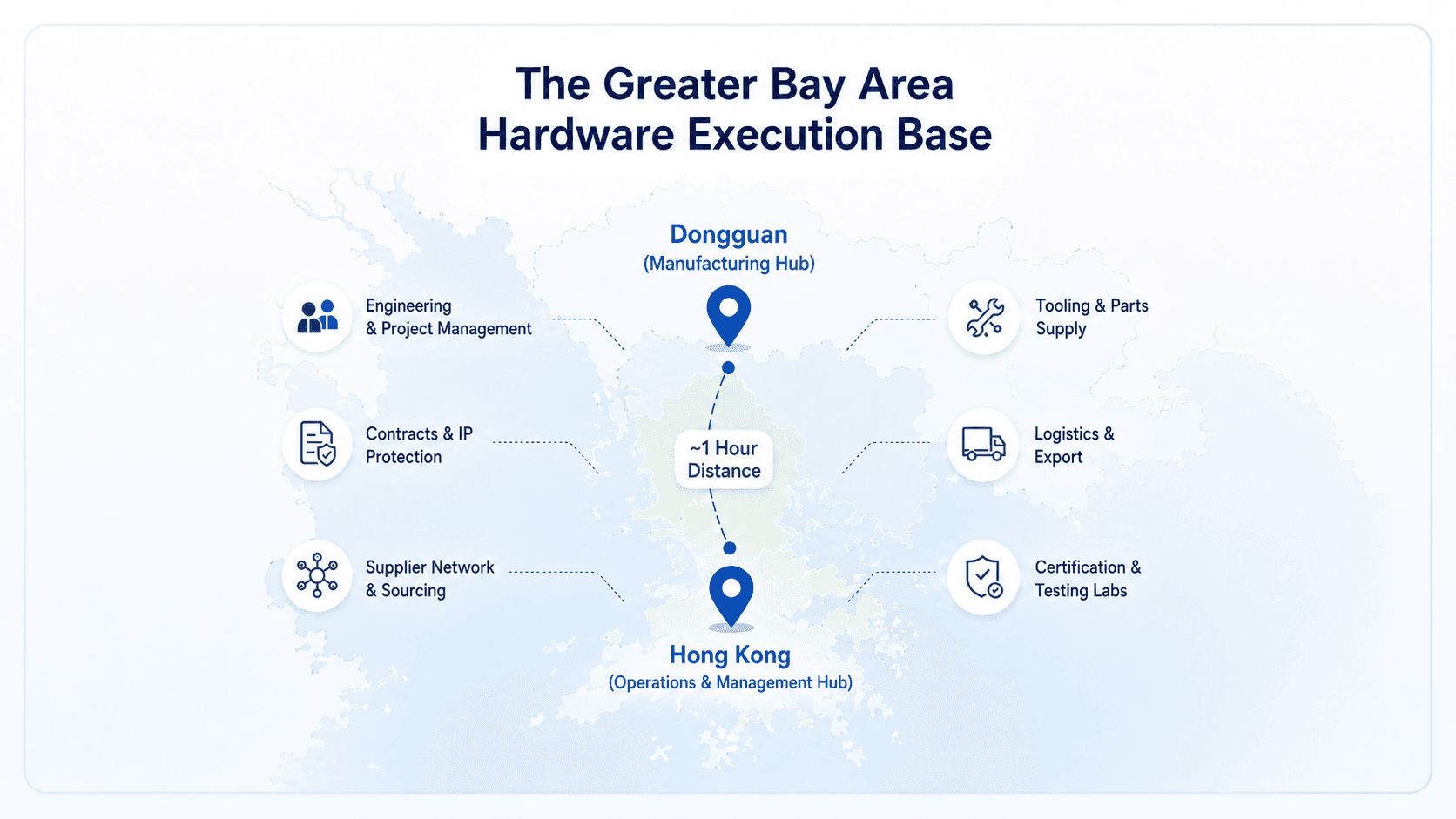
About an hour north of Hong Kong — less, when the border crossing cooperates — Dongguan rewards founders who actually show up.
Supplier Density You Can't Replicate Remotely
Dongguan manufacturing is concentrated in ways that are almost difficult to explain until you've driven through it. Electronics assembly in one district, plastic injection molding in the next, metal stamping and CNC a few kilometers away, PCB fabrication clustered nearby. This isn't a city with a few factories scattered around it. It's a city that is a manufacturing ecosystem — supply chains that grew up adjacent to each other over thirty years of export-driven growth.
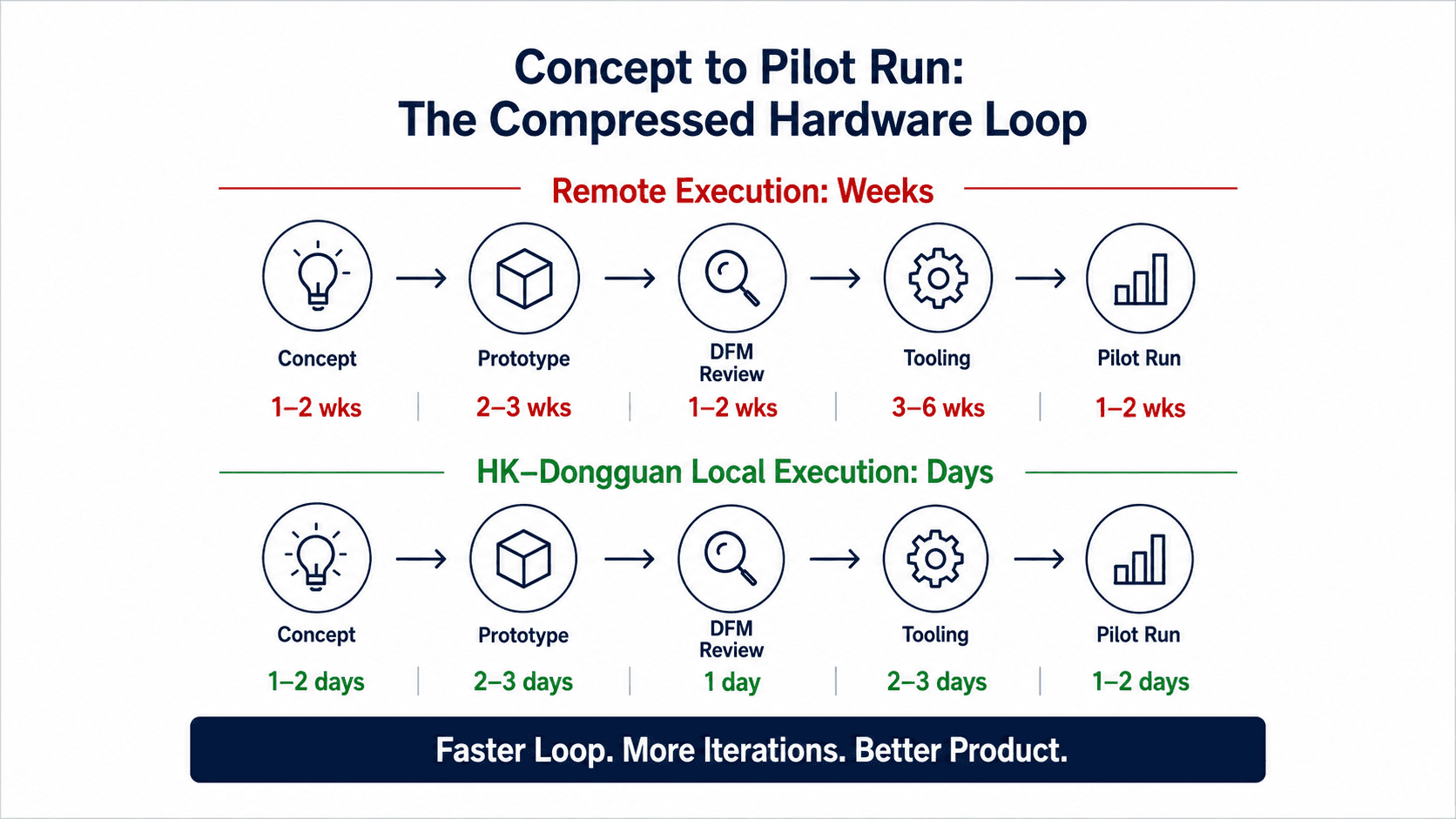
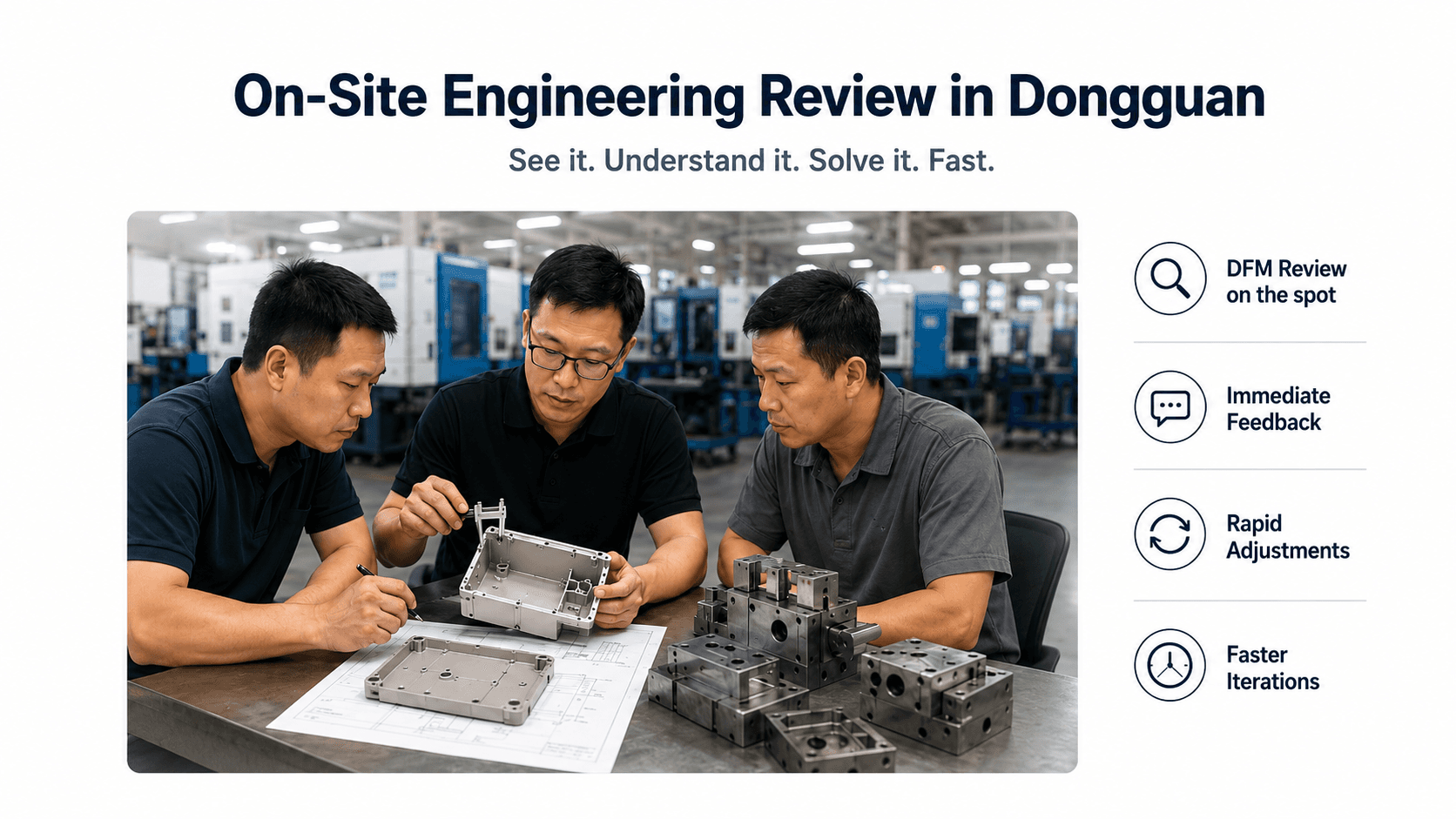
For a hardware startup, that density changes what's possible. Walk a component to a supplier. Run a tolerance test, get a result, have a revised sample in hand the same afternoon. Tooling shops here compete on turnaround; they know what fast looks like because they've had to. The prototype-to-DFM-to-pilot-run loop that takes weeks when managed from a distance can compress to days when someone is physically moving through that cluster.
Electronics, Mechanical Parts, and the Tacit Knowledge Problem
There's also something harder to name — tacit knowledge embedded deep in the supplier base. A tooling shop that's produced ten thousand molds carries pattern recognition that never shows up in a spec sheet. A component supplier who's worked through a dozen similar assemblies can spot a likely failure mode before it's been documented anywhere. That knowledge moves in conversation, during walkthroughs, in the margins of a DFM review. It does not move over email.
Hardware manufacturing at this level is collaborative by nature. The best outcomes come from treating suppliers as genuine partners in the design process rather than vendors executing a brief. That collaboration requires presence — not every single day, but consistently enough that relationships are real and feedback is candid.

The Remote Management Problem
Here’s where a lot of founders bleed time and money without fully understanding why.
Managing China suppliers from the US or UK feels workable at first. Specs go out, quotes come back, samples get exchanged. Then something slides sideways — a component goes out of stock, a measurement is off by a millimeter, a production batch ships with an issue nobody flagged. And now you’re diagnosing and fixing it across a twelve-hour time gap, through a communication layer that loses nuance at every step.
The issue isn’t that Chinese manufacturers are unreliable. Most aren’t. The issue is that hardware development demands a density of small decisions, rapid feedback loops, and real-time course corrections — exactly what remote communication handles badly. Every gap in the loop adds a day. Days become weeks. Weeks become a launch delay, a capital raise that misses its proof point, a retail buyer who moves on.
Founders who’ve been through this once tend to restructure things the second time around. They find local execution — someone embedded in the region, rooted in those supplier relationships, able to walk a factory floor and make a judgment call in person. That’s the gap the HK–Dongguan base fills, when it’s staffed and used correctly.
Closing the Loop: Local Execution in Practice
The geography only works if someone is actually working it.
This is where the Geniotek team fits in. Based across Hong Kong and the Greater Bay Area, the work is less about acting as a middleman and more about being the local engineering presence a startup can’t yet afford to hire full-time. Running supplier conversations in Mandarin, walking Dongguan factories during DFM, catching tolerance issues before they become tooling commitments, keeping the founder’s roadmap intact through all of it — that’s the actual work.
The model for China-side hardware development that holds up for early-stage companies isn’t outsourced project management. It’s embedded execution: people who understand both the product intent and the manufacturing reality, sitting at the intersection, making the judgment calls that matter. The hardware project examples on the site show the actual range — consumer electronics, industrial devices, IoT products, mechanical assemblies.
Hardware development in Hong Kong isn’t a workaround. For startups that need speed, transparency, and real control over their supply chain, it’s the strategy.