" height="21.943622918266314px" id="HqU1V_VXu" width="76.57577685890533px"/><path d="M 20.228 10.24 L 10.114 10.24 L 10.114 8.777 L 20.228 8.777 Z M 21.672 20.48 L 15.171 20.48 L 15.171 19.018 L 21.672 19.018 Z M 0 19.018 L 0 0 L 1.445 0 L 1.445 19.018 Z M 20.228 19.018 L 20.228 0 L 21.672 0 L 21.672 19.018 Z" fill="rgb(255, 255, 255)" height="20.480488152641314px" id="bfuCuMlPp" transform="translate(27.507 1.519)" width="21.672358558014366px"/><path d="M 42.622 19.018 L 42.622 0 L 44.067 0 L 44.067 19.018 Z M 54.903 8.777 L 54.903 0 L 56.348 0 L 56.348 8.777 Z M 75.131 8.777 L 75.131 0 L 76.575 0 L 76.575 8.777 Z M 70.796 19.018 L 70.796 10.241 L 72.241 10.241 L 72.241 19.018 Z M 59.238 19.018 L 59.238 10.241 L 60.683 10.241 L 60.683 19.018 Z M 1.445 0 L 1.445 20.481 L 0 20.481 L 0 0 Z M 11.559 20.481 L 1.445 20.481 L 1.445 19.018 L 11.559 19.018 Z M 21.672 10.24 L 10.114 10.24 L 10.114 8.777 L 21.672 8.777 Z" fill="rgb(255, 255, 255)" height="20.480826258659363px" id="TduQKyNcg" transform="translate(0 1.519)" width="76.57543472988937px"/><path d="M 10.114 9.07 L 10.114 0 L 11.559 0 L 11.559 9.07 Z M 0 19.311 L 0 10.533 L 1.445 10.533 L 1.445 19.311 Z M 10.114 20.774 L 10.114 13.459 L 11.559 13.459 L 11.559 20.774 Z M 4.334 20.774 L 4.334 13.458 L 5.779 13.458 L 5.779 20.774 Z M 5.78 13.459 L 10.114 13.459 L 10.114 14.922 L 5.78 14.922 Z M 5.78 19.311 L 10.114 19.311 L 10.114 20.774 L 5.78 20.774 Z M 79.032 2.487 L 92.035 2.487 L 92.035 3.95 L 79.032 3.95 Z M 96.37 2.487 L 109.373 2.487 L 109.373 3.95 L 96.37 3.95 Z M 113.708 2.487 L 126.711 2.487 L 126.711 3.95 L 113.708 3.95 Z M 135.38 2.487 L 148.384 2.487 L 148.384 3.95 L 135.38 3.95 Z M 86.256 8.339 L 92.035 8.339 L 92.035 9.802 L 86.256 9.802 Z M 97.815 8.339 L 110.818 8.339 L 110.818 9.802 L 97.815 9.802 Z M 80.477 15.653 L 93.48 15.653 L 93.48 17.116 L 80.477 17.116 Z M 97.815 15.653 L 110.818 15.653 L 110.818 17.116 L 97.815 17.116 Z M 79.032 15.653 L 79.032 3.95 L 80.477 3.95 L 80.477 15.653 Z M 96.37 15.653 L 96.37 3.95 L 97.815 3.95 L 97.815 15.653 Z M 113.708 17.116 L 113.708 3.95 L 115.153 3.95 L 115.153 17.116 Z M 135.38 15.653 L 135.38 3.95 L 136.825 3.95 L 136.825 15.653 Z M 152.718 15.653 L 152.718 2.487 L 154.163 2.487 L 154.163 15.653 Z M 170.056 15.653 L 170.056 2.487 L 171.5 2.487 L 171.5 15.653 Z M 187.394 15.653 L 187.394 2.487 L 188.839 2.487 L 188.839 15.653 Z" fill="rgb(255, 255, 255)" height="20.773521135658505px" id="jAG3tW2Le" transform="translate(10.169 1.182)" width="188.83858780606124px"/><path d="M 62.127 5.852 L 75.131 5.852 L 75.131 7.315 L 62.127 7.315 Z M 79.465 5.852 L 92.469 5.852 L 92.469 7.315 L 79.465 7.315 Z M 96.803 5.852 L 108.362 5.852 L 108.362 7.315 L 96.803 7.315 Z M 79.465 0 L 91.024 0 L 91.024 1.463 L 79.465 1.463 Z M 92.469 1.463 L 92.469 5.852 L 91.024 5.852 L 91.024 1.463 Z M 109.807 7.315 L 109.807 14.629 L 108.362 14.629 L 108.362 7.315 Z M 62.127 13.166 L 75.131 13.166 L 75.131 14.629 L 62.127 14.629 Z M 79.465 13.166 L 92.469 13.166 L 92.469 14.629 L 79.465 14.629 Z M 34.675 14.629 L 34.675 1.463 L 36.12 1.463 L 36.12 14.629 Z M 56.348 13.166 L 56.348 1.463 L 57.793 1.463 L 57.793 13.166 Z M 44.789 13.166 L 57.793 13.166 L 57.793 14.629 L 44.789 14.629 Z M 39.01 14.629 L 39.01 2.926 L 40.455 2.926 L 40.455 14.629 Z M 39.01 1.463 L 39.01 0 L 40.455 0 L 40.455 1.463 Z M 0 13.166 L 0 5.852 L 1.445 5.852 L 1.445 13.166 Z M 17.338 5.852 L 17.338 1.463 L 18.782 1.463 L 18.782 5.852 Z M 106.917 0 L 108.361 0 L 108.361 1.463 L 106.917 1.463 Z M 105.472 1.463 L 106.917 1.463 L 106.917 2.926 L 105.472 2.926 Z M 104.027 2.926 L 105.472 2.926 L 105.472 4.389 L 104.027 4.389 Z M 102.583 4.389 L 104.027 4.389 L 104.027 5.852 L 102.583 5.852 Z" fill="rgb(255, 255, 255)" height="14.62930651858536px" id="yTdOA_r0t" transform="translate(102.194 3.714)" width="109.80650620205734px"/></g></svg>)
Hardware product development cost is a sequence of decisions across concept, design, prototypes, DFM, and tooling, not one quote. See what changes each stage.
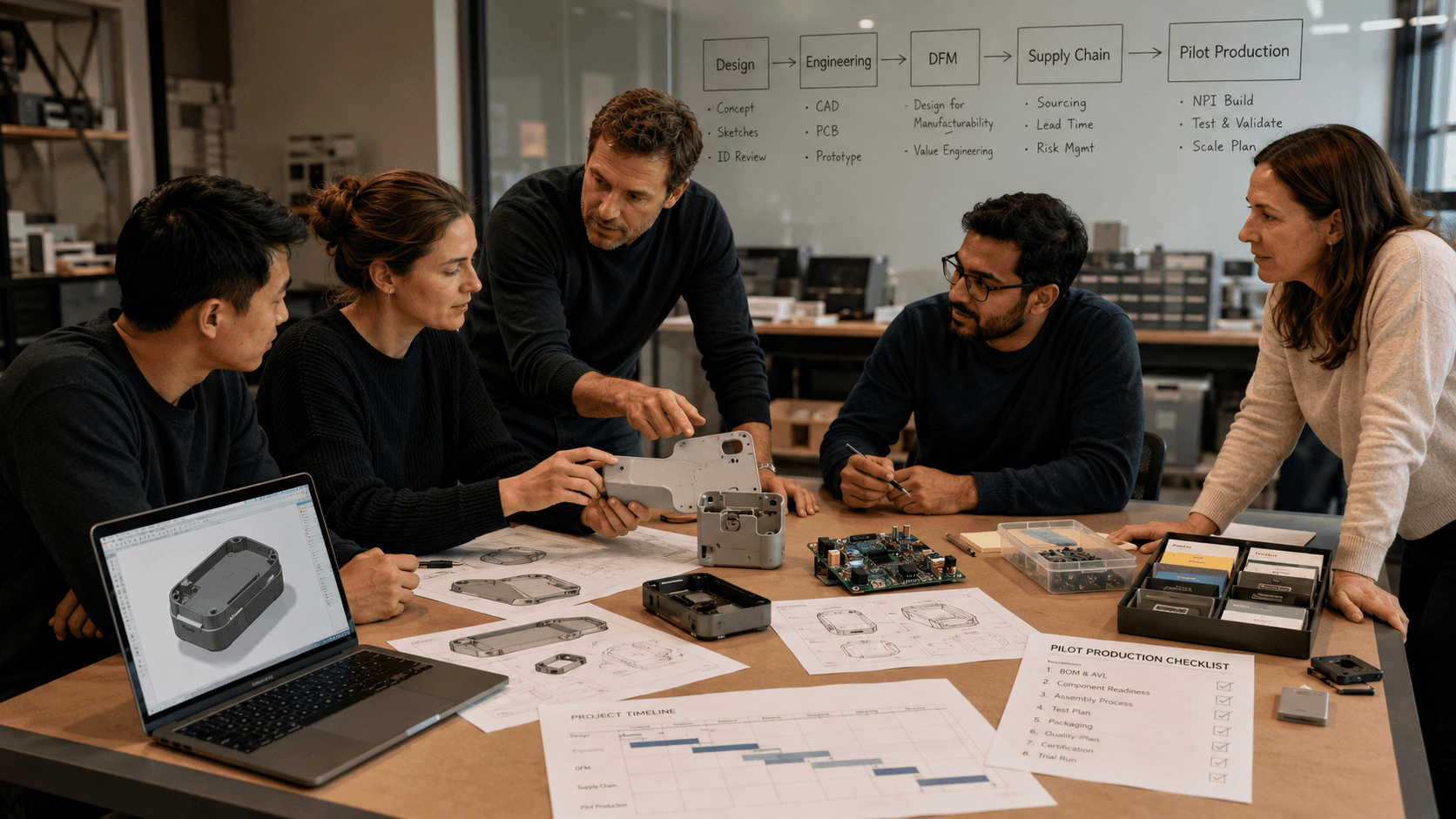
There is no single hardware development cost because cost is a sequence of decisions across five stages: concept, design, prototypes, DFM, and tooling. Each stage buys something different. Concept buys turning unknowns into knowns. Design buys aligning the three sets of assumptions held by ID, mechanical, and electronics. Prototypes buy the specific question you want answered. DFM buys moving problems out of the mold and onto paper. Tooling buys nothing new. It just settles, in steel and money, every judgment you skipped earlier.
Why there is no single number
Ask what it costs to build a hardware product and you have asked something close to what it costs to renovate a house. The question is not stupid. It just compresses a sequence into a digit.
Hardware cost is not a quote. It is a chain of decisions. Concept, design, prototypes, DFM, tooling. Each stage changes the price of the stages after it. What you save by skipping a judgment early rarely disappears. It relocates. The most common new address is the mold. Once the tool is cut, the steel is gone, you pay per part, and any change is a new tool.
This piece carries no prices. A real number needs a BOM, a quantity, tolerances, and a certification scope, and every one of those moves the number. What we can talk about honestly is stages, and the single decision inside each stage that actually moves the budget.
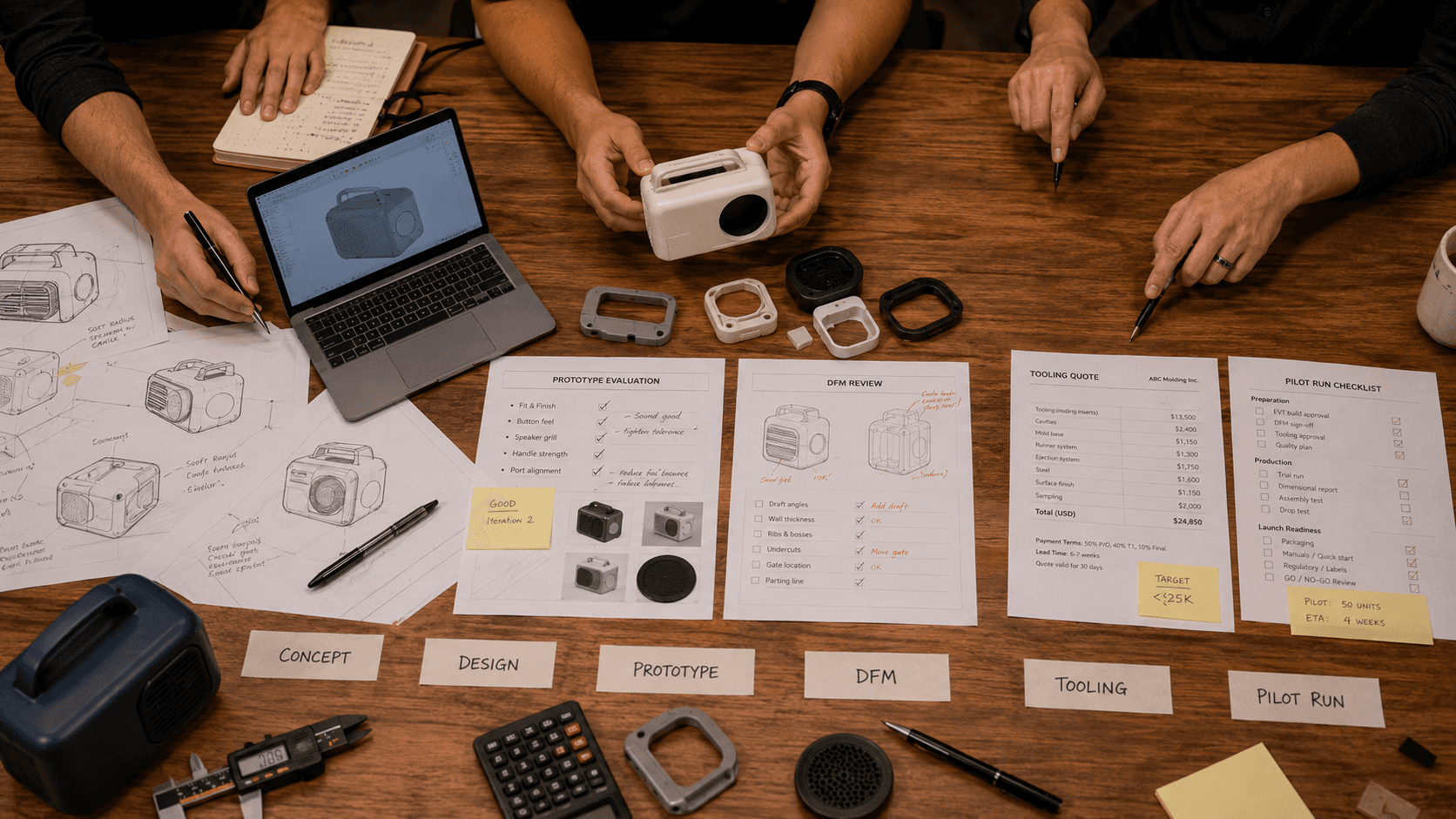
The decision that changes the budget in each stage
Concept and feasibility: which unknowns become later rework
Spending at the concept stage looks small, which is why it gets skipped. But you are not buying drawings. You are buying the conversion of unknowns into knowns.
An unverified assumption, say that this mechanism fits inside this enclosure, is a question mark at concept, a redraw at prototype, and a new tool at molding. The same issue costs more the later you find it. That is not a clever insight, it is how any serial process behaves: the later a defect surfaces, the more has been built on top of it. Idea borrowed from manufacturing, but it applies to your calendar too.
So the concept budget is really an "answer the unknowns" budget. Every unknown you leave unconfirmed gets confirmed later, by someone else, at a higher rate. There is a fuller checklist of what to check at this stage here (feasibility checks before design).
Industrial design and engineering: when look, structure, and electronics disagree
Industrial design makes decisions on paper. Mechanical makes decisions in space. Electronics makes decisions in copper and routing. Three sets of assumptions, rarely aligned at the start.
Disagreement is not the mistake. Late discovery is. The look wants a seamless surface, the structure needs a parting line, the electronics need somewhere to put the antenna. Until those three meet in the same model, nobody knows they will collide. Once they do, the cost shows up as redraws, remade parts, and slipped dates.
Two things get confused here. Blaming the overrun on "we were missing an expert" is usually a story told after the fact. It sounds like an explanation and explains nothing. The actual mechanism is conflict between assumptions that never got surfaced early. Putting all three sets into one review costs a few days of meetings. Putting them into alignment after the tool is cut costs a new tool.
Electronics is a budget line, not a slogan. It has its own parts, its own prototype builds, its own certification path. Managing it as a component is cheaper than talking about it as a story.
Prototypes: an appearance model is not something that can prove function
The word prototype gets swapped more than any other word in this business. An appearance model proves resemblance. It does not prove function.
A 3D printed shell can be close in size. It is not close in material behavior. The assembly logic is untested. A drop test on it means nothing. You can carry it into a fundraise, a channel meeting, a packaging review. You cannot carry it into a claim that the structure still works once it becomes an injection molded part. What you paid for was "looks right," not "is actually feasible."
So the prototype budget depends on the question you want it to answer. If the question is appearance, pay for appearance. If the question is whether structure and electronics can coexist, pay for a working engineering build. If the question is whether it can be produced, pay for a build that uses production-like processes. The same sentence, "make a prototype," can carry wildly different prices. The difference is entirely in which type you bought. This is broken out further here (which prototype you are paying for).
DFM and tooling: DFM hunts for what will be slower, more expensive, or unstable
DFM is not an aesthetics review. It is looking for where this design, placed on a line, becomes slower, more expensive, or less stable. Uneven wall thickness shrinks. Insufficient draft drags. Tolerances written tighter than the process can hold drop the yield.
Those problems are invisible on a drawing and visible in a mold. So DFM exists to move problems out of the mold and back onto paper. On paper, you change a drawing. In the mold, you change steel. A steel change means a new tool, and every day the line sits still, the meter keeps running. That is why delays here are so expensive. The relationship between DFM and production delays is spelled out here (DFM checks before tooling).
Tooling itself produces no new information. It only settles, all at once, every judgment you skipped earlier. What you never confirmed at concept, never aligned at design, never verified at prototype, arrives now in its most expensive form.
Which overruns you can see early
Within the scope this page covers, only three, and all of them are predictable without any hindsight data:
Complexity. More parts, more assembly steps, more reliance on manual adjustment. Complexity is the one cost driver you can spot at the concept stage.
Long-lead parts. Chips, custom components, unusual materials. These are not a money problem, they are a time problem. In hardware, time converts into money, because the team waits, the line waits, and the opportunity waits.
Misalignment between the founder, design, and engineering. This is not a competence problem, it is an interface problem. Three parties can each do their own job well and still not fit together. The later that shows up, the more it looks like rework.
Notice what is not on this list: whether you negotiated a good price. That belongs to sourcing. It affects the execution cost of one given design, not the shape of the stages. Keep the two apart.
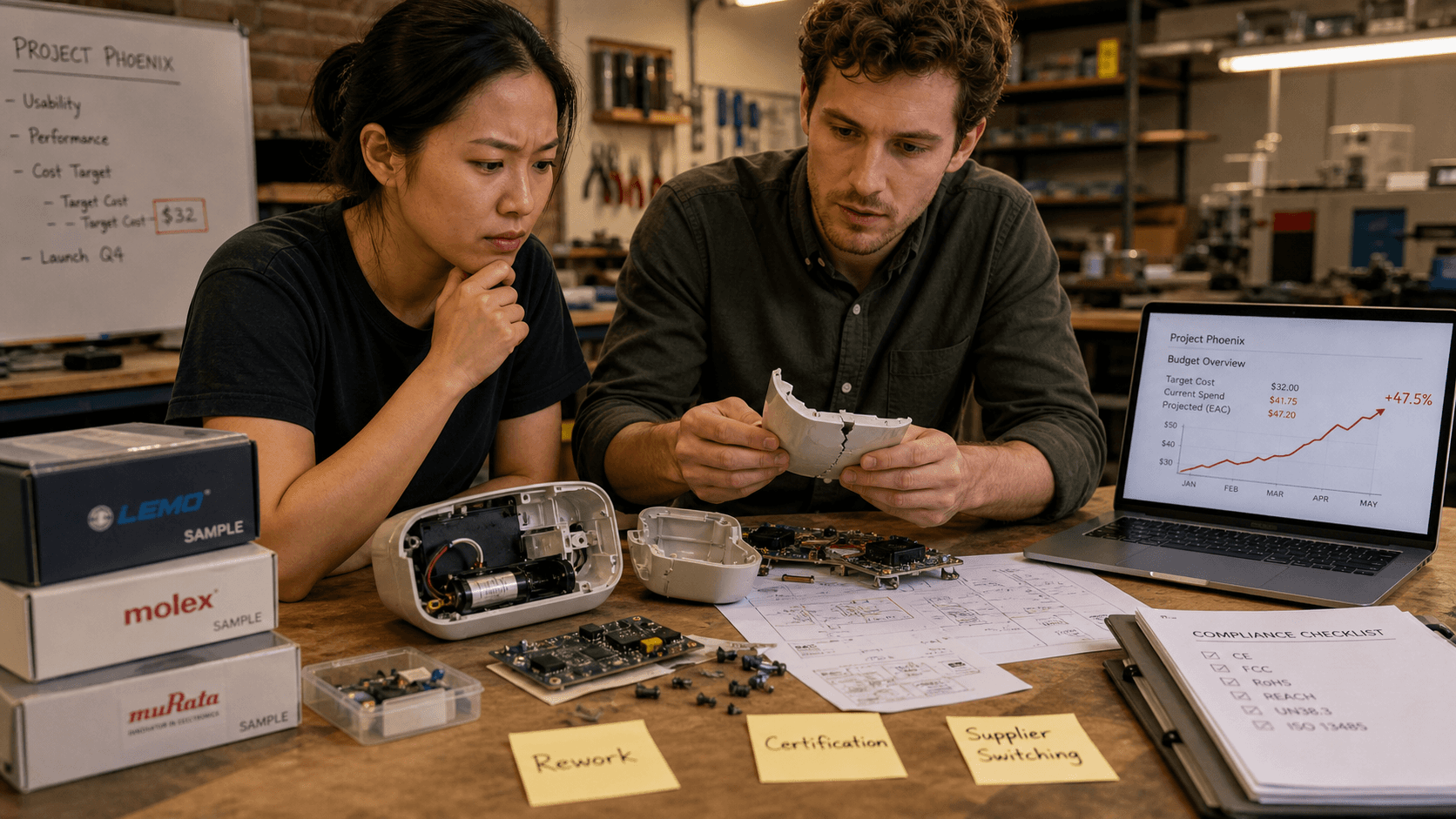

How an inventor, a startup, and a brand adding a SKU read the same stages
Same pipeline, three different holes to fall into.
An inventor most often skips concept and feasibility, because that stage does not look like "building the product." It only asks questions. But an inventor holds the most unknowns, so skipping it costs the most.
A startup most often skips alignment between design and engineering. The usual belief is that if the people are right, the thing will be right. The people can be right and the interfaces still wrong, and wrong interfaces still get redrawn.
A brand already shipping, now adding a SKU, most often skips prototypes. They think of themselves as people who have done this before, and go straight to DFM. But a new structure in a new product line is new to them. Experience saves process, not verification.
This is not a price tier. It is an attention tier.
Which shortcut saves a model, and which one shows up in the tool
The test is simple. Ask whether what you cut was a display object or a judgment.
Cutting the finish on an appearance model saves the cost of a display object. Limited risk. Cutting a functional verification saves a judgment. Cutting DFM saves the chance to move a problem out of the mold. The last two do not vanish. They relocate. Where they land depends on whether you left budget and time downstream for them.
The real question is never "how do I spend less." It is "what am I buying at this stage." If you are buying a judgment, the money you save is simply a tooling cost you have postponed. If you are buying a display, the money you save is profit.
One condition: this reading holds when requirements are stable, constraints are written down, and you are willing to spend time on verification. If requirements are still moving, this is not the stage to cut, because you do not yet know what you would be verifying.
Closing: read cost as a sequence, not a figure
The shape of hardware cost is not a rising curve. It is a series of bets that carry interest. Every unknown you leave unconfirmed early collects interest downstream, and the rate gets worse the later it gets. Understanding this changes two choices directly: what you confirm first, and when you stop.
If your project has locked appearance and marketing, and you are only waiting on production, this whole reading is the wrong tool. You need sourcing and price negotiation. If you are still between concept and design, the thing to manage is the number of unknowns, not this month's spend.
One concrete next action: list every assumption in your current stage that is still unconfirmed, and next to each one write where it will send you a bill if you leave it. That list will forecast your final cost better than any budget spreadsheet.