" height="21.943622918266314px" id="HqU1V_VXu" width="76.57577685890533px"/><path d="M 20.228 10.24 L 10.114 10.24 L 10.114 8.777 L 20.228 8.777 Z M 21.672 20.48 L 15.171 20.48 L 15.171 19.018 L 21.672 19.018 Z M 0 19.018 L 0 0 L 1.445 0 L 1.445 19.018 Z M 20.228 19.018 L 20.228 0 L 21.672 0 L 21.672 19.018 Z" fill="rgb(255, 255, 255)" height="20.480488152641314px" id="bfuCuMlPp" transform="translate(27.507 1.519)" width="21.672358558014366px"/><path d="M 42.622 19.018 L 42.622 0 L 44.067 0 L 44.067 19.018 Z M 54.903 8.777 L 54.903 0 L 56.348 0 L 56.348 8.777 Z M 75.131 8.777 L 75.131 0 L 76.575 0 L 76.575 8.777 Z M 70.796 19.018 L 70.796 10.241 L 72.241 10.241 L 72.241 19.018 Z M 59.238 19.018 L 59.238 10.241 L 60.683 10.241 L 60.683 19.018 Z M 1.445 0 L 1.445 20.481 L 0 20.481 L 0 0 Z M 11.559 20.481 L 1.445 20.481 L 1.445 19.018 L 11.559 19.018 Z M 21.672 10.24 L 10.114 10.24 L 10.114 8.777 L 21.672 8.777 Z" fill="rgb(255, 255, 255)" height="20.480826258659363px" id="TduQKyNcg" transform="translate(0 1.519)" width="76.57543472988937px"/><path d="M 10.114 9.07 L 10.114 0 L 11.559 0 L 11.559 9.07 Z M 0 19.311 L 0 10.533 L 1.445 10.533 L 1.445 19.311 Z M 10.114 20.774 L 10.114 13.459 L 11.559 13.459 L 11.559 20.774 Z M 4.334 20.774 L 4.334 13.458 L 5.779 13.458 L 5.779 20.774 Z M 5.78 13.459 L 10.114 13.459 L 10.114 14.922 L 5.78 14.922 Z M 5.78 19.311 L 10.114 19.311 L 10.114 20.774 L 5.78 20.774 Z M 79.032 2.487 L 92.035 2.487 L 92.035 3.95 L 79.032 3.95 Z M 96.37 2.487 L 109.373 2.487 L 109.373 3.95 L 96.37 3.95 Z M 113.708 2.487 L 126.711 2.487 L 126.711 3.95 L 113.708 3.95 Z M 135.38 2.487 L 148.384 2.487 L 148.384 3.95 L 135.38 3.95 Z M 86.256 8.339 L 92.035 8.339 L 92.035 9.802 L 86.256 9.802 Z M 97.815 8.339 L 110.818 8.339 L 110.818 9.802 L 97.815 9.802 Z M 80.477 15.653 L 93.48 15.653 L 93.48 17.116 L 80.477 17.116 Z M 97.815 15.653 L 110.818 15.653 L 110.818 17.116 L 97.815 17.116 Z M 79.032 15.653 L 79.032 3.95 L 80.477 3.95 L 80.477 15.653 Z M 96.37 15.653 L 96.37 3.95 L 97.815 3.95 L 97.815 15.653 Z M 113.708 17.116 L 113.708 3.95 L 115.153 3.95 L 115.153 17.116 Z M 135.38 15.653 L 135.38 3.95 L 136.825 3.95 L 136.825 15.653 Z M 152.718 15.653 L 152.718 2.487 L 154.163 2.487 L 154.163 15.653 Z M 170.056 15.653 L 170.056 2.487 L 171.5 2.487 L 171.5 15.653 Z M 187.394 15.653 L 187.394 2.487 L 188.839 2.487 L 188.839 15.653 Z" fill="rgb(255, 255, 255)" height="20.773521135658505px" id="jAG3tW2Le" transform="translate(10.169 1.182)" width="188.83858780606124px"/><path d="M 62.127 5.852 L 75.131 5.852 L 75.131 7.315 L 62.127 7.315 Z M 79.465 5.852 L 92.469 5.852 L 92.469 7.315 L 79.465 7.315 Z M 96.803 5.852 L 108.362 5.852 L 108.362 7.315 L 96.803 7.315 Z M 79.465 0 L 91.024 0 L 91.024 1.463 L 79.465 1.463 Z M 92.469 1.463 L 92.469 5.852 L 91.024 5.852 L 91.024 1.463 Z M 109.807 7.315 L 109.807 14.629 L 108.362 14.629 L 108.362 7.315 Z M 62.127 13.166 L 75.131 13.166 L 75.131 14.629 L 62.127 14.629 Z M 79.465 13.166 L 92.469 13.166 L 92.469 14.629 L 79.465 14.629 Z M 34.675 14.629 L 34.675 1.463 L 36.12 1.463 L 36.12 14.629 Z M 56.348 13.166 L 56.348 1.463 L 57.793 1.463 L 57.793 13.166 Z M 44.789 13.166 L 57.793 13.166 L 57.793 14.629 L 44.789 14.629 Z M 39.01 14.629 L 39.01 2.926 L 40.455 2.926 L 40.455 14.629 Z M 39.01 1.463 L 39.01 0 L 40.455 0 L 40.455 1.463 Z M 0 13.166 L 0 5.852 L 1.445 5.852 L 1.445 13.166 Z M 17.338 5.852 L 17.338 1.463 L 18.782 1.463 L 18.782 5.852 Z M 106.917 0 L 108.361 0 L 108.361 1.463 L 106.917 1.463 Z M 105.472 1.463 L 106.917 1.463 L 106.917 2.926 L 105.472 2.926 Z M 104.027 2.926 L 105.472 2.926 L 105.472 4.389 L 104.027 4.389 Z M 102.583 4.389 L 104.027 4.389 L 104.027 5.852 L 102.583 5.852 Z" fill="rgb(255, 255, 255)" height="14.62930651858536px" id="yTdOA_r0t" transform="translate(102.194 3.714)" width="109.80650620205734px"/></g></svg>)
A comparison article for founders deciding between hiring a hardware development company or going factory-direct, focused on time, risk, ownership, and production readiness.

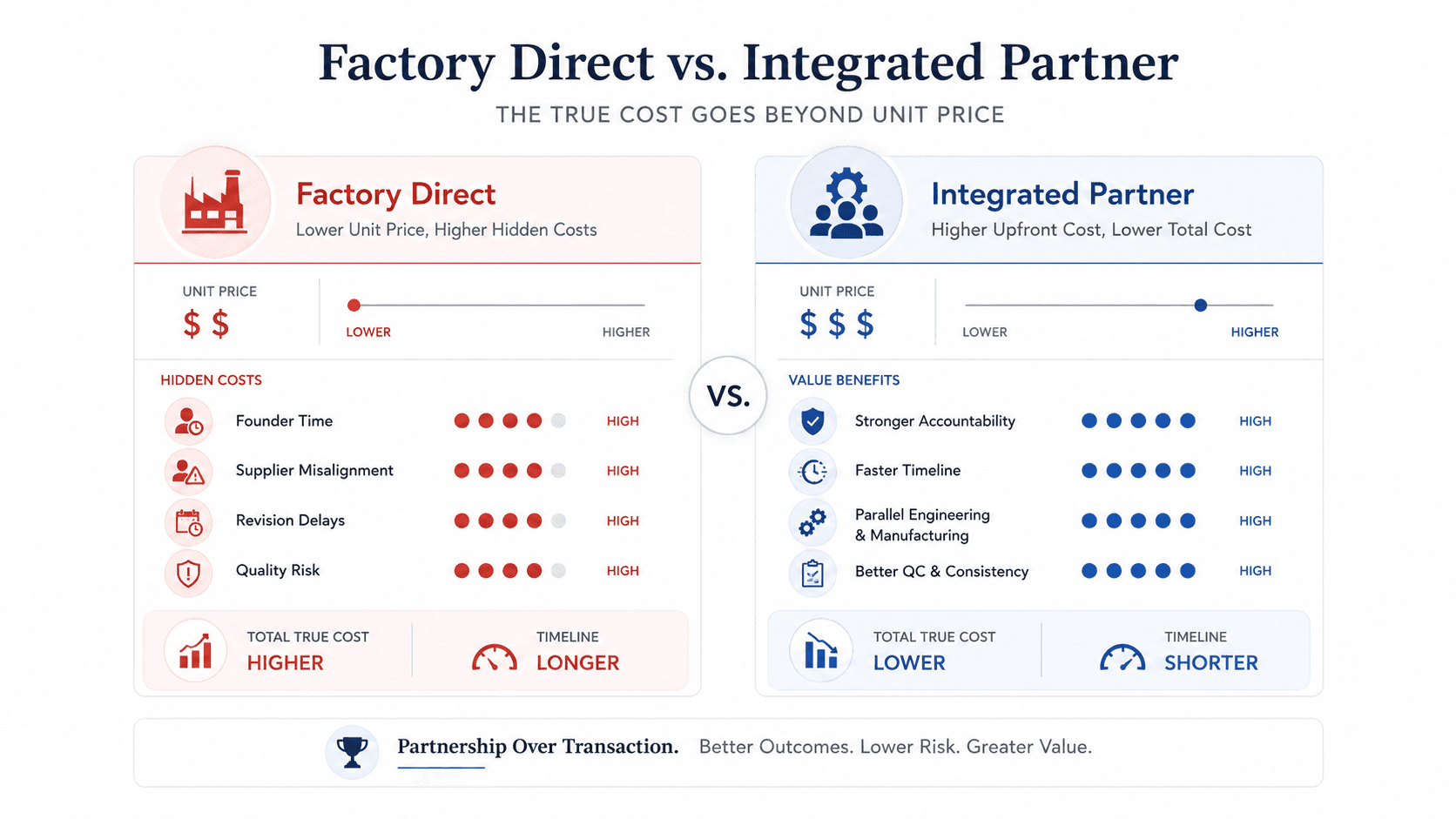
Most founders who go factory-direct don’t save time, they spend it — six months into production, chasing three different suppliers who don’t speak to each other, while their firmware still isn’t finished. A hardware development company integrates engineering, DFM, supplier management, and quality control under one accountable roof. That’s not a convenience. That’s the difference between shipping and not shipping. If you have a locked spec, a manufacturing-experienced team, and zero open engineering questions, factory direct is viable. Otherwise, you’re paying for the illusion of speed with the currency of delay.
The Hidden Cost That Factory Direct Never Shows You Upfront
Looks cheaper. Everybody says so.
A factory in Shenzhen will quote you a unit price that makes your eyes light up. No middlemen. No overhead. Direct access to the line. Founders love the logic of it, because the logic is clean.
The problem is what that quote doesn’t include.
It doesn’t include the thirty-seven emails you’ll send trying to get a PCB house, an enclosure molder, and a firmware contractor to agree on a timeline. It doesn’t include the three-week delay when the molder delivers parts the PCB doesn’t fit, because nobody ran DFM across both simultaneously. It doesn’t include the Saturday morning call where you realize your QC process was entirely verbal, and the factory interpreted it generously.
Coordination is labor. Invisible labor. Founders who go factory-direct don’t eliminate that labor — they absorb it personally.
Think of it like building your own bicycle from component suppliers versus buying one. You could source the frame, fork, drivetrain, and wheels from four separate specialists. Each part might be marginally better. The total cost, in time and tolerance mismatches, will wreck you.
A hardware development company doesn’t add a layer. It collapses five layers into one accountable relationship. That’s the invisible detail worth getting right: accountability. Nobody notices it until it’s gone.
The coordination cost of factory-direct manufacturing compounds with complexity. One supplier is manageable. Two is a negotiation. Three is a project management job you didn’t sign up for and probably can’t fill.

What a Hardware Development Company Actually Does That a Factory Cannot
Factories execute.
That's not an insult, it's a description. A factory's job is to produce a defined thing at volume, reliably, to spec — and they're extraordinarily good at that. Ask them to co-develop the spec while managing three external engineering contributors and feeding DFM constraints back into a firmware team in real time, and you've handed a concert violinist a hammer.
Wrong tool. Genuinely wrong.
A hardware development partner, built properly, runs engineering and manufacturing at the same time, not one after the other. Mechanical, electrical, firmware, and thermal constraints get resolved in parallel during the design phase, not after the first prototype fails. That single structural difference is responsible for most of the schedule compression founders experience when they move from factory-direct to an integrated partner.
Here's the concrete version. A founder in Austin once told me it took his team fourteen weeks to get from approved prototype to production-ready units, going direct. The next product — same complexity class, same market — he worked with an integrated China manufacturing partner that handled DFM, supplier qualification, and QC protocol design internally. Eight weeks. Same product complexity. Half the timeline. The gap wasn't the factory's speed. It was coordination overhead, compressed out of existence.
The detail nobody sees: DFM feedback loops. When a development company runs engineering and production planning together, the mold designer sees the PCB layout before the design is locked. That alone saves one tooling revision cycle almost automatically — and one revision cycle in injection molding is four to six weeks and ten to thirty thousand dollars. Founders going factory-direct rarely know this is happening (or not happening) until the invoice arrives.
Browse hardware product development case studies and the pattern holds. The projects that hit timeline are the ones where engineering and manufacturing weren't separated into sequential handoffs.
The Decision Matrix Founders Actually Need
Two routes. Two founder profiles. And the decision is less about the product than about where you are in the process.
Factory direct makes sense under exactly three conditions. Your engineering is finished, genuinely finished, with complete documentation and no open questions. Your team has direct manufacturing experience and knows what to ask a factory. Your need is pure execution, not development.
If all three are true: go direct. You'll save money and you don't need the overhead of a development layer.
Everything else, factory direct breaks.
Evolving requirements? Broken. The factory will charge you revision fees on every change, and they'll be right to do so. Their job is to run a stable process, not to absorb your discovery phase.
Ownership gap? Broken. If you don't have an engineer who wakes up at 2am worried about your thermal management, no factory will fill that role. They'll ship what they made. Whether it works is your problem.
Cross-supplier coordination? Broken. The factory makes their part. They don't manage your other suppliers. That job has no home, so it lands on the founder.
A hardware development company is the right route when your requirements are still tightening, when you need someone who owns outcomes not just outputs, and when you can't afford to be the project manager, quality engineer, and supplier liaison simultaneously.
(Honestly, almost no early-stage founder can handle all three at once, even if they think they can.)
Back when factory-direct was the default assumption, founders with deep manufacturing backgrounds could pull it off. Most today can't, and the practical decision matrix reflects that. Ask yourself one question before anything else: do I have a locked, fully documented specification with no open engineering questions? If yes, consider factory direct. If no, stop. You need a development partner.
A second question. Do I have someone on my team who has personally managed manufacturing in China, knows the quality control vocabulary, and has supplier relationships? If yes, factory direct is plausible. If no, the factory will win every ambiguous negotiation, because they know the rules and you don't.
Third question. Is my schedule tolerance zero? Because coordination failures in a factory-direct setup don't announce themselves. They accumulate silently for weeks before surfacing as a production hold.
Answer no to any of these, and you're not choosing factory direct because it's better. You're choosing it because the unit price number felt good.

Why Geniotek’s Model Exists at Exactly This Intersection
The integrated model — engineering capability paired with China manufacturing execution — exists because the two failure modes above are so predictable. Founders over-index on unit price. Factories under-scope their responsibility. The gap between those two things is where products die.
Geniotek was built to close that gap. Engineering and production planning run together. DFM constraints feed back into design in real time. Supplier qualification, QC protocol, and tooling management sit under one roof, one relationship, one timeline. The hardware development services cover the full arc from concept refinement to production-ready handoff, with China manufacturing infrastructure already built in (and it works, surprisingly well).
That’s not a pitch for complexity. It’s a pitch for removing the coordination tax that kills founder timelines.
When a founder comes to Geniotek mid-disaster — three suppliers who don’t talk, firmware incomplete, mold already cut wrong — the conversation starts the same way every time. When did engineering and manufacturing stop talking to each other? The answer is usually: they never started.
The factory-direct route assumes those two things are separate. A hardware development company assumes they never should have been.
Already past the decision point and feeling the weight of coordination overhead that wasn’t in the original plan? Talk to Geniotek. Bring your actual situation. Not the clean version.
The best time to integrate your engineering and manufacturing was at the start. The second best time is right now.